
Share







Copied
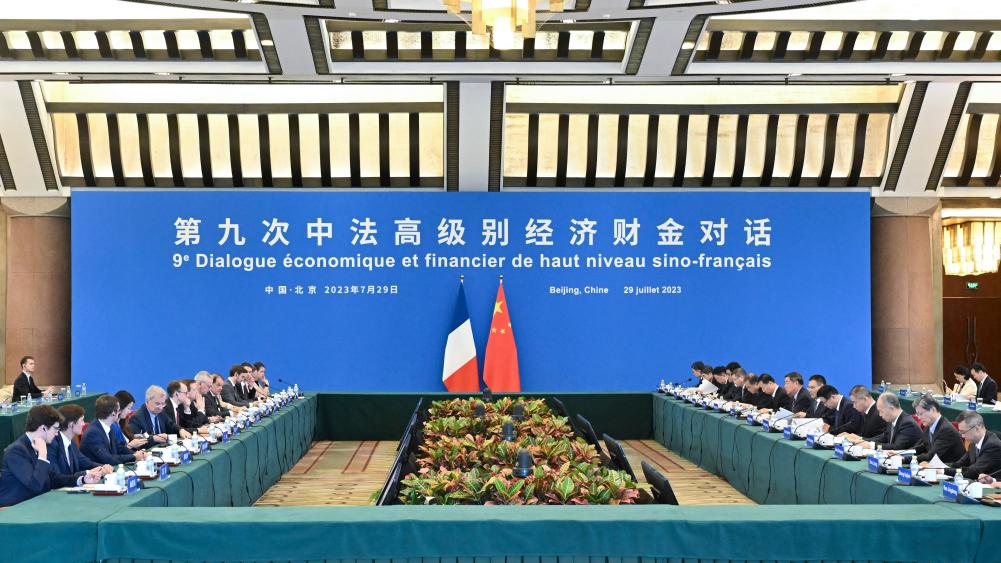
Chinese Vice Premier He Lifeng co-chairs the ninth China-France High Level Economic and Financial Dialogue with Bruno Le Maire, Minister of Economy, Finance and Industrial and Digital Sovereignty of France in Beijing, China, July 29, 2023. /Xinhua
Editor's note: Imran Khalid, a special commentator on current affairs for CGTN, is a freelance columnist on international affairs. The article reflects the author's opinions and not necessarily the views of CGTN.
Unlike some of the hawkish allies of the U.S. in the EU, France stands out as an exemplar of diplomatic pragmatism and independent decision-making, particularly in its interactions with China. The sagacious approach adopted by France in nurturing ties with the world's second largest economy is a testament to the robustness of its pragmatic intent to bolster bilateral relations and camaraderie with China. Amidst the differences that naturally arise, France has consistently pursued a path of mutual benefit, exemplifying the spirit of harmonious cooperation.
France's enlightened outlook on Chinese affairs is being reciprocated by the win-win collaboration from Beijing. On July 29, 2023, Chinese Vice Premier He Lifeng co-chaired the ninth China-France High Level Economic and Financial Dialogue in Beijing with Bruno Le Maire, Minister of Economy, Finance and Industrial and Digital Sovereignty of France. During the meeting, Le Maire rejected the "illusion" of countries "decoupling" from China, asserting that the world's second-largest economy doesn't pose a risk. His stance appears firm against the notion of isolating China.
Amidst the global chorus of "de-risking from China," Le Maire's visit to China signals the robust trajectory of their economic ties. While the U.S. and allies are contemplating distancing, Le Maire advocates leveraging economic cooperation to disprove decoupling's appeal. He underscores that "de-risking" doesn't equate to considering China a threat, offering an alternative perspective on pursuing development opportunities. France's engagement with China becomes a tangible example of avoiding the fallacy of complete decoupling. The visit has served as a pragmatic demonstration, challenging the notion that cutting ties with China is the solution. Instead, it highlights the complexities of global interdependence and strategic engagement in the realm of international trade.
During French President Emmanuel Macron's visit to China in April, top leadership from both countries vehemently agreed to deepen market access, tech collaboration, and industrial ties, fostering robust economic relations. France's move to extend Huawei's 5G licenses in some cities showcases mutual trust. Additionally, Le Maire has also extended a warm invitation for Chinese investments in the auto industry, heralding it as a positive development. This dynamic approach underscores the spirit of openness and cooperation between France and China. "We want to have a stronger economic relationship between Europe and China, between France and China, which means to get access for all European goods," Le Maire said in a recent interview.
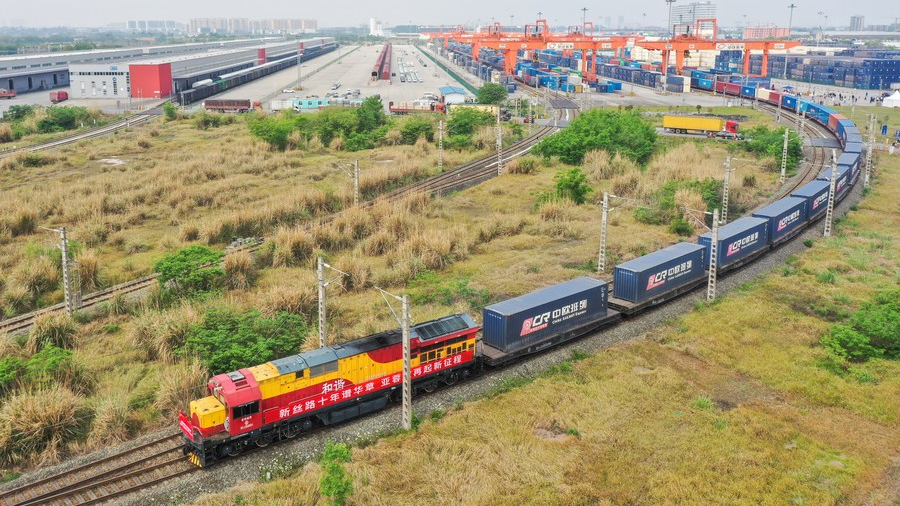
A "DPD France" international freight train pulling out of the Chengdu International Railway Port in Chengdu, southwest China's Sichuan Province, April 26, 2023. /Xinhua
Unlocking Chinese market prospects for French firms and luring investments to France's electric car sector has dominated Le Marie's agenda this time. The China-France meeting yielded rich results, spanning diverse sectors from industrial chains to financial services and the digital economy, all while emphasizing robust intellectual property protection. In the realm of the digital economy, the focus is on processing market access applications from Chinese-funded enterprises in a fair and non-discriminatory manner, adhering to existing laws and regulations, including those about national security considerations. The broad scope of agreements underscores the commitment to fostering a balanced and secure economic relationship between the two nations. Despite the U.S.-driven "de-risking" narrative, China-France economic and trade relations maintain a robust momentum, defying external pressures. Statistical evidence reflects an upward trajectory, challenging the notion of cooling ties. France's proactive stance on strategic autonomy highlights its intent to navigate a delicate equilibrium between China and the U.S. This approach, rooted in self-reliance, positions France to foster positive outcomes in its trade dealings with China.
The complexities of global dynamics prompt France to seek pragmatic solutions that balance its interests and autonomy with broader international considerations, shaping a nuanced and dynamic China-France trade relationship. For obvious reasons, being an EU member, France is facing certain limitations in its China ties, influenced by factors like the Ukraine crisis and EU-level regulations. However, China-France ties find stability through the resumption of dialogues and exchanges, fostering mutual understanding. However, deeper cooperation remains crucial for sustained relations, paving the way for long-term stability.
China has always rejected any notion of posing risks to countries engaged in equitable economic exchanges. On the contrary, it offers a vast market with abundant opportunities, exemplified by Le Maire's visit yielding significant progress in sectors like cosmetics, aerospace, and food and beverages – key components of France's exports to China. This robust collaboration foreshadows a promising future for Sino-French economic ties.
Guided by a strategic vision from both leaders, China-France economic ties display resilience and robust growth. Without a doubt, China is resolutely committed to strengthening policy communication, enhancing practical cooperation, and bolstering coordination on global and multilateral issues. This resolute effort aims to elevate the China-France comprehensive strategic partnership to new heights, as asserted by Chinese President Xi Jinping during President Macron's visit to Beijing, signifying an unwavering commitment to bilateral progress.
(If you want to contribute and have specific expertise, please contact us at opinions@cgtn.com. Follow @thouse_opinions on Twitter to discover the latest commentaries in the CGTN Opinion Section.)
Search Trends
SITEMAP
Copyright © 2023 CGTN. 京ICP备16065310号

Disinformation report hotline: 010-85061466
SITEMAP
Copyright © 2023 CGTN. 京ICP备16065310号
Disinformation report hotline: 010-85061466