
Share







Copied
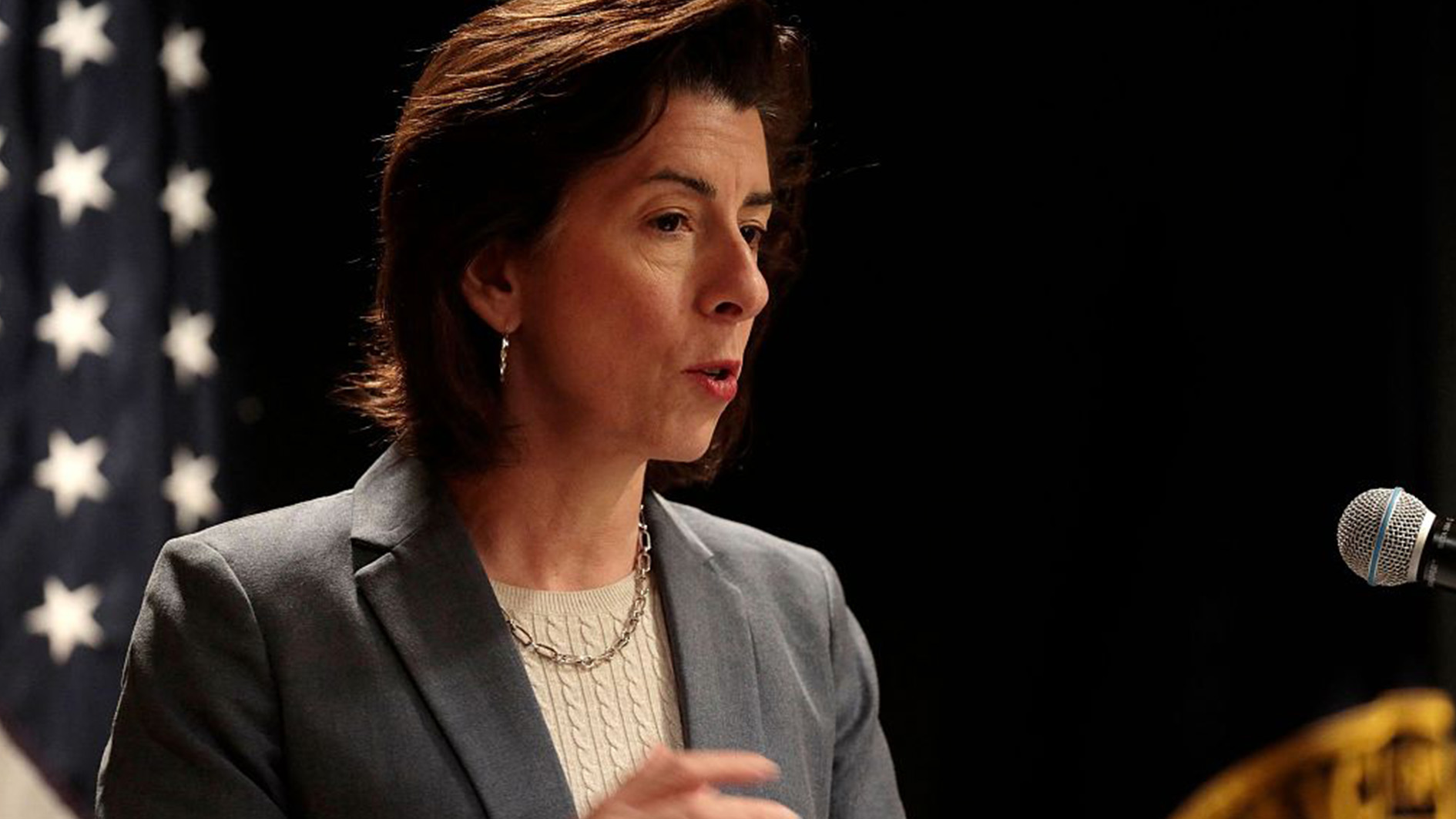
U.S. Commerce Secretary Gina Raimondo is expected to land in Beijing in a few hours to start a four-day visit to China that will last until Wednesday, making her the fourth U.S. senior official to travel to China over the past 10 weeks.
During her visit, China will state its position on economic and trade issues of concern to the U.S. side, according to a spokesperson for the Chinese Commerce Ministry, who added that China looks forward to in-depth discussions on resolving economic and trade differences and promoting practical cooperation.
In an "in-depth, pragmatic and constructive" discussion with Raimondo in Washington D.C. ahead of her visit, Chinese Ambassador to the United States Xie Feng urged the U.S. side to work with China and "make the list of cooperation longer and shorten the negative list" in joint efforts to stabilize China-U.S. relations.
'Bedrock foundation'
Raimondo's visit comes days after the U.S. Department of Commerce announced the removal of 27 Chinese entities from its export-control "unverified list," a long over-due move the Chinese Commerce Ministry has hailed as "conducive" to normal trade between the world's two largest economies.
The China-U.S. bilateral trade relationship is seen as having reached a low point since 2018, when former U.S. President Donald Trump launched a trade war with China, unilaterally imposing tariffs on over $300 billion worth of Chinese goods. Since taking office, Joe Biden has yet to make a decision to scrap any of the tariffs imposed by his predecessor.
Despite the tariffs or export controls, data released by the U.S. Department of Commerce in February, which were not adjusted for inflation, showed that goods trade between the U.S. and China hit a record $690.6 billion in 2022, with goods exports to China increasing by $2.4 billion and imports by $31.8 billion.
"U.S. exports to China support a broad swath of the U.S. economy," said the U.S.-China Business Council (USCBC) in its 2023 report on U.S. exports to China. "These exports contribute to American livelihoods across the country."
China is just one of three countries – Canada and Mexico were the other two – whose purchase of U.S. goods and services supported more than one million jobs across the United States, according to the USCBC.
During a visit to Beijing this week, in celebration of the council's 50th anniversary, USCBC President Craig Allen described the economic and commercial interactions between the U.S. and China as the "bedrock foundation" of the bilateral relationship, saying "that bedrock is strong and solid."
In briefing reporters about Raimondo's China visit, U.S. National Security Adviser Jake Sullivan said on Tuesday that the U.S. commerce secretary will "carry with her the message that the United States is not seeking to decouple from China, but rather to de-risk."
Wang Yiwei, director of the Institute of International Affairs at Renmin University of China, said despite the change in rhetoric, Washington still seeks to "decouple" from China, only in a gradual manner.
Because of the reluctance of U.S. allies and the interests of U.S. businesses and consumers, the U.S. has stopped using the language of "decoupling," Wang told CGTN. "'De-risking' is 'decoupling' in a slow process."
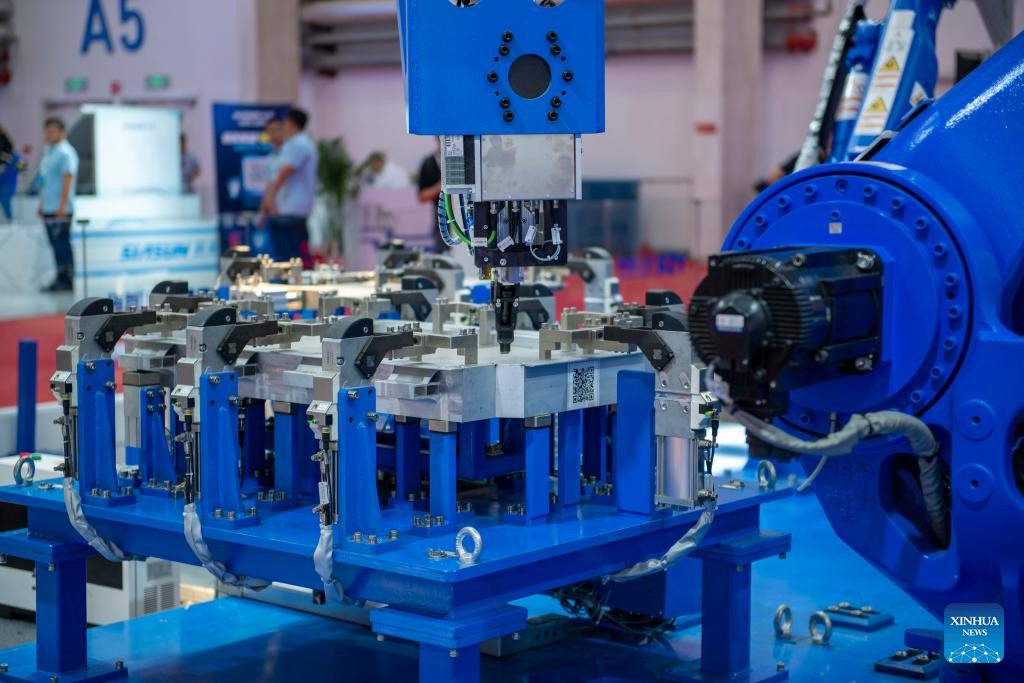
A manufacturing robot at the World Robot Conference 2023 in Beijing, capital of China, August 16, 2023. /Xinhua
Tech curbs: 'It's not worth it'
In a departure from its repeatedly stated pledge of no "decoupling," Biden signed an executive order earlier this month to bar American investment in categories like semiconductors and microelectronics, quantum information technologies and artificial intelligence in China.
The latest ban comes as the Biden administration doubles down on its drive to hobble the world's second-largest economy's high-tech advancement, following the so-called Chips and Science Act it rolled out last year.
The slew of tech restrictions has impeded the revenue growth of U.S. chip companies to some extent. According to Xinhua News Agency, the CEOs from three semiconductor giants – Intel, Qualcomm and NVIDIA – met with top officials from the Biden administration last month and urged it to exercise restraint in implementing further curbs on chip exports to China, pause and assess the current policies' impact on the industry.
"The U.S. industry has imposed great pressure on the U.S. government," Wang said. He added that they want a relaxation when it comes to China and a share of the Chinese market.
"So the U.S. government might be weighing that it's not worth it to suppress [China's high-tech sector] recklessly," he said.
Raimondo's visit also coincides with reports that the U.S. is seeking a short-term renewal of a landmark agreement with China on scientific and technological cooperation.
The U.S.-China Agreement on Cooperation in Science and Technology, which was signed in 1979 and has been renewed roughly every five years ever since, expires on Sunday. It was last officially extended in August 2018 when the Chinese side called it a legal framework for China-U.S. intergovernmental scientific and technological cooperation and an effective platform for such non-governmental cooperation.
William Jones, a former White House correspondent, warned about the cost the U.S. could pay if the protocol of the deal were not extended.
"In that respect, the U.S. will become the 'odd man out' since China is very open to working with other countries in science, and most of these other countries are open to such collaboration," Jones wrote in an opinion piece published by CGTN.
'Smooth' communication
Raimondo's trip to China follows on the heels of U.S. Secretary of State Antony Blinken, U.S. Treasury Secretary Janet Yellen and U.S. Special Presidential Envoy for Climate John Kerry's recent visits.
During Blinken's June visit, China and the U.S. agreed to encourage more people-to-people and educational exchanges and stay committed to increasing passenger flights between the two countries.
In the latest implementation of such agreement, China on August 10 announced the resumption of group travel to the U.S., and Chinese and U.S. airlines will be allowed to make a total of 36 round-trip flights a week from September 1, with the number rising to 48 from October 29 and doubling the current figure.
The U.S. commerce secretary welcomed the resumption of group travel. "Before COVID-19, as many as 3 million Chinese travelers visited the United States annually, contributing more than $30 billion to the U.S. economy. We look forward to once again welcoming Chinese group travel to the United States," she said in a statement.
With Raimondo's visit, there will be another round of high-level interaction between China and the U.S., said Sun Chenghao, a research fellow at the Center for International Security and Strategy at Tsinghua University.
"It shows that the communication between China and the U.S. is still very smooth from top to bottom," Sun told CGTN. "And that is definitely conducive to stabilizing China-U.S. relations."
(Cover: A file photo of the national flags of China and the United States. /Xinhua)
Search Trends
SITEMAP
Copyright © 2023 CGTN. 京ICP备16065310号

Disinformation report hotline: 010-85061466
SITEMAP
Copyright © 2023 CGTN. 京ICP备16065310号
Disinformation report hotline: 010-85061466