
Share







Copied
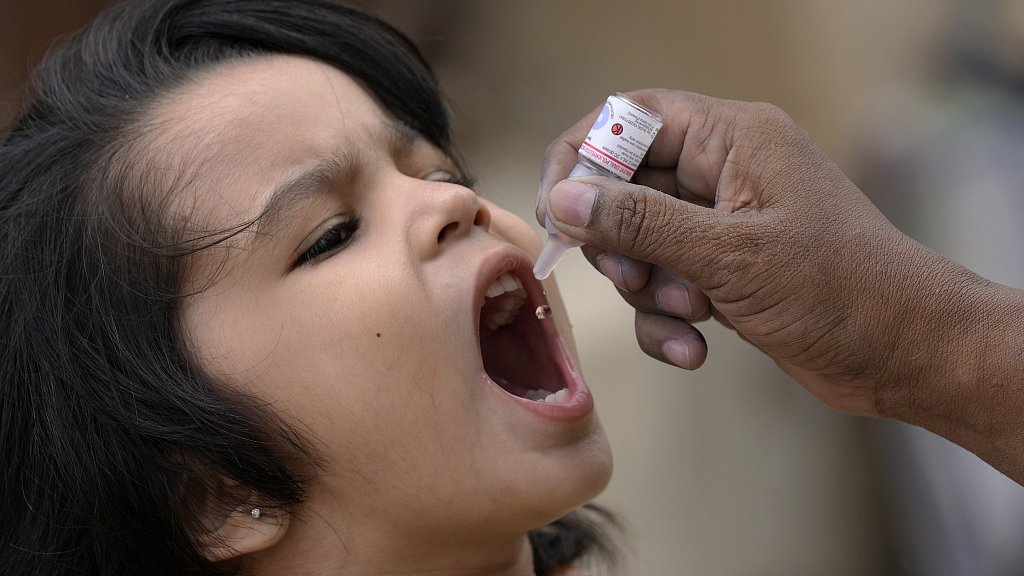
A health worker administers a polio vaccine to a child at a neighborhood in Karachi, Pakistan, June 19, 2023. /CFP
The World Health Organization (WHO) announced on Friday that the risk of poliovirus transmission is still a "public health emergency of international concern (PHEIC)."
The 36th meeting of the Emergency Committee under the International Health Regulations (2005) (IHR) on the international spread of poliovirus was convened by the WHO director-general on August 16, 2023, with committee members and advisers attending via video conference, supported by the WHO secretariat.
The Emergency Committee reviewed the data on wild poliovirus (WPV1) and circulating vaccine-derived polioviruses (cVDPV) in the context of the global target of eradication of WPV and cessation of outbreaks of cVDPV2 by the end of 2023.
Technical updates were received about the situation in the following countries: Afghanistan, Algeria, Burkino Faso, Kenya, Madagascar, Pakistan, the United Republic of Tanzania and Zambia.
The committee recognized concerns regarding the lengthy duration of the polio PHEIC and the importance of exploring alternative measures, including convening a polio IHR review committee to advise the WHO director-general on the possible issuance of standing recommendations, and encouraged further discussion regarding these alternatives.
Nevertheless, it felt it was still too early to discontinue the PHEIC as the risk of exportation of both WPV and cVDPVs remains significant and the removal of the PHEIC may send the wrong message at a critical juncture in polio eradication.
Since the detection of WPV1 in Africa in February 2022, an effective coordinated response across Malawi, Mozambique, Tanzania, Zambia and Zimbabwe has been implemented. In 2023, only two genetic clusters of WPV1 have so far been identified, compared to three in 2022 and five in 2021.
However, there have been multiple chains of transmission within these two genetic clusters, detected primarily in the endemic zones of Eastern Afghanistan and South Khyber Pakhtunkhwa of Pakistan, including an extreme orphan virus, indicating some gaps in surveillance.
The Global Polio Laboratory Network plans to perform a thorough review of genetic characteristics and classification of WPV-1 by the end of 2023 and its findings will be shared with the emergency committee, when available.
Search Trends
SITEMAP
Copyright © 2023 CGTN. 京ICP备16065310号

Disinformation report hotline: 010-85061466
SITEMAP
Copyright © 2023 CGTN. 京ICP备16065310号
Disinformation report hotline: 010-85061466