
Share







Copied
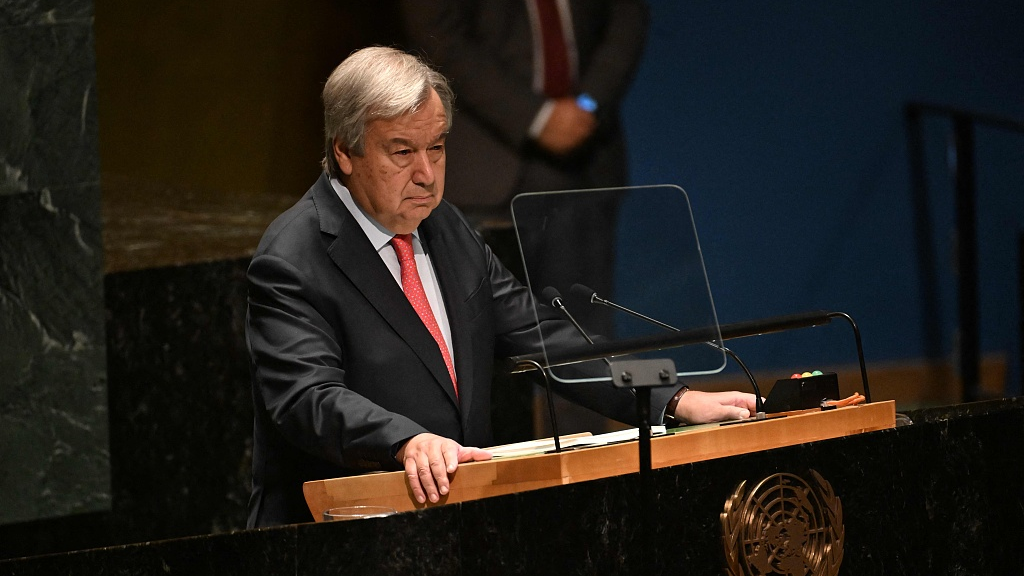
UN Secretary-General Antonio Guterres addresses the 78th United Nations General Assembly at UN headquarters in New York City, September 19, 2023. /CFP
UN Secretary-General Antonio Guterres on Tuesday called for effective multilateral institutions to tackle global challenges.
"The world has changed. Our institutions have not. We cannot effectively address problems as they are if institutions do not reflect the world as it is. Instead of solving problems, they risk becoming part of the problem," he said.
In his "state-of-the-world" report right before the opening of this year's General Debate of the UN General Assembly, Guterres warned that the world is becoming "unhinged." "Geopolitical tensions are rising. Global challenges are mounting. And we seem incapable of coming together to respond."
The world confronts a host of existential threats, from climate crisis to disruptive technologies, the world is undergoing "a chaotic" transition, he noted.
For much of the Cold War, international relations were largely seen through the prism of two superpowers, then came a short period of unipolarity, and now the world is rapidly moving toward a multipolar world, said the UN chief. "This is, in many ways, positive. It brings new opportunities for justice and balance in international relations. But multipolarity alone cannot guarantee peace."
At the beginning of the 20th century, Europe was truly multipolar as it had numerous powers, it, however, lacked robust multilateral institutions and the result was World War I, Guterres said.
"A multipolar world needs strong and effective multilateral institutions. Yet global governance is stuck in time," he warned.
The UN Security Council and the Bretton Woods system reflect the political and economic realities of 1945 when many countries in today's UN General Assembly were still under colonial domination.
He warned that divides are deepening – divides among economic and military powers, divides between North and South, East and West.
"We are inching ever closer to a Great Fracture in economic and financial systems and trade relations; one that threatens a single, open internet; with diverging strategies on technology and artificial intelligence; and potentially clashing security frameworks," he said.
"It is high time to renew multilateral institutions based on 21st century economic and political realities, rooted in equity, solidarity and universality and anchored in the principles of the United Nations Charter and international law."
That means reforming the Security Council in line with the world of today. It means redesigning the international financial architecture so that it becomes truly universal and serves as a global safety net for developing countries in trouble, he said.
Time for 'global compromise'
The UN chief called for compromise when it comes to the reform of the Security Council as well as tackling global challenges.
"I have no illusions. Reforms are a question of power. I know there are many competing interests and agendas. But the alternative to reform is not the status quo. The alternative to reform is further fragmentation," he said.
"It's reform or rupture," he warned.
"Our world needs statesmanship, not gamesmanship and gridlock. As I told the G20 (Group of 20), it is time for a global compromise," said Guterres.
"Politics is compromise. Diplomacy is compromise. Effective leadership is compromise," he said, adding that leaders have a special responsibility to achieve compromise in building a common future of peace and prosperity for humanity's common good.
Nuclear threats warned
Guterres also called for determination to uphold the UN Charter's pledge for peace.
The world is witnessing a surge of "conflicts, coups and chaos," he noted. "If every country fulfilled its obligations under the UN Charter, the right to peace would be guaranteed. When countries break those pledges, they create a world of insecurity for everyone."
"Nuclear threats put us all at risk. Ignoring global treaties and conventions makes us all less safe. And the poisoning of global diplomacy obstructs progress across the board," said Guterres. "We must not relent in working for peace – a just peace in line with the UN Charter and international law."
Peace is inextricably linked to sustainable development, he said. "We see a familiar pattern around the world: the closer a country is to conflict, the farther it is from the Sustainable Development Goals."
On global warming
Guterres called for determination to tackle the most immediate threat to humanity: global warming.
"We have just survived the hottest days, hottest months, and hottest summer on the books. Behind every broken record are broken economies, broken lives, and whole nations at the breaking point," the UN chief said.
Actions are falling "abysmally" short, he said, urging the G20 countries, which are responsible for 80 percent of greenhouse emissions, to lead.
"Developed countries must reach net zero as close as possible to 2040, and emerging economies as close as possible to 2050. Developed countries must finally deliver the $100 billion every year for developing country climate action, as promised; double adaptation finance by 2025, as promised; and replenish the Green Climate Fund, as promised," he said.
All countries must work to operationalize the loss and damage fund this year and ensure universal early warning coverage by 2027, he said. "Climate chaos is breaking new records. But we cannot afford the same old broken record of scapegoating and waiting for others to move first."
On AI threats
The UN chief stressed the need to tackle the threats posed by new technologies.
Generative artificial intelligence (AI) holds much promise, he noted, but it may also lead humanity across a Rubicon and into more danger than humanity can control.
"Even some of those who developed generative AI are calling for greater regulation. But many of the dangers of digital technology are not looming on the horizon. They are here," he said.
New technologies require new and innovative forms of governance, he said.
"There is an urgent need for a Global Digital Compact between governments, regional organizations, the private sector and civil society to mitigate the risks of digital technologies, and identify ways to harness their benefits for the good of humanity."
(With input from Xinhua)
Search Trends
SITEMAP
Copyright © 2023 CGTN. 京ICP备16065310号

Disinformation report hotline: 010-85061466
SITEMAP
Copyright © 2023 CGTN. 京ICP备16065310号
Disinformation report hotline: 010-85061466