
Share







Copied
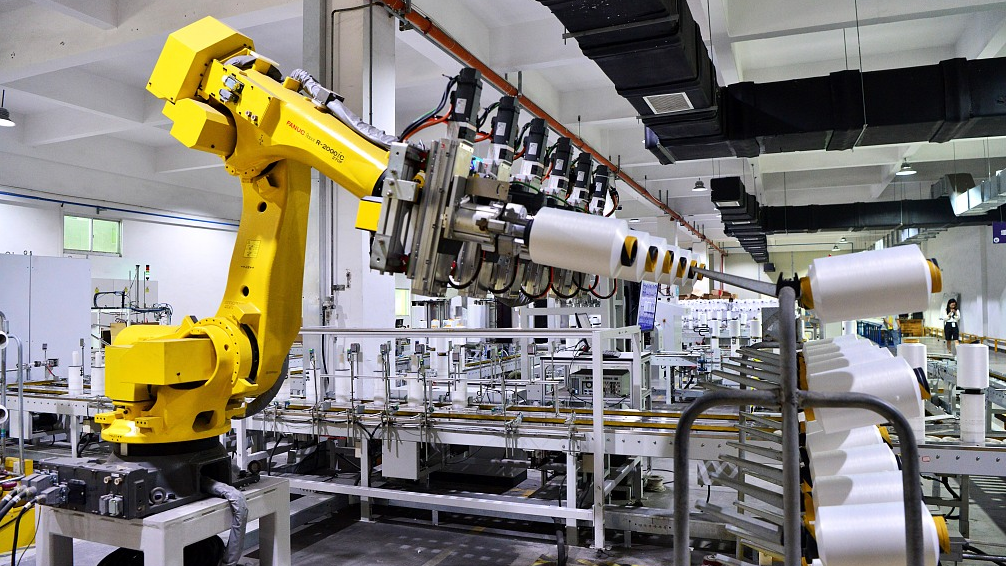
A robot arm operates in a textile plant in southeast China's Fujian Province, May 31, 2023. /CFP
Editor's note: Bruce Pang is the chief economist and head of research at JLL Greater China. The article reflects the author's opinions and not necessarily the views of CGTN. It has been translated from Chinese and edited for brevity and clarity.
Data released by the National Bureau of Statistics of China on October 18 reveals that China's GDP registered a year-on-year growth of 4.9 percent in the third quarter, way higher than market expectations. This indicates a higher probability of achieving the annual target of around 5 percent for GDP growth.
Meanwhile, the quarter-on-quarter growth rate accelerated to 1.3 percent, exceeding market expectations. This signifies a well-established trajectory for China's overall economic recovery, as well as an accelerated pace and enhanced efficiency.
In September, the year-on-year growth rate of value-added industrial output of major enterprises maintained a growth rate of 4.5 percent, the same as figures in August, marking a 0.8-percent increase from July. Moreover, it exhibited a month-on-month growth of 0.36 percent.
This highlights that the industrial sector, as the main body and engine for economic growth, is providing substantial support to stabilize the overall economy. Its role as an anchor is further highlighted, achieving robust dynamics, optimized structure and stable expectations.
In September, the business activity index for the service sector reached 50.9, a 0.4 point increase from August. The business activity expectations index stood at 58.1.
These figures suggest that the peak summer travel season has propelled a rapid recovery in the service sector, particularly contact-intensive services. Furthermore, the consolidation and strengthening of the manufacturing industry's recovery have bolstered the prosperity of production services such as postal and financial services. This reflects how the production and service sectors are collaborating to contribute to economic recovery and stable economic performance.
In the first three quarters, the total retail sales of social consumer goods rose 6.8 percent year on year. With effective local policies to boost consumption and the strong demand for travel during the summer peak season, the consumption market has maintained its rapid growth and outstanding performance this year.
This year, relevant departments have implemented a comprehensive set of policy measures to stabilize economic growth, boost confidence and mitigate risks, consistently reinforcing the positive trend in China's economic recovery.
It is anticipated that policies stabilizing economic growth and countercyclical measures will be further refined, their quality and efficiency will be improved, and detailed implementation measures will be carried out. Major economic indicators are expected to improve in October, and the year-on-year GDP growth rate in the fourth quarter is likely to reach appropriate levels of above and around 5 percent.
To preserve the positive changes and growth in China's macroeconomic situation, the country needs to address short-term challenges like weak internal driving forces and insufficient demand, and adhere to the long-term policy direction of economic transformation and high-quality development.
In the coming period, monetary policies are expected to remain stable, provide adequate monetary conditions, effectively ensure reasonable liquidity, flexibly manage the credit allocation pace and enhance coordination with fiscal and industrial policies.
At the same time, these policies will focus on key areas, adopt reasonable and appropriate approaches, take advancement or retreat measures as appropriate, and continue targeted, precise, and sustained efforts. Simultaneously, enterprises will be encouraged to stabilize or lower overall financing costs and reduce personal consumption credit costs. Interest rate cuts may still be necessary later in the year.
In addition, measures such as special refinancing bonds, extended interest rate cuts, and strengthened regular audits and evaluations will be utilized to facilitate the implementation of a host of debt solutions. Tax and fee incentive policies, along with tax and fee support policies, will be employed for key groups and areas, including small and micro enterprises, individual businesses, technological innovation, entrepreneurship, and employment.
These policies will help stimulate fiscal policy's countercyclical adjustment role, ensuring people's welfare, expanding government investment, supporting business entities, and tackling and mitigating risks. Meanwhile, these measures are set to strengthen development momentum and boost market confidence, allowing fiscal policies to continuously play their vital role in propelling economic recovery and improvement.
Search Trends
SITEMAP
Copyright © 2023 CGTN. 京ICP备16065310号

Disinformation report hotline: 010-85061466
SITEMAP
Copyright © 2023 CGTN. 京ICP备16065310号
Disinformation report hotline: 010-85061466