
Share






Copied
Scientists grappling with dating the age of the modern Yellow River, China's second-longest river, the "mother river" of the nation and the cradle of Chinese civilization, have made a breakthrough using a quantum technique.
The modern water system of the Yellow River was formed about 1.25 million years ago, according to a study published in the latest edition of Earth and Planetary Science Letters.
The team behind the discovery was led by researchers from the Institute of Geology and Geophysics under the Chinese Academy of Sciences, Beijing Normal University, and University of Science and Technology of China. They dated the geothermal water in central China's Weihe Basin, via a combined use of isotopic krypton and chlorine, which are used to identify underground water that recharged between 100,000 and million years ago.
The study applied the Atom Trap Trace Analysis (ATTA), a laser-based atom-counting method capable of analyzing environmental isotope tracers, to count at the single atomic level, which allows for extremely sensitive measurement.
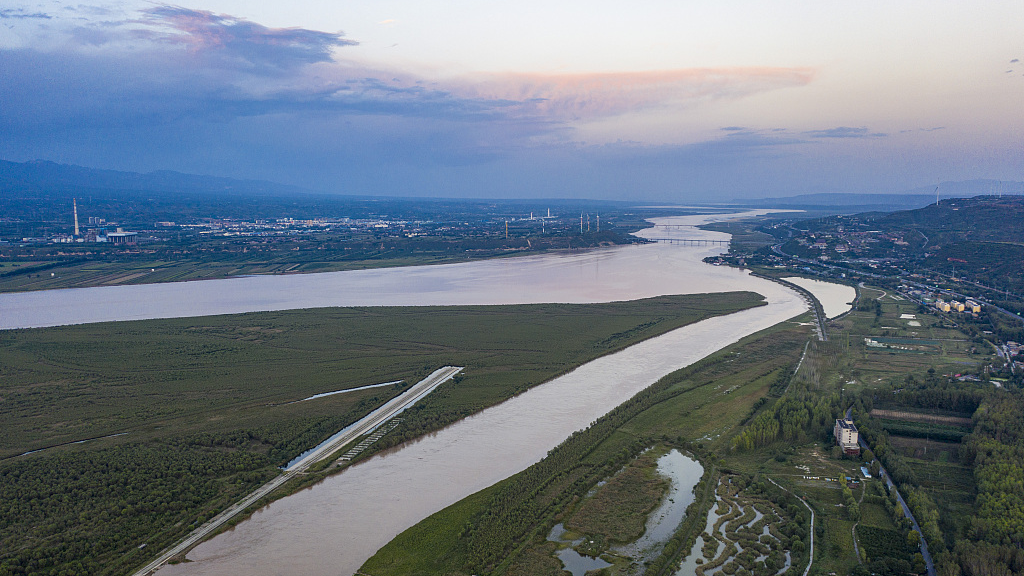
Scenery of the Yellow River in Weinan City, northwest China's Shaanxi Province, September 20, 2021. /CFP
The formation of the modern Yellow River drainage had previously been controversial. Hydrologists proposed that the river might have taken its present shape 150,000, 1.2 million or 5 million years ago.
The new results supported the hypothesis that the birth of the modern Yellow River was at about 1 to 1.3 million years ago.
The 5,464-km-long Yellow River feeds about 12 percent of China's population, irrigates about 15 percent of arable land, supports 14 percent of national GDP and supplies water to more than 60 cities.
(With input from Xinhua)
(If you have specific expertise and want to contribute, or if you have a topic of interest that you'd like to share with us, please email us at nature@cgtn.com.)
Search Trends
SITEMAP
Copyright © 2023 CGTN. 京ICP备16065310号

Disinformation report hotline: 010-85061466
SITEMAP
Copyright © 2023 CGTN. 京ICP备16065310号
Disinformation report hotline: 010-85061466