
Share







Copied
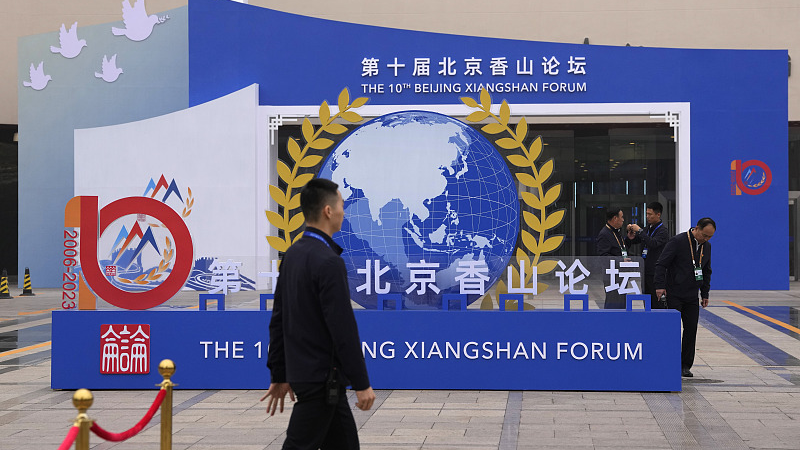
A person walks past the venue of the Xiangshan Forum in Beijing, capital of China, October 29, 2023. /CFP
Editor's note: Kulsum Begum, a special commentator on current affairs for CGTN, is a security and strategic affairs researcher and freelance columnist. The article reflects the author's opinions and not necessarily the views of CGTN
The participation of the U.S. defense delegation at the ongoing 10th Beijing Xiangshan Forum held from October 29 to 31 is a latest indication of improving relations between China and the U.S. It underscores the close collaboration between the two nations and sets the path for increased cooperation between their forces. The ongoing bilateral interaction between China and the United States is indicating a stabilization of the relationship; nonetheless, the resumption of military-to-military contact is critical.
The Xiangshan Forum enables military officials from various locations to get together and discuss ideas, seeking collaborative solutions to critical challenges. The ties built during the seminar and army-to-army exchanges have assisted in identifying shared interests for pragmatic multilateral solutions and coping with growing challenges. But trust should be created at the strategic level to promote stability between the two sides. To restore strong military relations, the U.S. must acknowledge China's security concerns and show sincere care for each other's interests. During his visit to the U.S., Chinese Foreign Minister Wang Yi underlined the need for dialogue in fostering better ties with the U.S. It is important to eliminate the misconceptions and distortions held by U.S. politicians against China. The actual China is different from what they routinely berate. To stop the relationship from further deteriorating, Chinese Foreign Minister Wang Yi and U.S. President Joe Biden met in Washington, D.C. on October 27. Friendly relations with China were emphasized by Biden in the hour-long talk, during which he stated that the U.S. is ready to maintain communication with China and jointly address global challenges.
Wang's Washington visit acts as a continuation of the previous bilateral engagements. Following the visits by U.S. Secretary of State Antony Blinken, U.S. Treasury Secretary Janet Yellen, and U.S. Commerce Secretary Gina Raimondo this year, high-level contacts between China and the U.S. have in fact increased recently. Wang's visit was intended to communicate with the U.S. and effectively implement the important consensus reached at the meeting between the two heads of state in Bali last year, as well as look forward to San Francisco, to promote the stabilization and recovery of China-U.S. relations so that it can quickly return to a healthy and stable development track. The goal of the discussions, which included National Security Advisor Jake Sullivan and U.S. Secretary of State Antony Blinken, was to promote sound growth and stabilize the U.S.-China relationship. Taiwan question, the main obstacle to China-U.S. ties, has been highlighted by Wang Yi during his meeting with Biden. Wang emphasized that "the one-China principle and the three China-U.S. joint communiques are the most important political foundation for the bilateral relationship."
The two nations have decided to work together to arrange a summit between the two heads of state in San Francisco to talk about high-level contacts. The Biden administration aims to successfully host APEC by improving relations with China and stabilizing the relationship between the two countries. Maintaining the steady environment created by increased contact will guarantee meaningful higher-level interactions as both nations anticipate high-level summit in San Francisco.
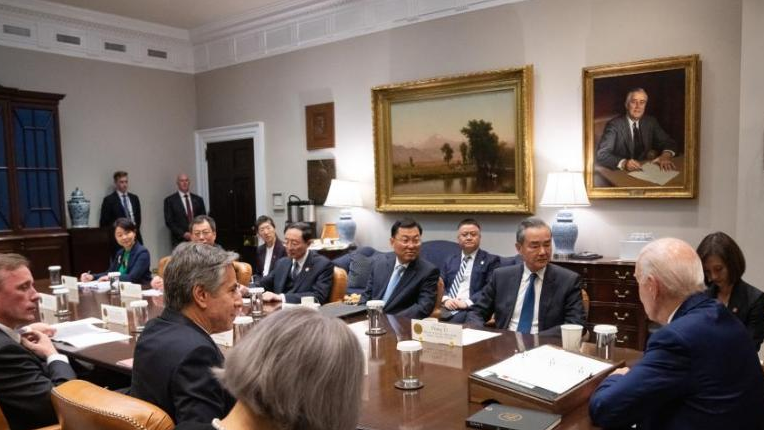
U.S. President Joe Biden meets with Wang Yi, a member of the Political Bureau of the Communist Party of China Central Committee and Chinese foreign minister, at the White House in Washington, D.C., U.S., October 27, 2023. /Xinhua
Wang Yi said both sides must uphold the common understandings reached by the two heads of state, must stabilize bilateral relations, must keep communication channels open, must properly manage differences, disputes and frictions, and must promote mutually beneficial cooperation. These timely "five musts" need to be highly prioritized to mend the U.S.-China ties. The U.S. should be more sincere in its action by abiding by these "five musts."
By inviting Wang Yi to meet with U.S. officials, Blinken showed Washington's intention to improve relations with China. The U.S. should now avoid provocative and hegemonic gestures. Instead of adopting anti-China policies and containing China, the U.S. should be more sincere in its efforts to improve ties. To restart military contact with China, the Pentagon has sent delegates to the ongoing Xiangshan Forum. Reducing provocative deployments, reassuring Beijing that U.S. policy remains oriented towards peaceful coexistence, lifting sanctions, acknowledging China's security priorities, and persuading Beijing that Washington genuinely seeks to manage differences responsibly are all important steps towards addressing the ongoing challenges posed by contentious questions like Taiwan and the South China Sea.
On the trade and economic front, the first meeting of the China-U.S. economic working group, conducted on October 24 via video link, helped strengthen economic and trade ties by removing trade barriers. Establishing the working groups and arranging the first meeting are crucial to maintain China-U.S. ties and minimize macroeconomic and financial policy miscommunications that might benefit the global economy.
With shared issues and responsibilities, China and the U.S. find themselves at a pivotal juncture in their relationship. China feels that communication, collaboration, and mutual gain should be the way ahead since the two nations' shared interests exceed their disagreements and conflicts. In order to achieve a stable and long-lasting relationship with China, the U.S. should be prepared to improve communication, avoid mistakes in judgement, look into potential areas of collaboration, and be ready for more high-level meetings.
(If you want to contribute and have specific expertise, please contact us at opinions@cgtn.com. Follow @thouse_opinions on Twitter to discover the latest commentaries in the CGTN Opinion Section.)
Search Trends
SITEMAP
Copyright © 2023 CGTN. 京ICP备16065310号

Disinformation report hotline: 010-85061466
SITEMAP
Copyright © 2023 CGTN. 京ICP备16065310号
Disinformation report hotline: 010-85061466