
By continuing to browse our site you agree to our use of cookies, revised Privacy Policy and Terms of Use. You can change your cookie settings through your browser.
Putin meets Iranian FM Araghchi, pledges support for Iran

Share







Copied
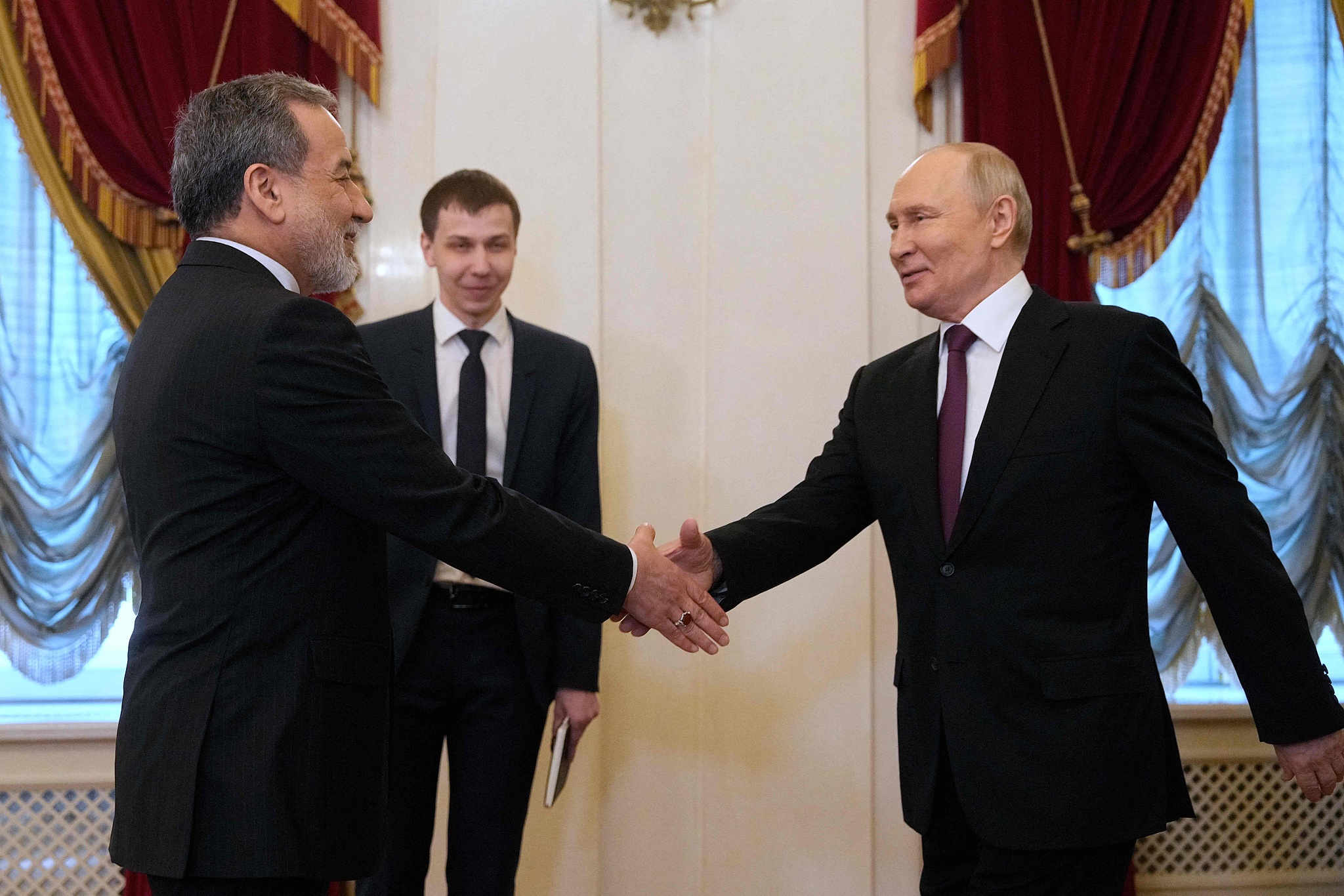
Russian President Vladimir Putin shakes hands with Iranian Foreign Minister Abbas Araghchi during their meeting in St. Petersburg, Russia, April 27, 2026. /VCG
Russian President Vladimir Putin held talks with Iranian Foreign Minister Abbas Araghchi in St. Petersburg on Monday and said he hoped the Iranian people would weather what he described as a "difficult period," and that peace would soon prevail.
"For our part, we will do everything that serves your interests and the interests of all the peoples of the region to ensure that peace is achieved as quickly as possible," Putin told Araghchi, according to Russian state media RIA Novosti.
"Last week, I received a message from Iran's supreme leader. I would like to ask you to convey my most sincere thanks for this and to confirm that Russia, like Iran, intends to continue our strategic relationship," Putin said.
During the meeting, Araghchi said relations between Russia and Iran would continue to strengthen and thanked Putin for Moscow's support, Russia's RIA news agency reported.
Elaborating on the diplomatic process mediated by Pakistan to end the US-Israeli war on Iran and establish peace and security in the West Asia region and the Strait of Hormuz, Araghchi said, "The main reasons for the slow progress of diplomacy are the US continuation of its destructive habits, especially its insistence on putting forward unreasonable demands, frequently changing positions, threat rhetoric and recurrent breaking of promises."
Araghchi said Iran will make an appropriate decision about the current diplomatic process while taking into consideration its previous experiences, "especially the two military aggressions (by the US and Israel) against the country in the middle of diplomatic negotiations, attacks on its peaceful nuclear facilities as well as the US addiction to sanctions and economic pressure and continued piracy against Iranian commercial vessels."
Araghchi arrived in Russia early Monday on the last leg of a tour that has taken him to Pakistan twice and to Oman.
On February 28, Israel and the US launched joint attacks on Tehran and other Iranian cities, killing Iran's then Supreme Leader Ali Khamenei, senior commanders, and civilians. Iran responded with waves of missile and drone strikes targeting Israel and US interests in the Middle East, and a tightened control over the Strait of Hormuz.
A ceasefire was achieved between the warring parties on April 8, followed by lengthy talks between Iranian and US delegations in Pakistan's capital Islamabad, which failed to yield an agreement. The United States later imposed its own blockade on the waterway.
Iranian and US delegations were reportedly expected to hold another round of peace talks in Pakistan last week, but Iran refrained from attending the negotiations, citing US continued naval blockade and "excessive" demands as main reasons.
(With input from agencies)
Search Trends
