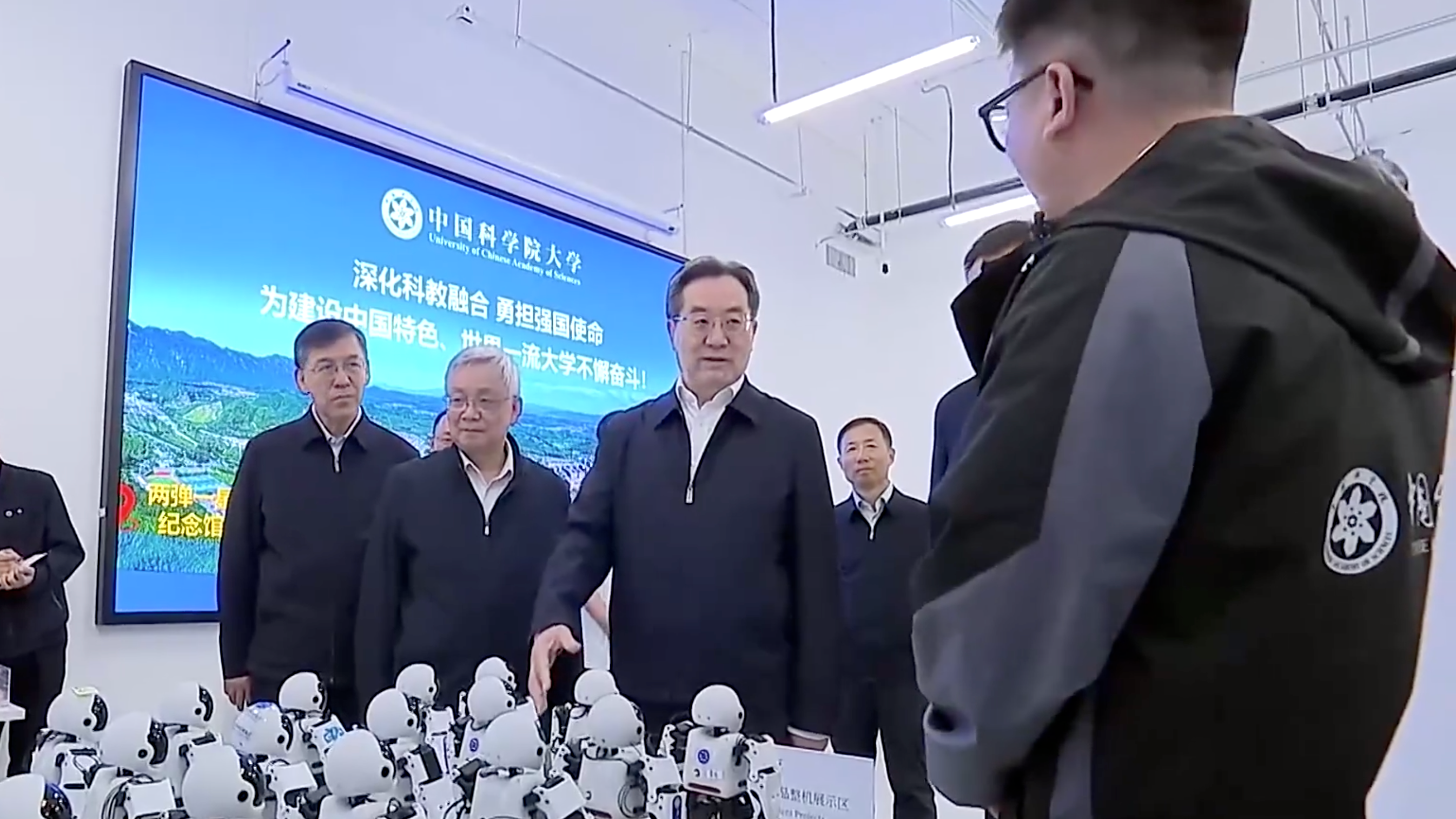
Chinese Vice Premier Ding Xuexiang, also a member of the Standing Committee of the Political Bureau of the Communist Party of China Central Committee, inspects the University of the Chinese Academy of Sciences. /CMG
Chinese Vice Premier Ding Xuexiang has stressed that the country needs to comprehensively improve its basic research level and original innovation capability.
Ding, also a member of the Standing Committee of the Political Bureau of the Communist Party of China Central Committee, made the remarks during recent inspection tours in Fujian Province, Shanghai and Beijing.
Ding visited the Chinese Academy of Sciences (CAS) and the Huairou Laboratory to learn about progress in original innovation and breakthroughs in core technologies in key fields.
He stressed the need to optimize the layout of basic research, with a clear focus on priority areas and major fields. He called for strengthening original and disruptive innovation to achieve mutually reinforcing progress in scientific discovery and technological invention.
He also inspected the High Energy Photon Source facility, and stressed the importance of strengthening the construction of major national scientific infrastructure to enhance research support capabilities and accelerate breakthroughs in basic research.
While visiting Shanghai Jiao Tong University and the University of the Chinese Academy of Sciences, Ding emphasized the importance of advancing the integrated development of education, science and technology, and talent cultivation.
During a visit to the memorial of the "two bombs, one satellite," referring to China's first atomic bomb, intercontinental ballistic missile and satellite, at the CAS, Ding underscored the importance of carrying forward the spirit legacy, and encouraged scientists and researchers to shoulder the mission entrusted by the country and scale new heights in science.
During inspections at Contemporary Amperex Technology, a leading electric vehicle battery maker, and Huawei's Lianqiu Lake R&D Center, Ding praised the achievements made by leading technology companies in basic research. He called for closer integration of basic research, application development and commercialization to strengthen innovation and maintain technological leadership.
(With input from Xinhua)