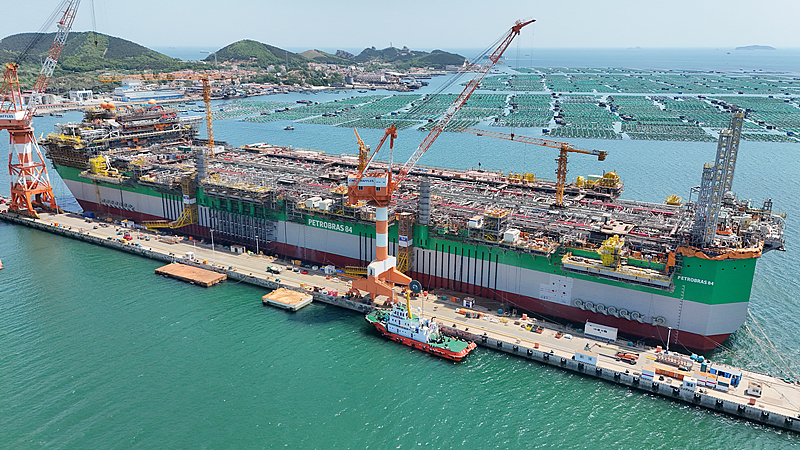
A floating production storage and offloading (FPSO) vessel is under construction at a shipyard in Yantai, east China's Shandong Province, May 9, 2026. /VCG
China's shipbuilding industry has kicked off 2026 with a historic first-quarter performance, driven by surging global demand and a rapid shift toward green technologies, according to data released by the Ministry of Industry and Information Technology on Saturday.
In the first three months of the year, China's shipbuilding output reached 15.68 million deadweight tonnes (DWT), up 46% year on year, accounting for 57.3% of the global market share. New orders jumped a staggering 195.2% to 59.53 million DWT – representing a commanding 84.9% of the global total. Handheld orders also rose 43.6% from a year ago to 322.3 million DWT, or 69.8% of the world's share.
The data revealed that China led new orders in 15 of the world's 18 major ship types. In large vessel segments, such as very large crude carriers (VLCCs), large car carriers and large container ships above 10,000 twenty-foot equivalent units (TEUs), China's share of new global orders exceeded 90%.
Green ships lead the way
Beyond volume, China's shipbuilding sector is accelerating its green transformation. The first quarter saw a wave of deliveries of methanol, LNG and pure electric-powered vessels, with green technology breakthroughs across the board.
Notable deliveries included the self-developed Kun series 15,000-TEU methanol dual-fuel container ship, which can cut carbon dioxide emissions by 120,000 tonnes annually; the Tianshan 174,000 cubic meter large LNG carrier, meeting the world's strictest emissions standards; and the Chuangxin 19, China's first single-methanol-fueled sea-river direct bulk carrier, which reduces CO2 emissions by 90% and nearly eliminates sulfur oxides.
According to the ministry, newly added green ship orders accounted for 80.2% of China's international market share in Q1, covering dual-fuel solutions such as LNG, LPG, methanol, and ethane-based vessels, as well as electric ships.
Efficiency gains from industrial clusters
China's shipbuilding efficiency has also seen significant improvement. The 46% output growth in the first quarter reflects faster delivery times and stronger industrial coordination, according to Chen Wenbo, deputy secretary-general of the China Association of the National Shipbuilding Industry.
"The industry has shifted from individual enterprise competition to an ecosystem-based model. Industrial clusters are greatly reducing construction time and costs," Chen said.
In Qidong, east China's Jiangsu Province, a high-end marine engineering and shipbuilding industrial cluster is taking shape. The local shipyard has built over 70 "world-first" and "China-first" vessels. For a floating production storage and offloading (FPSO) unit, the localization rate rose from 60% in 2019 to 90% today, with construction cycles shortened by more than half a year.
Moreover, more than 93% of material categories and 27 percent of core equipment now come from Jiangsu and its surrounding areas, demonstrating the region's full-chain ecological advantages from design to manufacturing.
With AI technologies also being integrated into production, China's shipbuilding industry is moving from "building more" to "building smarter," further consolidating its global competitiveness.