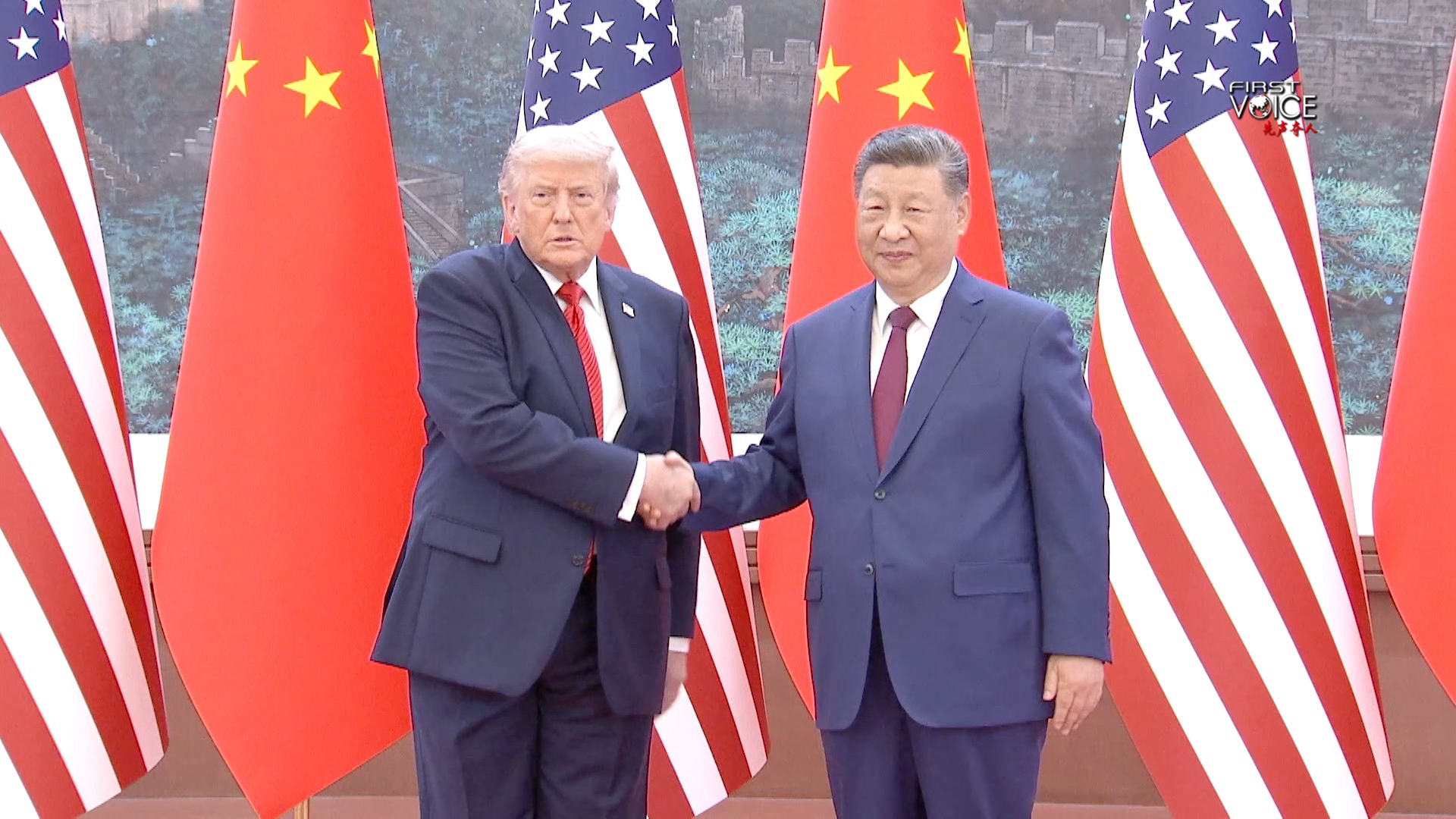
Chinese President Xi Jinping shakes hands and poses for a photo with US President Donald Trump, who is in China for a state visit, at the Great Hall of the People in Beijing, May 14, 2026. /CMG
Editor's note: CGTN's First Voice provides instant commentary on breaking stories. The column clarifies emerging issues and better defines the news agenda, offering a Chinese perspective on the latest global events.
Chinese President Xi Jinping, once again, stressed the importance of China-US relations during talks with his US counterpart, Donald Trump, in Beijing on Thursday.
The two leaders agreed to work toward building a bilateral relationship of constructive strategic stability. The constructive strategic stability, as Xinhua quoted Xi, should be a positive stability centered on cooperation, healthy stability with measured competition, normal stability with manageable differences and enduring stability with prospects for peace.
Xi also noted that he expects 2026 to be a historic, landmark year that opens up a new chapter in China-US relations.
At a time of trade tensions and global instability, Sino-US head-of-state diplomacy promotes positive change in the world's most consequential bilateral relationship.
Xi said on Thursday that where disagreements and frictions exist, equal-footed consultation is the only right choice.
Previous meetings between the two top leaders have slowed down escalation and created temporary guardrails. That is exactly why Thursday's meeting matters.
In April 2017, Trump and Xi met for the first time at Mar-a-Lago. The talks created a channel of communication at a moment when both sides could have easily drifted toward confrontation. It established a pattern: Even when Washington and Beijing disagreed on a slew of issues, the leaders still recognized the need to talk.
The more revealing example came later. At the 2019 G20 Summit in Osaka, the two sides agreed to restart trade negotiations, avoid immediate tariff escalation, and keep the door open for a broader deal. The leaders used the summit to prevent the trade conflict from getting worse.
That pattern repeated in more recent encounters. In 2025, the Xi-Trump meeting in South Korea produced practical steps: China agreed to halt export restrictions on rare-earth materials, and the United States reduced some tariffs on fentanyl-related imports. The outcome reassures markets that the two governments have the will to keep China-US relations on track.
Those earlier meetings show that Xi-Trump diplomacy has lowered the temperature enough to keep trade, security, and communication from collapsing. This is why this week's meeting matters. It arrives at a moment when trade tensions are alive and regional security concerns continue to hover. A meeting between the top leaders cannot erase all those issues, but it can shape how they are handled.
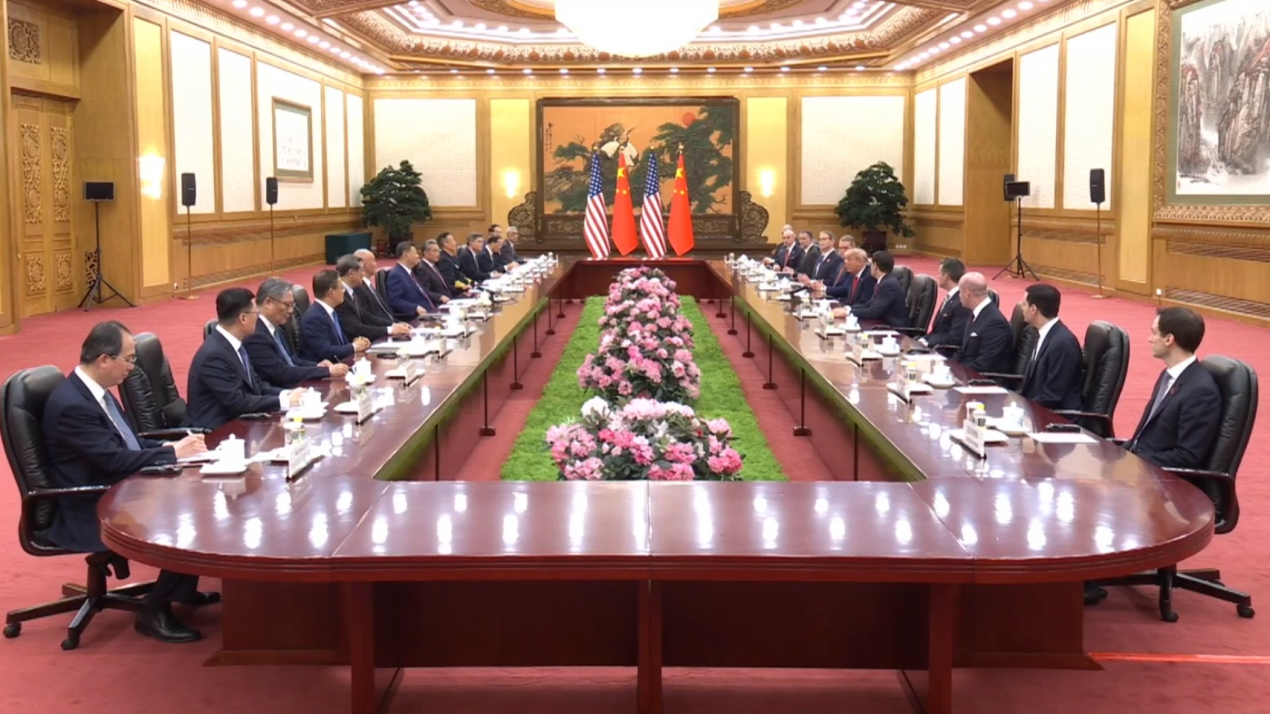
Chinese President Xi Jinping holds talks with US President Donald Trump in Beijing, capital of China, May 14, 2026. /CMG
"We are going to have a fantastic future together," Trump said on Thursday, noting that the relationship between China and the US "is going to be better than ever before."
Trade, without suspense, is on the agenda for the meeting. Both countries have strong incentives to keep commerce moving despite their intense competition in technology, manufacturing, and industrial policy. Beijing-Washington interdependence is why both sides need to keep talking.
It is worth noting that business executives from America's most consequential industries, including Tesla CEO Elon Musk and Nvidia boss Jensen Huang, are accompanying Trump on the trip.
On Wednesday, Chinese and American economic and trade teams produced generally balanced and positive outcomes. Xi said on Thursday that China-US economic and trade ties are mutually beneficial, and the two sides should jointly sustain the good momentum that they have worked hard to create, stressing that trade wars have no winners.
There is also a geopolitical dimension that cannot be separated from the economic one. The Taiwan question and regional security in Asia still remain part of the broader background. The purpose of the meeting is not to erase disagreements. It is to manage them in a way that keeps divergences from turning into a crisis.
That is why diplomacy matters. Direct contact between leaders can reduce the chance of miscalculations and policy mistakes. Such clarity can be more valuable than grand rhetoric. It can help prevent sudden escalations, mistaken signals, and unnecessary confrontations. The Xi-Trump meeting on Thursday also reassures the international community that the relationship is being handled with seriousness rather than impulsivity.
In an era of strategic competition, dialogue can serve as a form of restraint. Thus, the importance of the Xi-Trump meeting is not that it will transform the relationship. It could define the terms under which the relationship continues.
The author Jianxi Liu is a Beijing-based political and international relations analyst. She writes on topics about the US, the EU, and the Middle East.
(If you want to contribute and have specific expertise, please contact us at opinions@cgtn.com. Follow @thouse_opinions on Twitter to discover the latest commentaries in the CGTN Opinion Section.)