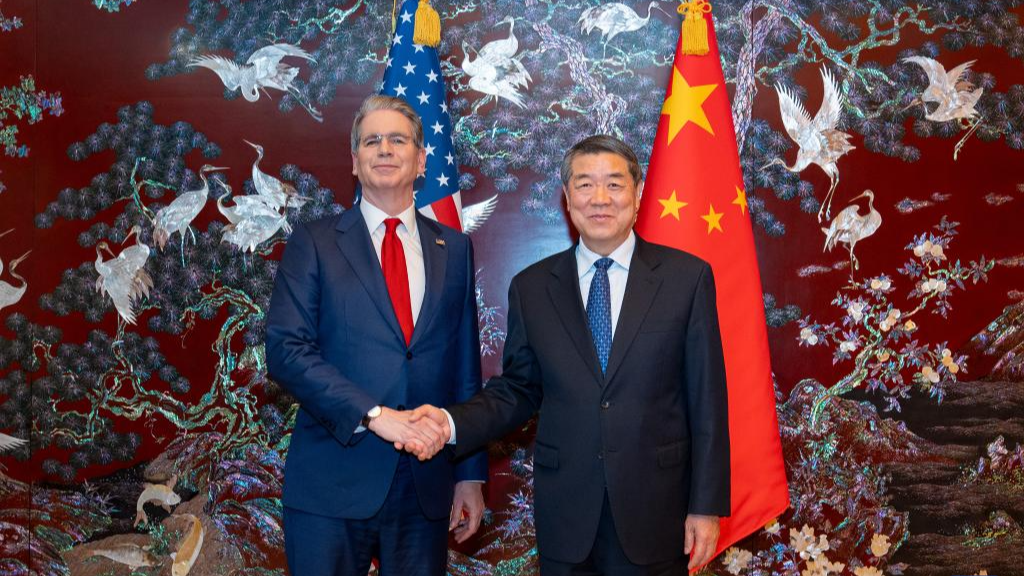
Chinese Vice Premier He Lifeng (R) shakes hands with US Treasury Secretary Scott Bessent prior to their consultations in the Republic of Korea, May 13, 2026. /Xinhua
China's Ministry of Commerce on Wednesday elaborated on the preliminary outcomes of the recently held China-US economic and trade consultations, covering issues such as tariffs, agricultural trade, rare-earth export controls and aircraft trade.
The two sides have agreed in principle to discuss a reciprocal tariff-reduction framework for products of equivalent scale, worth $30 billion or more on each side, under the trade council, a ministry official said, referring to the bilateral consultations held in the Republic of Korea from May 12 to 13.
The products, as agreed by both sides, are expected to enjoy most-favored-nation tariff rates or even lower rates, according to the official.
"Once implemented, the arrangement will not only help stabilize and expand bilateral trade between China and the United States, but also serve as a useful reference for global open cooperation," the official said, adding that the economic and trade teams of the two sides will maintain close communication, work out specific arrangements, and push for early implementation.
Regarding export controls on rare earths and other critical minerals, the official noted that China implements such measures in accordance with laws and regulations and reviews license applications for compliance and civilian use.
"China is willing to work with the United States to jointly create favorable conditions for promoting mutually beneficial cooperation between the two countries' enterprises and ensuring the security and stability of global industrial and supply chains," the official said.
As another outcome of the consultations, China will purchase 200 Boeing aircraft to meet its air transport development needs in line with its commercial principles. Meanwhile, the United States will guarantee China a sufficient supply of engines and spare parts, according to the official.
Regarding bilateral agricultural trade, the official said that imports of US agricultural products can help bridge structural supply-demand gaps in China's domestic market and diversify food supplies for consumers, while China's vast consumer market provides a steady income for US farmers.
The official added that China's specialty agricultural products, such as dairy, aquatic products, vegetables and fruits, also have strong potential demand in the US market.
Following equal consultations, the two sides achieved positive outcomes in the agricultural sector and reached multiple consensuses on two-way market access for agricultural products, the official said.
Addressing the registration of US beef enterprises, the official noted that China attaches great importance to bilateral agricultural trade cooperation and welcomes high-quality US agricultural products entering the Chinese market.