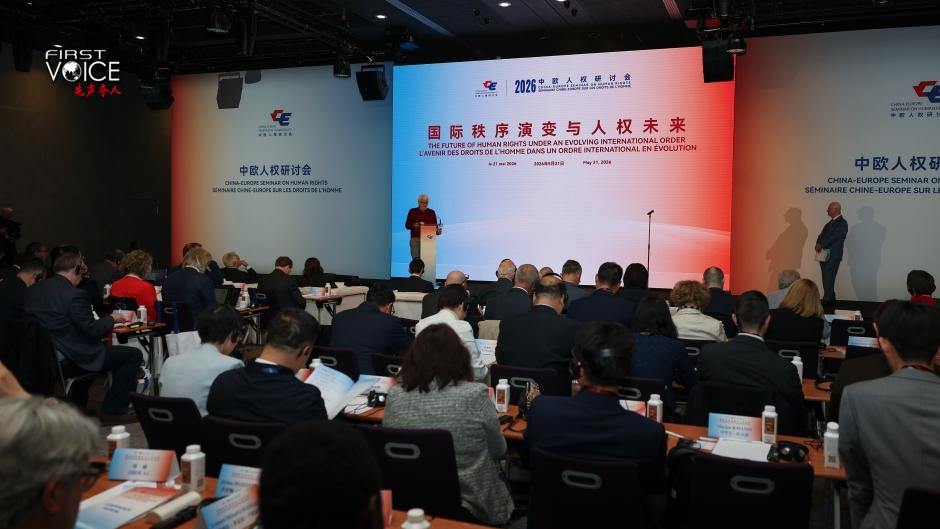
The China-Europe Seminar on Human Rights in Paris, France. /Xinhua
Editor's note: CGTN's First Voice provides instant commentary on breaking stories. The column clarifies emerging issues and better defines the news agenda, offering a Chinese perspective on the latest global events.
In 1789, France gave birth to the Declaration of the Rights of Man and of the Citizen, articulating a universal vision of human dignity, liberty, and equality – the principles that inspired the French Revolution and helped shape the modern world.
Now, it is in the same place in France that scholars from China and across Europe are gathering for this year's China-Europe Seminar on Human Rights, addressing the evolving challenges of protecting human rights.
More than two centuries later, the international order is undergoing profound changes. Deficits in peace, development, security, and governance are increasingly intertwined, posing serious challenges to the future of human rights.
Christophe Peschoux, former official at the UN Office of the High Commissioner for Human Rights (OHCHR), warned at the seminar that the UN is now at a standstill.
"It (the UN) is being reduced, at best to the role of an ambulance, a humanitarian actor sent to the battlefields which have been set alight by States, to pick up the pieces of what can still be saved. At worst, to a powerless spectator, wriggling its hands, and invoking like an incantation states obligations, international law, human rights, humanitarian principles," Peschoux noted.
Certain countries' pursuit of hegemony is regarded as a threat to global human rights protection. There has never been a single path to realizing human rights, and there should not be. Yet today, some countries continue to undermine multilateral mechanisms, using human rights as a tool for geopolitical interests.
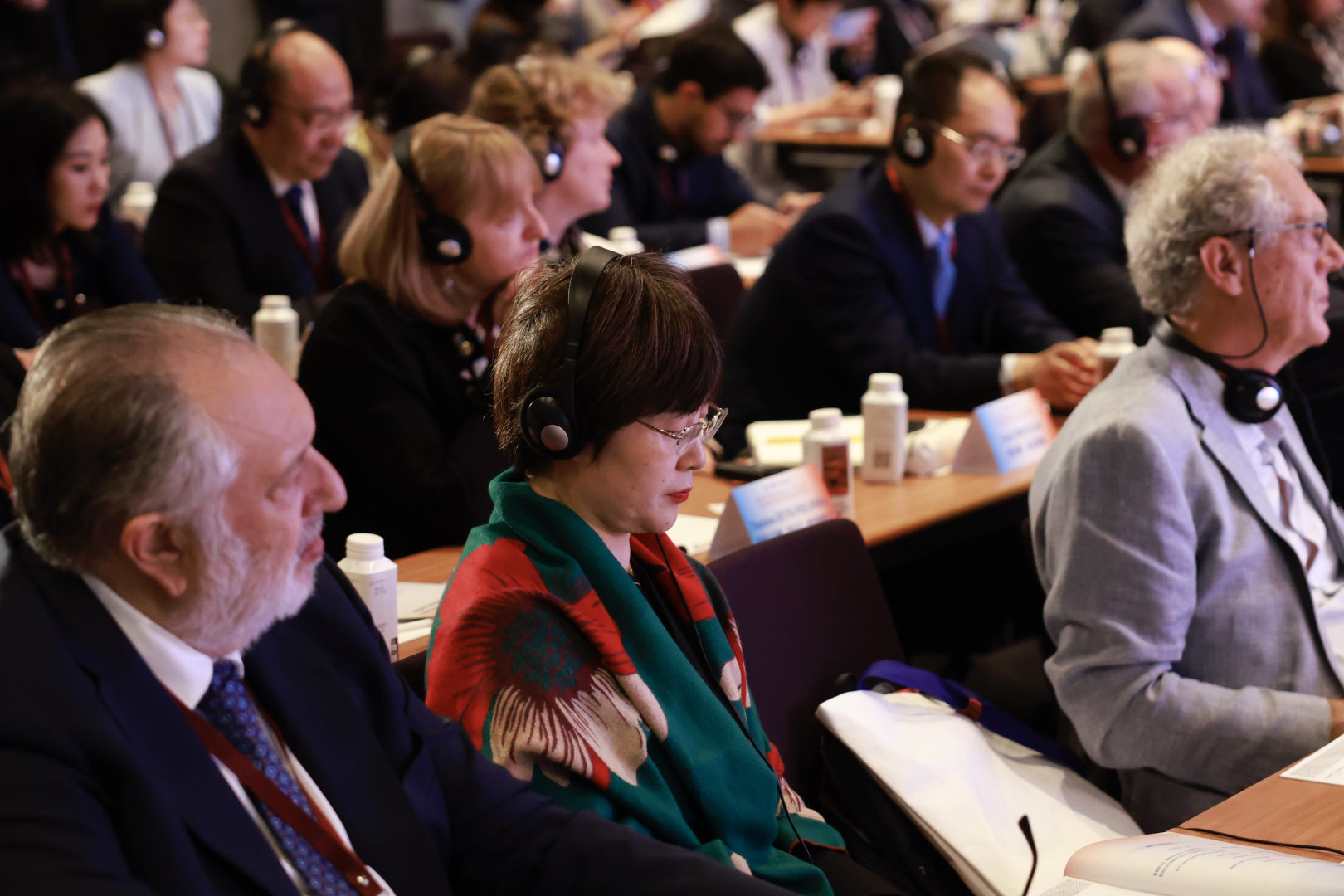
The China-Europe Seminar on Human Rights in Paris, France. /Courtesy of Institute of Administrative and Management Studies
Against this backdrop, China has put forward four major global initiatives, focusing on development, security, civilization, and governance, aiming to inject fresh momentum into global human rights progress.
"These initiatives deal with development, security, civilization, and good governance. Their contents do not represent a restricting national Chinese stance, but are aimed at strengthening the all-embracing existing UN charter," Peter Hediger, former Military Attaché at the Embassy of Switzerland in China, said at the seminar.
Through initiatives such as the Global Governance Initiative, China has sought to amplify the voice of developing countries and promote more inclusive international cooperation. Platforms like the Belt and Road Initiative (BRI) are also seen as contributing to a more balanced and equitable global order.
Hussein Askary, vice-chairman of the Belt and Road Institute in Sweden, spoke highly of the BRI at the forum. The Initiative, as Askary put it, "has been a great success in terms of bringing more than 140 nations around a concept of economic development and cooperation based on bridging the huge gaps in development, especially financing and building infrastructure which is an absolute necessity for any economic development process and alleviation of poverty."
China has consistently upheld the international system with the United Nations at its core. But some critics argue that China is seeking to overthrow the current global order. Participants at the seminar believe this to be a pure misunderstanding of China's approach.
"When China speaks of multilateralism, it does so on the basis and in defense of the charter of the UN. China is unique in history for the consistency of its existence as a nation. The secret lies in respecting borders," Hediger said, adding that "China has never had any ambitions to dominate the whole world."
Ultimately, the protection of human rights is a shared global endeavor. It is central to building a community with a shared future where development benefits all and the rights of every individual are respected and protected.
The future of human rights should not be an arena for confrontation, but a platform for dialogue among civilizations.
As scholars gather in Paris, more than two centuries after the French Revolution, the conversation continues, seeking to explore new pathways forward. In this context, China's vision of a shared future offers one perspective in an increasingly interconnected world.
The author Jianxi Liu is a Beijing-based political and international relations analyst. She writes on topics about the US, the EU, and the Middle East.
(If you want to contribute and have specific expertise, please contact us at opinions@cgtn.com. Follow @thouse_opinions on Twitter to discover the latest commentaries in the CGTN Opinion Section.)