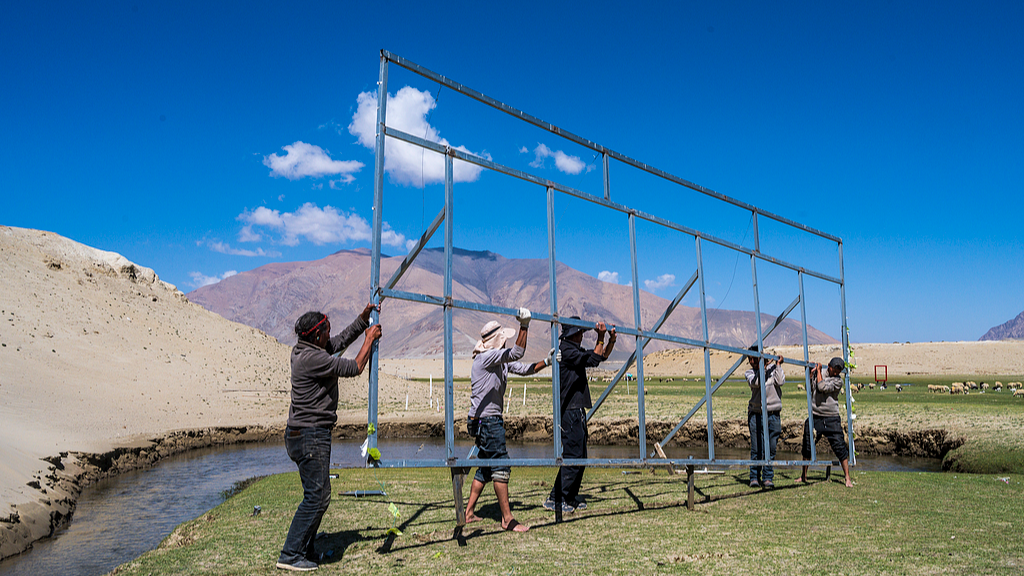
People preparing for the upcoming summer tourism peak season in the Shaha Oasis of Dingri County, Xigaze, southwest China's Xizang Autonomous Region, on May 21, 2026. /VCG
May 23, 2026, marks the 75th anniversary of the peaceful liberation of Xizang, following the signing of an agreement between the Central People's Government and the local Xizang authorities in Beijing on May 23, 1951.
Since then, Xizang has achieved historic progress across all sectors. Its GDP has grown from 129 million yuan (equivalent to about $58 million at the then exchange rate) in 1951 to 303 billion yuan (about $45 billion at current exchange rate) in 2025, according to the People's Government of Xizang Autonomous Region. Xizang's GDP growth led the nation at 6.1% in the first quarter of 2026, demonstrating robust resilience amid a slow global economic recovery, the local government reported.
As China enters the 15th Five-Year Plan period (2026-2030), Xizang's priorities include building a plateau-specific modern industrial system. Key sectors include specialty agriculture and animal husbandry, clean energy, cultural tourism and green mining. The region is also accelerating modern infrastructure development and advancing green economic transformation – all aiming to improve residents' quality of life.
In recent years, Xizang has leveraged its unique local advantages to develop specialty industries.
In Xigaze, known as the "Xizang granary" and the "world's home of highland barley," scientists and local enterprises have collaborated to modernize highland barley production. A new dedicated processing line in Gyangze County was set up in 2024. It can produce over 13,000 tonnes of refined barley flour and 26,000 tonnes of pre-mixed baking flour annually, generating more than 300 million yuan in value, according to Guo Wenhong, the chairman of the board of Xizang Keyan Agricultural Technology Co., Ltd.
Traditional handicrafts are also thriving. In Nyemo County, Lhasa, Tenzin Chodrak transformed a small workshop producing Tibetan incense into a 600-square-meter facility with products sold domestically and exported to Nepal. The company achieved an annual output of over 4 million yuan in 2025, according to reports by the Xizang Daily.
Xizang's tourism sector also continues to innovate, blending natural sightseeing with intangible cultural heritage experiences, traditional costume photography, immersive night tours and vibrant cultural streets. Large-scale events such as the Nyingchi Peach Blossom Festival, Xigaze Mount Qomolangma Cultural Tourism Festival and Yalong Cultural Tourism Festival attract millions of visitors. At the work conference on culture and tourism of the Xizang Autonomous Region, officials reported that Xizang received over 70.7 million domestic and international tourists, generating 81.68 billion yuan in tourism revenue in 2025.
Infrastructure development has also surged. Xizang is strengthening a modern comprehensive transport system, including railways, highways and logistics hubs.
The South Asia land-sea corridor, connecting Xizang with South Asian countries, now enables domestic electric vehicles to reach Nepal in 10 days. In 2025, 12,938 Chinese-brand new energy vehicles were exported via Xizang's customs ports, a record high, according to the Lhasa Customs. Statistics from the China Railway Qinghai Tibet Group Co., Ltd. show that the Qinghai-Xizang Railway has expanded cargo throughput from 361,000 tonnes in 2006 to 8.313 million tonnes in 2025, ensuring rapid transport of coal, building materials and fresh produce within 48 hours, becoming a vital lifeline for local livelihoods.
Economic growth has translated into improved living standards.
Xizang now offers 15 years of free education, modern digital learning platforms and a five-tiered healthcare system covering urban and rural areas. Average life expectancy has reached 72.5 years in 2025, as per the State Council Information Office. From 2012 to 2025, per capita disposable income increased significantly, reaching 33,600 yuan region-wide, with urban residents averaging 58,794 yuan and rural residents 23,184 yuan, according to the office.
From industry upgrades to thriving tourism and enhanced connectivity, Xizang is forging a high-quality development model on the plateau. At the start of the 15th Five-Year Plan, the region continues to advance its vision of prosperity for its people, writing a new chapter in high-quality economic and social development.