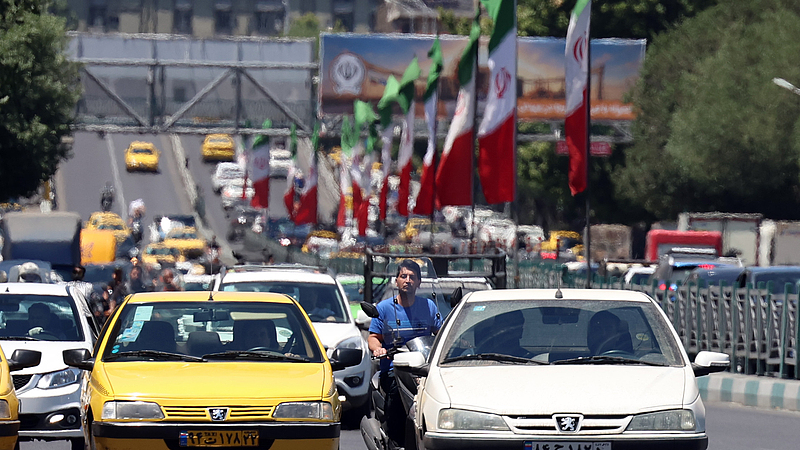
Iranians drive on a street in Tehran, Iran, 23 May 2026. Tensions between the US and Iran remain as mediation talks continue to reach an agreement on ending the US-Iran conflict and allowing the passage of ships through the Strait of Hormuz. /VCG
US President Donald Trump announced Saturday that a US-Iran peace deal has been "largely negotiated," while Iranian President Masoud Pezeshkian struck a cautious stance, vowing to prioritize national interests amid lingering bilateral distrust and unresolved negotiating divergences.
In a post on Truth Social, Trump said the agreement was subject to finalization between the United States, Iran and other relevant countries in the Middle East.
As part of the agreement, the Strait of Hormuz will be opened, Trump added. Final aspects and details of the deal are being discussed and will be announced "shortly," he said.
However, Iran's semi-official Fars news agency reported early on Sunday that the agreement would allow Iran to manage the Strait of Hormuz and that Trump's assertion on the strait was "inconsistent with reality."
Iran to excise 'utmost caution'
Pezeshkian said Saturday that his country seeks to safeguard national interests and remains highly cautious in negotiations with the United States.
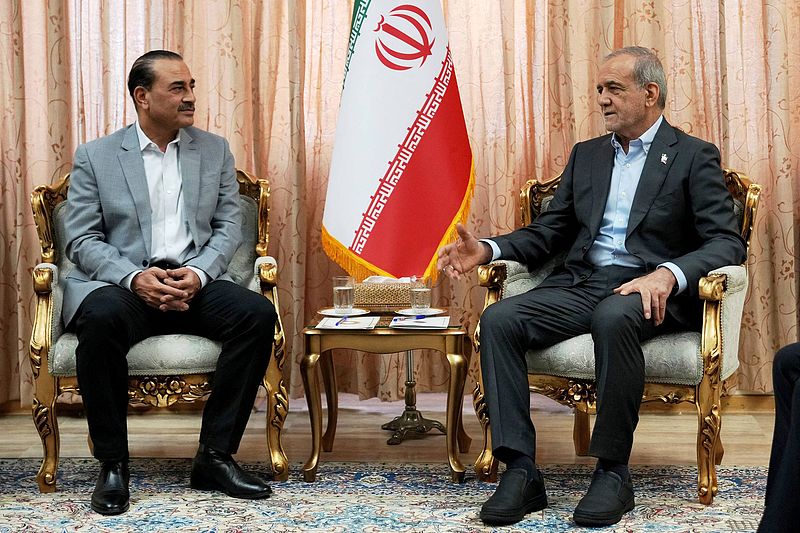
In this handout picture provided by the Iranian presidency, Iranian President Masoud Pezeshkian (R) meets with Pakistani Army Chief Asim Munir in Tehran, Iran, May 23, 2026. /VCG
During a meeting with visiting Pakistani Army Chief Asim Munir in Tehran, Pezeshkian cited Washington's repeated breach of commitments, attacks on Iran amid talks and targeted killings of its officials as the basis for widespread public mistrust, according to a presidency statement.
Under such circumstances, Iran has pursued negotiations relying on its "brotherly relations" with friendly countries, including Pakistan, "but our main goal is to solely safeguard the Iranian nation's interests through appropriate solutions," Pezeshkian said.
"We merely seek to safeguard our people's legal and legitimate rights, but our history and experience of negotiating with the United States urge us to exercise utmost caution," he said.
War has never been in anyone's interest and will only bring losses to the region and the world, he added.
Munir, who arrived in Tehran Friday night, reaffirmed in the meeting his commitment to regional stability, welcomed the progress made in the negotiations, and voiced hope that they would yield favorable results for Iran and regional states.
The Pakistani army said the negotiations had resulted in "encouraging" progress. Two Pakistani sources involved in the talks said the deal being negotiated is "fairly comprehensive to terminate the war."
Separately, Fars news agency reported on Saturday that if Washington does not show flexibility, peace talks with Tehran will be doomed to failure.
Iran insists on not discussing its nuclear program at this stage, releasing its frozen assets prior to negotiations, and continuing its control and management over the Strait of Hormuz, Fars reported, citing an informed source close to the Iranian negotiating team.
No negotiation will take place if the three remaining serious issues of disagreement are not resolved, it reported.
Trump has repeatedly said that the US struck Iran to prevent it from obtaining nuclear weapons. Iran has denied it is pursuing nuclear weapons and says it has a right to enrich uranium for civilian purposes.
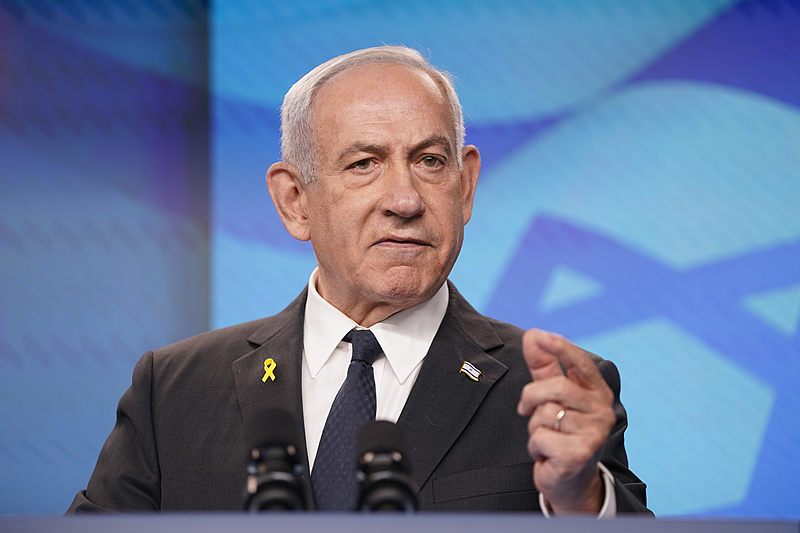
A file photo of Israeli Prime Minister Benjamin Netanyahu. /VCG
Netanyahu calls an emergency meeting
Israeli Prime Minister Benjamin Netanyahu on Saturday convened an emergency meeting of the governing coalition and senior security officials to discuss a US-Iran agreement, China Media Group reported, citing Israeli sources.
Israel fears the emerging terms of the agreement could be "very harmful" to its national security.
The talks between the US and Iran were focused on a draft memorandum of understanding. If finalized, the interim agreement would launch a 60-day negotiation period aimed at ending the conflict that started late February.
Citing an anonymous Israeli official, Israel's Channel 12 reported that Trump's special envoy Steve Witkoff was "urgently pressing Trump to accept the deal." The same source described Witkoff as being "willing to secure an agreement almost at any cost" and applying "enormous pressure on Trump to prevent a resumption of war."
According to the report, if details leaked to international media were accurate, the deal would be "terrible" for Israel. "It's hard to imagine Trump agreeing to this," the report added.
The emerging terms appear to stand in stark contrast to Netanyahu's public statements and even diverge from remarks Trump made just hours earlier.
Leaked terms suggest Iran would reopen the Strait of Hormuz in exchange for economic concessions, including lifting the US naval blockade, a gradual rollback of sanctions, and the unfreezing of some Iranian assets. Discussions on Iran's nuclear program and the fate of its enriched uranium would be postponed to a later stage. Notably, Iran's ballistic missile program was not even on the negotiating table, Channel 12 reported.
Despite deep concerns, the Channel 12 report stressed that Trump and Netanyahu remained in close coordination with no rift between them.
Trump wrote on Truth Social on Saturday that a call with Netanyahu went "very well."
Trump said he also had a phone call on Saturday with leaders from Saudi Arabia, Qatar, the United Arab Emirates, Jordan, Egypt, Turkey and Pakistan. Axios reported that the leaders encouraged Trump to agree to the emerging framework.
Iran, the United States and Israel reached a ceasefire on April 8 after 40 days of fighting that started with US and Israeli attacks on Iran on February 28.
Following the truce, Iranian and US delegations held one round of peace talks in Pakistan's Islamabad on April 11 and 12, which failed to yield an agreement.
Over the past weeks, the two sides have reportedly exchanged several proposed plans outlining conditions for ending the conflict through Pakistan's mediation.
(With input from agencies)