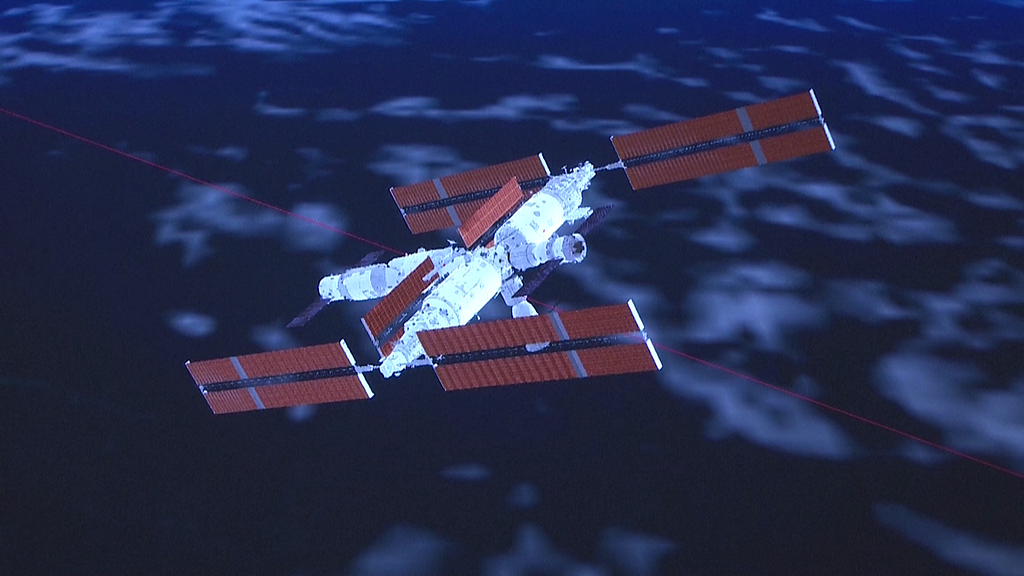
China's Shenzhou-23 crewed spaceship docks with the China Space Station, May 25, 2026. /China Manned Space Agency
China's Shenzhou-23 crewed spaceship successfully docked with the China Space Station early Monday morning, according to the China Manned Space Agency.
After entering orbit, the spacecraft docked with the radial port of the Tianhe core module at 2:45 a.m., about 3.5 hours after the rocket launch.
Behind this rapid and precise manoeuvre lies a domestically developed core piece of technology – the laser rendezvous and docking radar. In the early years, China had almost no experience in space rendezvous and docking measurement, lacking mature products, reference standards, or in-orbit operational know-how.
The primary goal of the first-generation product was simply to bridge the gap from nothing. The research team made breakthroughs step by step, from principle verification and ground simulation to environmental testing.
"The difficulty was the difference between ground and space conditions when we first started," said Li Lei, chief designer of the laser radar project at the 27th Research Institute of China Electronics Technology Group Corporation (CETC).
The team went to high-altitude regions to find weather conditions as close to space as possible, then used simulations and models to deduce how far we could measure on the ground and how far in space.
In 2011, the Shenzhou-8 spacecraft successfully completed a rigid connection with the Tiangong-1 space lab, marking the first victory for the rendezvous and docking laser radar.
In 2021, the Shenzhou-13 crewed spacecraft achieved the first radial rendezvous and docking with the Tianhe core module. The laser radar maintained stable tracking of the preset target and quickly switched between different cooperative targets at preset switching points.
In 2023, the rendezvous and docking laser radar successfully guided Shenzhou-16's precise radial docking with the space station's core module, completing the first crewed mission of the new phase of China Space Station application and development.
"In the Tiangong days, there was basically only one docking port. But with the space station, we have aft, forward, radial, and even fly-around needs – these requirements kept changing," said Zhao Mingfu, deputy chief designer of the laser radar project at CETC's 27th Institute. "We met all these evolving needs by updating the software."