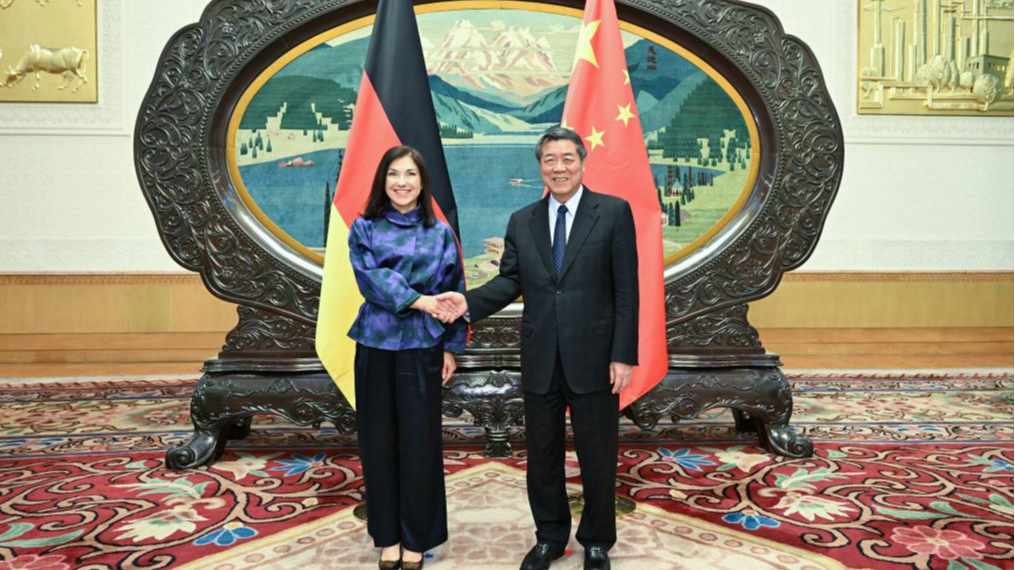
Chinese Vice Premier He Lifeng (R), also a member of the Political Bureau of the Communist Party of China Central Committee, shakes hands with German Economy and Energy Minister Katherina Reiche in Beijing, China, May 27, 2026. /Xinhua
Germany's Federal Minister for Economic Affairs and Energy Katherina Reiche undertook on her first official visit to China from May 26 to 29, accompanied by a delegation of 40 senior executives from leading German companies, including BASF, Siemens Energy and ThyssenKrupp.
The visit comes just three months after German Chancellor Friedrich Merz's February trip to China and represents a concrete step by the Merz government to deepen China-Germany relations.
Experts say that against the backdrop of sluggish global economic recovery and rising geopolitical uncertainty, the high-level engagement between China and Germany highlights Berlin's recognition of the two countries' deep economic interdependence and underscores Germany's pragmatic, cooperation-focused approach toward China.
During his February visit, Merz led a high-profile economic and trade delegation to China, signaling a strong commitment to reshaping China-Germany relations and deepening practical cooperation. The two sides reached a series of agreements covering trade and investment, green energy and other key sectors.
Reiche's trip has been described in Germany as a visit to implement these agreements, aimed at translating high-level political consensus into concrete cooperation between government departments and businesses.
Pushing for cooperation over 'decoupling'
During Reiche's visit to Beijing, Chinese Vice Premier He Lifeng, also a member of the Political Bureau of the Communist Party of China Central Committee, and Commerce Minister Wang Wentao held talks with her on deepening China-Germany economic and trade cooperation.
The vice premier expressed hope that both sides would promote the sustained and healthy development of bilateral economic ties through high-level cooperation.
Wang highlighted the alignment between the goals of China's 15th Five-Year Plan (2026-2030) and Germany's Industry 4.0 and low-carbon transition strategies. The two sides should consolidate cooperation in traditional industries while expanding collaboration in emerging sectors, creating a new model of mutually beneficial China-Germany partnership, he said.
Wang also voiced concern over recent European trade restrictions, noting their disruptive impact on China-Europe corporate cooperation, and called for joint support for free trade and multilateralism.
Reiche reiterated Germany's commitment to free trade and opposition to "decoupling" and supply chain disruption. She emphasized the German government's readiness to enhance policy dialogue with China and to build a rule-based, stable, balanced, trustworthy and future-oriented Germany-China economic and trade relationship.
Reiche's remarks come amid heated EU debates on China policy. She expressed cautious skepticism toward proposed import restrictions on Chinese goods and reaffirmed Germany's long-term commitment to market openness.
In an interview with German media before departing for China, Reiche said German companies are not afraid of competition and stressed that deeper China-Germany cooperation is essential to fostering a stable and mutually beneficial economic framework.
German companies show confidence in China
Amid rising global trade protectionism and energy supply uncertainties fueled by regional conflicts, China's role as Germany's largest trading partner has become increasingly strategic.
According to China's Foreign Ministry, trade between China and Germany reached $211.1 billion in 2025, a 4.6% year-on-year increase, marking the eighth consecutive year China remained Germany's top trade partner. In the first two months of 2026, bilateral trade rose 19.6% year on year, significantly outpacing Germany's overall foreign trade growth and demonstrating strong resilience.
For Germany, China represents not only a vast consumer market, but also a stable supply chain base, a high-return investment destination and a key partner in green transition initiatives.
Germany maintains global strengths in high-end manufacturing, chemicals, automotive and energy technology, while China offers a massive market, complete industrial chains, efficient supply networks and a continuously improving business environment – making the partnership inherently complementary and mutually beneficial.
Currently, more than 5,000 German companies operate in China. According to a May survey by the German Chamber of Commerce in China, 61% of German firms plan to increase investment in China over the next two years, the highest level since 2023. The survey also found that 51% of respondents believe supporting partnerships with Chinese firms should be the German government's top priority in helping businesses succeed in China.
Major projects, including BASF's integrated site in Zhanjiang, Siemens' digital factory and BMW's production base in Shenyang, continue to expand, reflecting long-term confidence in the Chinese market.
Meanwhile, data from the IW German Economic Institute showed that German direct investment in China exceeded 7 billion euros ($8.15 billion) in 2025, up 55.5% from the 4.5 billion euros recorded in both 2023 and 2024, marking a four-year high. Chinese investment in Germany also surpassed US investment, meaning China is Germany's largest source of foreign investment projects.
As two major global economies, China and Germany play an important role in shaping China-EU relations. Deepened bilateral economic cooperation could serve as a model for other EU countries by promoting pragmatic engagement, easing trade frictions, stabilizing supply chains and supporting the long-term development of Europe's economic ties with China.
Moreover, as major global manufacturing and trading nations, stronger China-Germany cooperation could also contribute to global supply chain stability, trade liberalization and broader economic recovery.