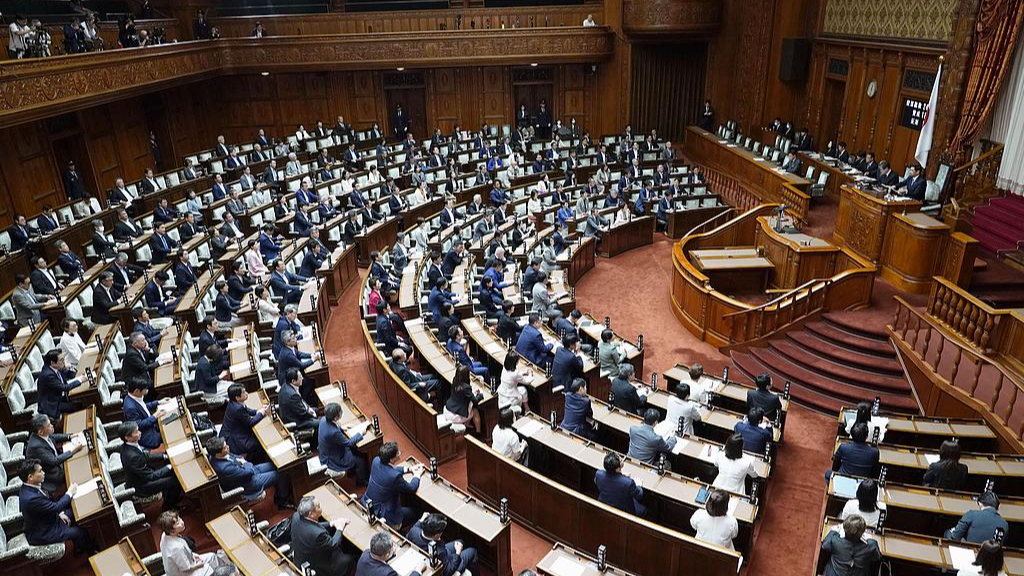
Japan's House of Councillors approves a bill to establish a new national intelligence council during a plenary session in Tokyo, Japan, May 27, 2026. /VCG
Japan's parliament has passed legislation to establish a national intelligence council, a move that has already given cause for concern over the country's hawkish shift and the potential erosion of its postwar pacifist framework.
The Japanese House of Councillors approved the law on Wednesday as Prime Minister Sanae Takaichi aims to centralize the country's intelligence gathering.
Devised in response to national security concerns, the new law stipulates that the national intelligence council will be chaired by the prime minister and composed of relevant cabinet members, including the chief cabinet secretary and foreign minister. It adds that the national intelligence bureau, the council's secretariat, will comprehensively coordinate intelligence work across government ministries and agencies, such as the National Police Agency, the Foreign Ministry and the Defense Ministry and other organizations.
The Japanese government could establish the council and bureau as early as July and set up an expert panel to discuss counterespionage legislation, according to Kyodo News.
Even so, the law has been met with a wall of opposition across Japanese society. Kyodo News reported that the new law lacks provisions for parliament to monitor intelligence activities, leaving questions regarding democratic oversight unresolved.
Ahead of the vote on Wednesday, Makoto Oniki, a lawmaker from the Constitutional Democratic Party of Japan, was quoted by The Mainichi as saying that "if intelligence agencies cannot be properly controlled and are left to go unchecked, they risk severe and unjust infringements on the rights of the public."
Public protests against the legislation have been taking place in Tokyo. The protesters warned that the newly passed intelligence legislation could once again "push the country toward war."
During a demonstration on Wednesday, one protester, speaking to China Media Group (CMG), pointed to the pre-World War II Peace Preservation Law, which was used to suppress political dissidents and anti-war activists, saying it was measures such as this that served as a prelude to militarism and ushered in a dark era in history.
The law has also revived memories of Tokko, Japan's notorious Special Higher Police, a civilian security and intelligence agency operating as "Thought Police" before and during World War II. In a recent editorial, the Ryukyu Shimpo warned that the historical lessons of wartime surveillance and crackdowns on anti-war voices should never be forgotten.
China also expressed concern. Chinese Foreign Ministry spokesperson Mao Ning said on Thursday that Japanese intelligence agencies historically helped facilitate militarism and wars of aggression, causing immense suffering to neighboring Asian countries as well as to the Japanese people themselves. Japan should learn from history and act with prudence, Mao added.
The Takaichi administration's push to establish the new intelligence apparatus reflects a broader effort to reshape Japan's postwar security structure, said Xiang Haoyu, a research fellow at the China Institute of International Studies, in an interview with CMG.
Placing the intelligence council directly under the prime minister would create a highly centralized decision-making system, fundamentally altering the relatively decentralized intelligence structure Japan maintained after World War II as a safeguard against the revival of militarism, Xiang said.
Xiang added that the law represents a critical step toward the militarization of Japan's intelligence system and could lay institutional groundwork for future efforts to revise the pacifist constitution and further expand military capabilities.
According to Xiang, intelligence reforms like this could provide strategic support for military expansion, potentially intensifying regional arms competition and undermining East Asia's existing security balance.
Xiang warned that in an extreme scenario, if Japan lacks effective domestic and international constraints, it could repeat the prewar path of "intelligence first, military expansion later," posing a serious threat to regional and global peace.