Gulf hostilities flared anew on Wednesday, with the US military saying Iranian missile attacks on Bahrain, Kuwait and other regional targets were either thwarted or failed as diplomacy between Washington and Tehran showed little progress.
Two Iranian missiles shot at Kuwait fell short or broke apart in flight, several ballistic missiles aimed at regional targets failed, and three missiles heading for Bahrain were intercepted, US Central Command said.
Since the conflict began in late February, Iran has repeatedly attacked targets in Bahrain and Kuwait, where US military bases are located.
Central Command said US forces also downed Iranian drones targeting civilian shipping in regional waters and carried out strikes on Qeshm Island near the Strait of Hormuz in response to the attempted attacks by Iran.
According to Iranian state media, the country's Revolutionary Guards Corps attacked the US Fifth Fleet headquarters in Bahrain, as well as an airbase and helicopters in an unspecified regional country using missiles and drones in response to the US attacks.
This was the latest of several such flare-ups. More than three months after the US and Israel launched strikes against Iran, the conflict is stuck in a stalemate with a shaky ceasefire in place.
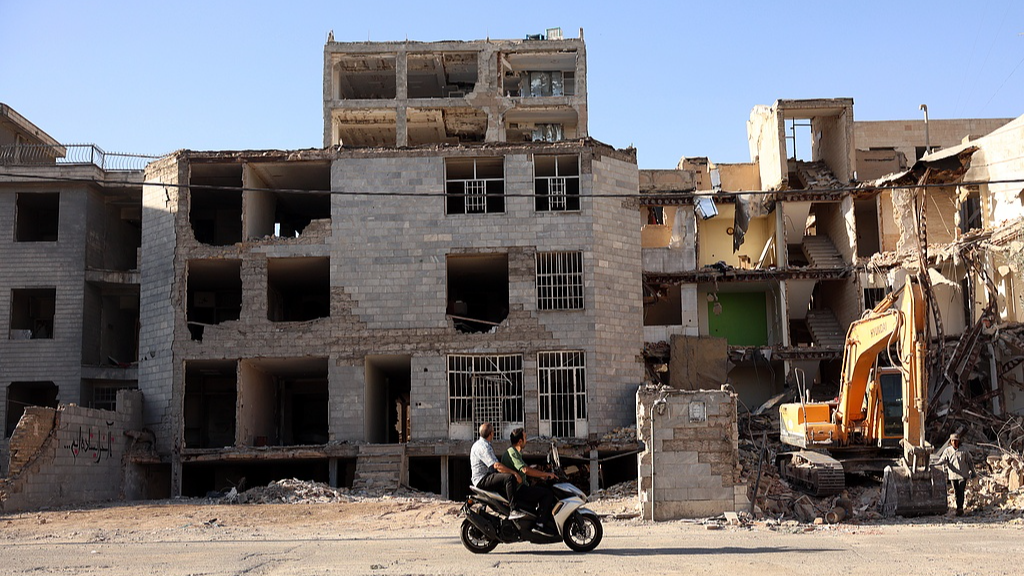
Iranians ride a motorbike past a residential building, destroyed by previous US-Israeli airstrikes, in Tehran, Iran, June 2, 2026. /VCG
Discussions on nuclear program
Iran and the US said last week they had reached a tentative initial agreement to halt the war. But the two sides have yet to sign off on the deal.
Iranian media reported that Tehran has not communicated with Washington for several days, but US President Donald Trump said negotiations have not stopped.
"The conversations between us have been going on continuously, including four days ago, three days ago, two days ago, one day ago, and today," he said in a social media post.
US Secretary of State Marco Rubio said on Tuesday a peace deal between Washington and Tehran is within reach, and Iran has agreed to negotiate aspects of its nuclear program during a hearing before the US Senate Foreign Relations Committee.
"Now we are in talks," Rubio said. "There is the prospect before us, which could happen today, it could happen tomorrow, it could happen next week, that for the first time, certainly in my memory, they have agreed to negotiate aspects of their nuclear program."
Rubio repeated Trump's position that Iran would not receive sanctions relief in exchange for reopening the Strait of Hormuz.
Israel keeps up strikes in Lebanon
A new round of ambassador-level talks between Israel and Lebanon is underway at the US State Department in Washington, DC, as clashes between Israel and Lebanese militant group Hezbollah continue.
The meeting lasted all day on Tuesday and is set to continue on Wednesday, according to CNN, citing an Israeli official.
US Deputy National Security Adviser Mike Needham and State Department counselor Dan Holler reportedly led the talks on the US side on Tuesday.
A senior Hezbollah official said on the same day that the group will not accept any partial ceasefire with Israel, refusing a reported US-backed proposal demanding that Hezbollah halt attacks against northern Israel in exchange for Israel sparing Beirut's southern suburbs.
Israel and Hezbollah continued trading attacks overnight into Tuesday. Lebanon's Public Health Emergency Operations Center said on Tuesday that Israeli attacks on Lebanon since March 2 have killed 3,468 people and injured 10,577 others.
(With input from agencies)