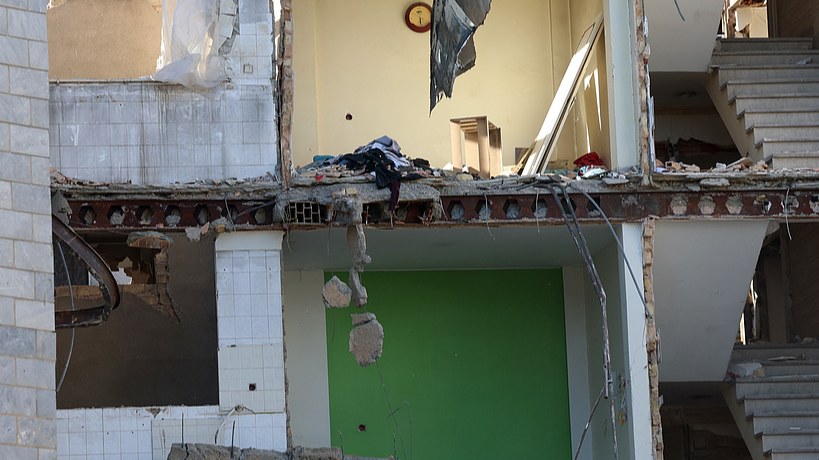
A residential building destroyed by previous US-Israeli airstrikes in Tehran, Iran, June 2, 2026. /VCG
An initial peace deal between the United States and Iran is still hard to see though President Donald Trump hinted it may happen as early as the upcoming weekend while Iranian Foreign Minister Abbas Araghchi said that "no tangible progress" has been made in negotiations to end the war.
Trump said on Wednesday that talks with Iran are going "very well" and Tehran has agreed to allow US personnel, in coordination with Iranian authorities, to enter Iran and recover buried nuclear material once the war ends.
The US president also suggested that it is possible an interim deal could be reached "over the weekend" as the ongoing talks are advancing.
"The negotiation itself has gone very well – actually, very well – even if it happens, and it might not happen, but if it happens, it could happen like over the weekend," Trump said.
Araghchi told Lebanese broadcaster Al Mayadeen on Wednesday that talks had not been cut off but no progress had been made.
"Communications with the Americans have not been cut off, and messages have been exchanged regarding the need to stop aggression against Beirut, but no tangible progress has been made in the negotiation process," the Tasnim News Agency quoted Araghchi as saying.
Also on Wednesday, Israel and Lebanon agreed in their latest round of high-level talks to implement a ceasefire to end hostilities. The ceasefire between Israel and Lebanon is thought as a must in any ceasefire between US and Iran.
Araghchi said Iran's armed forces are prepared to respond and remain ready to strike Israel if Beirut comes under attack.
Separately, the Republican-led US House of Representatives approved a resolution on Wednesday to block Trump from continuing the war against Iran.
Along with the uncertainty surrounding a peace deal, recent strikes in the Gulf region are raising concerns.
Iran's Islamic Revolution Guard Corps (IRGC) said on Wednesday its navy targeted a US destroyer in the Gulf of Oman for its violations of the regulations of the Strait of Hormuz and malicious acts against Iranian commercial vessels in the Gulf of Oman.
The IRGC said its navy is closely watching US and Israeli "enemies" and will respond instantly to any hostile move.
The US Central Command later denied the claim on social media platform X, saying US military assets at sea continue to operate "safely and unimpeded."
Separately, the IRGC denied firing any missile or drone at a passenger terminal at Kuwait International Airport, saying the damage to the terminal was caused by a malfunctioning US Patriot missile system, according to Sepah News.
The US military said that was not accurate, and that Iranian drones targeted the airport deliberately.
The attacks on Kuwait and in the Strait of Hormuz are the latest to test a shaky ceasefire between the US, Israel and Iran, sending oil prices up nearly 2%.
The rising energy prices tied to the conflict in the Middle East were the primary driver of inflationary pressures, with spillovers into shipping, packaging, groceries and fertilizer, according to the Federal Reserve.
(With input from agencies)