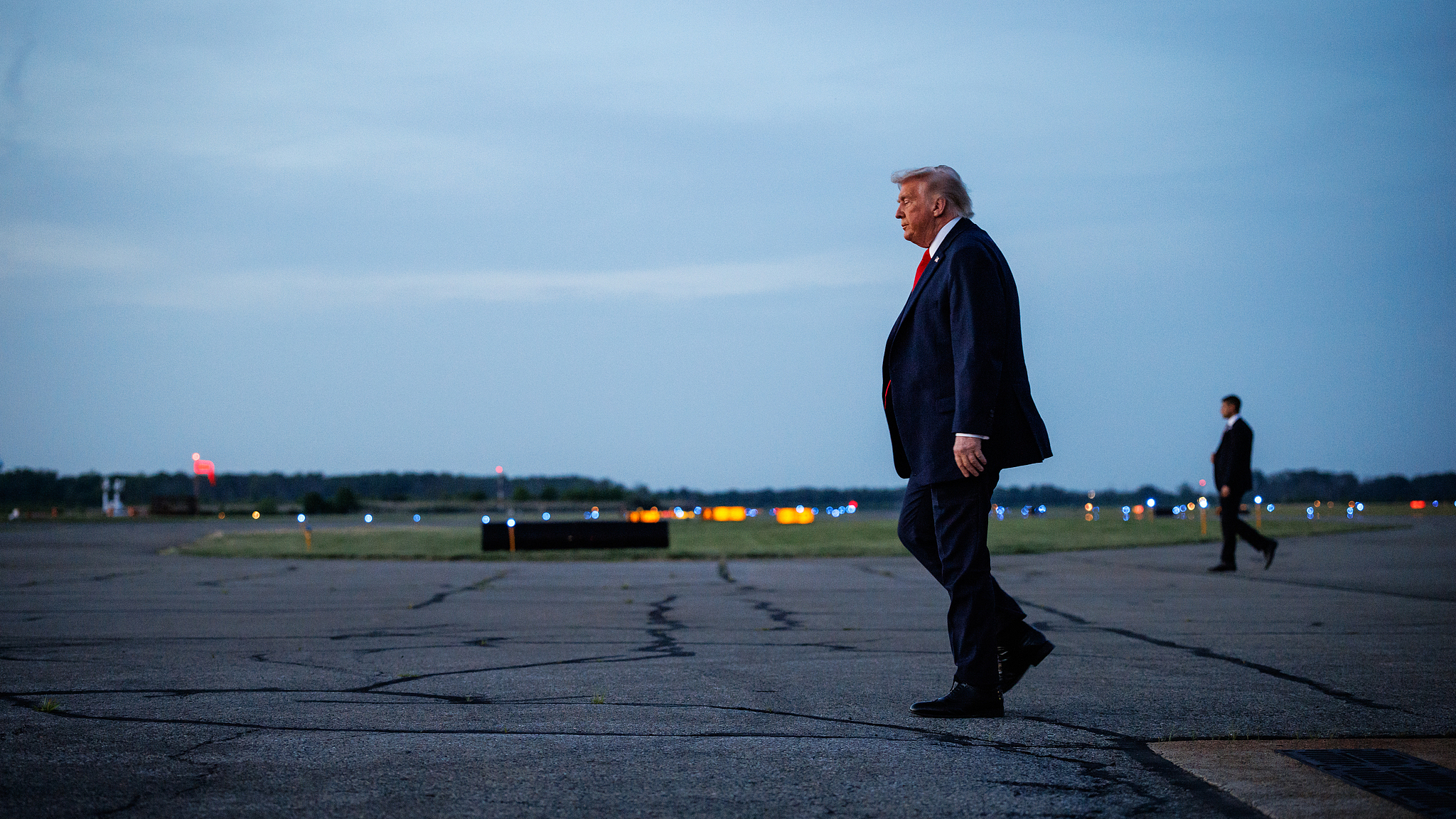
US President Donald Trump walks towards Marine One after arriving at Morristown Airport in Air Force One in Morristown, New Jersey, the United States on June 5, 2026. /VCG
One hundred days after the US and Israel launched a military campaign against Iran, a conflict initially presented by US President Donald Trump as a show of strength has become a growing political liability at home, fueling public unease, exposing Republican divisions and complicating the path toward this year's midterm elections.
As the conflict entered its fourth month, Americans increasingly began to view it through the lens of rising living costs rather than national security.
A Reuters/Ipsos poll conducted in May found that two out of three Americans believed Trump had failed to clearly explain the goals of the war, while concerns over gasoline prices and inflation weighed on public sentiment. A CNBC analysis estimates that American families have paid nearly $450 more on average during the Iran war.
The war's growing price tag has also become a focal point in Washington. Pentagon officials told Congress in May that US operations had already cost about $29 billion, though some independent analysts say the true figure, including equipment replacement and other indirect expenses, could be far higher. The official sum alone exceeds the annual budgets of several federal agencies and is roughly equivalent to what the US spends each year on Pell Grants for low-income college students.
Trump's standing with voters in the meantime has sunk sharply. According to The Economist's poll tracker based on YouGov surveys, his net approval rating fell to minus 25 percentage points amid the Iran war and persistent inflation, the lowest level recorded for any president since the tracker began in 2009.
Republican revolts
The backlash has been especially pronounced among Democrats. But cracks have also appeared inside Trump's own party, where some lawmakers have warned that an open-ended conflict risks undermining the "America First" message that helped return Trump to power. Polls showed that even among Republicans, support for prolonged military involvement was far from unanimous.
The political consequences have become increasingly visible in Congress.
Democrats have portrayed the conflict as a costly distraction at a time when voters are more concerned about prices and economic uncertainty. They have sought to revive congressional oversight by introducing measures aimed at limiting the president's war powers.
Those efforts gained support from several Republicans. This week, four House Republicans joined Democrats to back a resolution seeking to curb Trump's authority over the war, handing the White House a rare bipartisan rebuke.
Kentucky Representative Thomas Massie, one of the Republicans critical of the administration's approach, has argued that military action without congressional approval "is not America First." Senator Rand Paul has also repeatedly questioned the wisdom of deeper US involvement, warning against what he described as another prolonged conflict in the Middle East.
Midterm challenges
The timing poses a challenge for Republicans heading into this year's midterm elections.
Historically, periods of economic anxiety have weighed on the party occupying the White House. Democratic strategists have sought to capitalize on that pattern by arguing that the administration's focus abroad has diverted attention from problems facing ordinary Americans, while Republicans facing competitive races have grown increasingly uneasy as higher oil prices feed into gasoline costs and inflation, issues that voters consistently rank above foreign policy.
Ashley Hinson, the likely Republican nominee in Iowa's Senate race, admitted that the war will become a "political liability" if it stretches on for weeks longer.
That concern is being echoed by Trump himself, who appeared to acknowledge the political stakes this week, telling supporters during a campaign event in Wisconsin that he wanted the conflict brought to an end quickly.
No longer a political taboo
The strains have also prompted a more uncomfortable debate in Washington over Israel's role in the conflict.
While support for Israel remains strong among much of the Republican establishment, some lawmakers and influential voices on the right, including former Trump allies like broadcaster Tucker Carlson and ex-congresswoman Marjorie Taylor Greene, have questioned whether Israeli Prime Minister Benjamin Netanyahu had drawn the United States into another costly Middle East war that ran counter to Trump's "America First" agenda.
Those anxieties reflect a broader shift in Washington, where criticism of Israel has become less politically taboo than in previous years.
Democrats have become increasingly divided over US support for Israel since the Gaza war, and a younger generation of voters has shown growing skepticism toward the longtime ally. The Iran conflict has amplified those trends, creating unusual overlap between progressive Democrats and the isolationist wing of the Republican Party.
That convergence has left the White House navigating a political environment that is markedly less united behind Israel than at any time in recent decades. Even some traditional supporters of the alliance have begun asking whether US interests and Israeli objectives remain as closely aligned as they once appeared.
For Trump, who campaigned on promises to avoid foreign entanglements, the debate has exposed a delicate balancing act. Pressing ahead risks alienating voters who embraced his "America First" message, while creating distance between Washington and Israel could trigger resistance from more hawkish Republicans and longstanding allies of Israel.