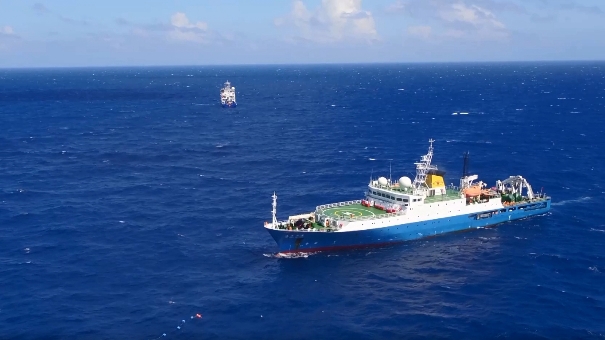
China's geological research vessel Haiyang Dizhi-6. /CMG
Chinese research vessel Haiyang Dizhi-6 (Ocean Geology-6) recently completed its 16th deep-sea geological survey expedition, achieving multiple results in the survey of deep-sea geological environments as well as the development and application of key marine exploration technologies, the China Geological Survey (CGS) of the Ministry of Natural Resources said on Monday.
During the expedition, the scientific team employed a variety of geological survey methods to collect valuable first-hand data and samples, including polymetallic nodules, seabed rocks and bottom-layer seawater.
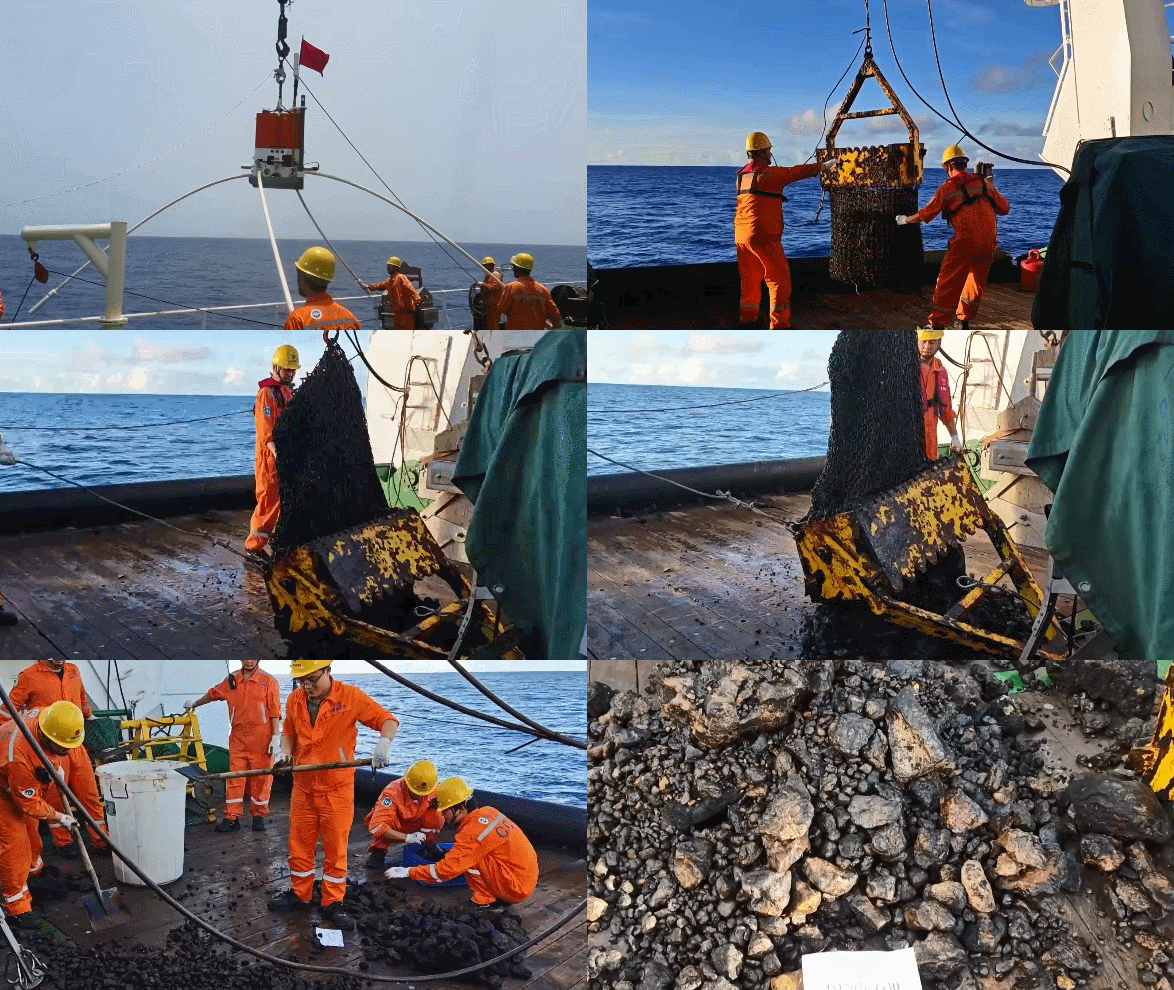
Samples collected by the expedition team. /CMG
"We have discovered high-abundance polymetallic nodules and successfully collected about 90 kilograms of basalt samples," said Qin Pengbo, deputy director of the Institute of Applied Marine Geology of the CGS's Guangzhou Marine Geological Survey. "These samples provide crucial support in studying the characteristics of the mantle source region in the sea area and the Earth's deep evolutionary processes."
The expedition also made breakthroughs in the development and application of technical equipment. The team completed sea trials and acceptance testing of China's independently developed – also the world's first – full-ocean-depth, 10,000-meter-class electromagnetic acquisition station and offshore operational system. High-quality data was obtained from an abyssal rift zone at a depth of 7,737 meters in the Western Pacific. Results demonstrated that all performance indicators fully met the required standards.
The successful sea trial marks a major advancement in China's deep-sea electromagnetic measurement capabilities, which will provide strong support for scientific research in the hadal zone and site selection for international ocean drilling.