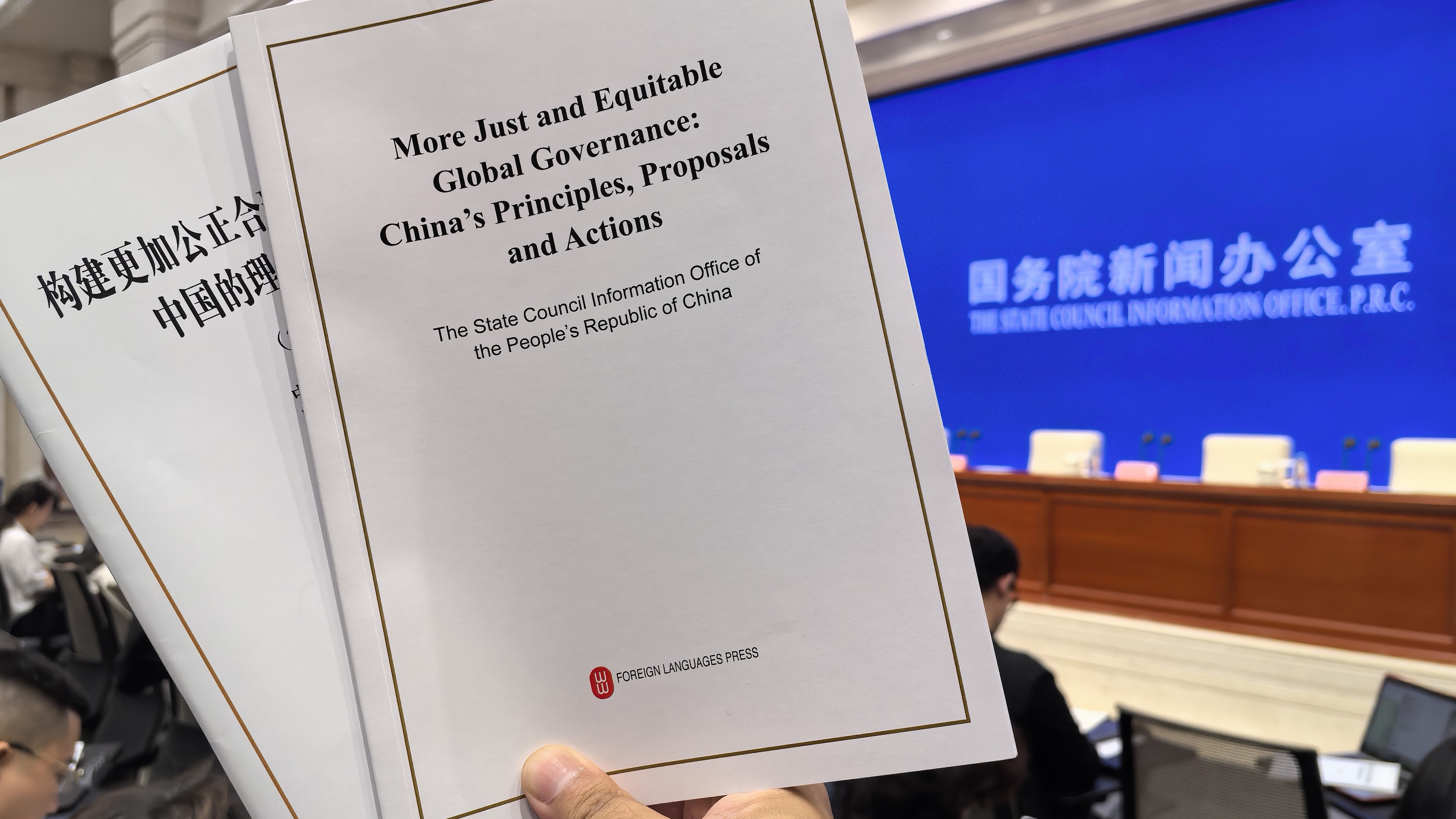
The white paper titled "More Just and Equitable Global Governance: China's Principles, Proposals and Actions." /CGTN
China's State Council Information Office released a white paper titled "More Just and Equitable Global Governance: China's Principles, Proposals and Actions" on Wednesday morning.
The white paper was published to introduce China's principles, proposals and actions on global governance, foster broader consensus within the international community, ensure more effective responses to global challenges, and build a more just and equitable global governance system.
Global governance is a common endeavor that bears on the well-being of all humanity, and building a just and equitable global governance system is a shared vision long pursued by people from across the world, the white paper said, adding that China has always been an active participant in, contributor to and builder of global governance.
In the new era, President Xi Jinping put forward the vision of building a community with a shared future for humanity. In promoting a global governance system characterized by extensive consultation and joint contribution for shared benefit, he has called for true multilateralism to foster an equal and orderly multipolar world and a universally beneficial and inclusive economic globalization, according to the white paper.
In 2025, Xi proposed the Global Governance Initiative (GGI), which is designed to offer a Chinese solution to two pressing questions of the era: what kind of global governance system should be established, and how can global governance be reformed and improved?
Upon its introduction, the GGI swiftly gained support from nearly 160 countries and international organizations, with over 60 countries joining the Group of Friends of Global Governance. The international community believes that the GGI sends a clear signal: uphold multilateralism, unite forces and pursue a fair future, the white paper said.
The GGI aligns with the growing trend towards greater democracy in international relations and bolsters international confidence in practicing multilateralism. It offers a clear and feasible roadmap for improving global governance, bringing valuable stability and positive energy to a turbulent world, according to the white paper.
China has proposed the GGI to expedite the building of a more just and equitable global governance system. Resolutely upholding the UN's authority and status is fundamental to the effective implementation of this initiative, the white paper said.
Success will also hinge on major countries bearing a sense of responsibility, and on all nations uniting and cooperating to address deficits in peace and development. All countries should firmly uphold the international system with the UN at its core, safeguard the international order based on international law, and uphold the basic norms governing international relations underpinned by the purposes and principles of the UN Charter, instead of reinventing the wheel, according to the white paper.
How GGI responds to challenges of times
Noting that the world today faces severe and complex challenges with the law of the jungle seriously undermining the international rule of law, the white paper said the GGI responds to challenges of the times.
Growing challenges call for more effective governance and efforts to shore up the governance system and to enable more Global South voices to be heard, the report said.
According to the white paper, the GGI is built on five core concepts: sovereign equality, the international rule of law, multilateralism, a people-centered approach and real actions.
Sovereign equality is enshrined in the UN Charter as the first among all principles and the supreme norm regulating state-to-state relations. Countries, whether large or small, strong or weak, developed or developing, are equal members of the international community. Every nation's sovereignty and dignity must be respected, and all countries are equally entitled to participate in, deliberate on and benefit from global governance, the white paper said.
The international rule of law is the fundamental safeguard for global governance. Only a global governance system that is grounded in the rule of law can provide all countries with a fair and just environment for development, achieve a balance between rights and obligations, and make international order more just and equitable, according to the white paper.
Multilateralism emerged for the cause of peace and development, and multilateral mechanisms are vital for addressing global issues. No country can achieve development outside the global governance system, nor can it secure a future without participating in international cooperation. It is not a matter of whether we choose it or not, multilateralism is the only viable path forward, the white paper said.
People's wellbeing is a core concern of global governance. The people of every country across the world are the essential participants and direct beneficiaries of global governance. Only by serving public interests, boosting public confidence and meeting public expectations can the global governance system win extensive support and function effectively, it said.
Global governance finds its source of vitality in practice, hinges on action, and is verified by its effectiveness. A vision is realized only through concrete action. It falls on the international community to turn this vision into reality – setting common goals, embracing a problem-oriented approach and acting in concert, it added.
China's contribution highlighted
The white paper highlighted China's role in actively advancing efforts for building a more just and equitable global governance system.
As a major country with the best peace and security record, China has enshrined in its Constitution a commitment to peaceful development, the white paper noted.
China champions the vision of common, comprehensive, cooperative and sustainable security, and has put forward the Global Security Initiative and acted on its principles, contributing to lasting world peace and stability, it said.
As the largest developing country, China has always pursued its own growth in the context of humanity's shared development and upheld openness, win-win cooperation, inclusiveness and shared benefits, according to the white paper.
Through Chinese modernization, the country has provided the world with new opportunities and boosted the global drive for modernization, it added.
China has also delivered effective results in implementing the Global Development Initiative. To accelerate the realization of the UN 2030 Agenda for Sustainable Development, China helps steer global development towards a new stage of balanced, coordinated and inclusive growth that delivers more robust, greener and healthier global development, said the white paper.
Noting that China will always be a member of the Global South, the white paper said China has firmly safeguarded the common interests of the Global South in international affairs, and led the Global South in building strength through joint efforts.
China has proposed the Global Civilization Initiative and promoted its implementation, championing the common values of humanity and fostering deeper exchanges and understanding among different peoples, and wider interactions and greater integration of diverse cultures in a joint effort to advance the development and progress of human civilization, it added.
China's ideas, actions increasingly resonate with intl. community
China's ideas and actions increasingly resonate with the international community, and the reason behind this lies in the fact that China understands how to meet the call of the day and shape the trends of our times, according to the white paper.
China has adopted a series of initiatives to confront various global risks and challenges, continuously enriching the practice of global governance.
Providing systematic solutions, China's four major global initiatives – on development, security, civilization and governance – run in parallel with a focus on different domains and form a complete action framework that promotes prosperity through development, ensures stability through security, enhances mutual trust through exchanges between civilizations, and seeks justice through governance, the white paper noted.
By proposing the GGI and a series of new ideas and approaches, China has deepened its understanding of the laws governing the development of human society, broken free from the outdated "core-periphery" framework of the old international order, transcended the flawed logic that "might makes right," abandoned the zero-sum mentality of "winner takes all" and promoted the advancement of human political civilization, it added.
Joint efforts urged
The white paper also calls on all parties to work together to build a more just and equitable global governance system to advance the GGI.
China advocates that countries unite and cooperate, take concrete action, and transform the vision and blueprint of the GGI into a roadmap and timeline for joint action, it added.
All countries must work hard and make unremitting efforts to reform and improve global governance – no one should look on, hesitate or slack off, the white paper read.
Looking ahead, as the international community gains a deeper understanding of this initiative and participates in it, the goal of building a more just and equitable global governance system will gradually become a reality, it said.
(With input from Xinhua)