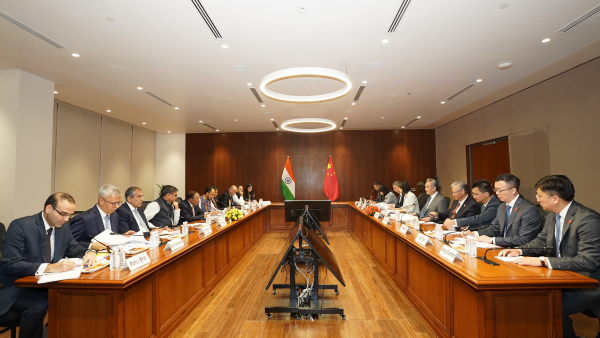
Wang Yi, a member of the Political Bureau of the Communist Party of China Central Committee and director of the Office of the Central Commission for Foreign Affairs, talks with India's National Security Advisor Ajit Doval, in New Delhi, India, June 22, 2026. /Chinese Foreign Ministry
Chinese Foreign Minister Wang Yi reaffirmed that China and India should be partners rather than competitors during a meeting with India's National Security Advisor Ajit Doval in New Delhi.
Wang, also a member of the Political Bureau of the Communist Party of China Central Committee and director of the Office of the Central Commission for Foreign Affairs, met with Doval on Monday while attending the 16th Meeting of BRICS National Security Advisors and High Representatives on National Security.
Wang noted that the leaders of the two countries agreed that China and India are partners instead of rivals, thus forming the most important strategic consensus between the two sides, providing an important impetus and strategic guarantee for the healthy and stable development of China-India relations.
Wang said that as the two economies with the largest populations, China and India should advance cooperation from a global perspective. He highlighted the broader rise of the Global South, saying BRICS should play a stronger role in promoting multipolarity, safeguarding the interests of developing countries, and advancing a more just and reasonable global order. China, he added, supports India in fulfilling its role as BRICS chair and in promoting the development and growth of the BRICS mechanism.
Wang also urged both sides to respect each other's core interests, properly manage sensitive issues, and place the China-India border issue in an appropriate position, so that it doesn't affect the overall situation of bilateral relations. He called for continued efforts to implement consensus reached by both leaders, expand dialogue mechanisms, and deepen cooperation in trade, finance, law enforcement and media. He also emphasized the importance of strengthening public and societal understanding to build a stronger foundation for bilateral ties.
Doval, in response, said India is willing to approach relations with China from a strategic and forward-looking perspective, implement leadership consensus, and manage differences constructively to achieve mutually beneficial outcomes.
He also reiterated that India, as one of the first countries to recognize the People's Republic of China, remains consistent in its position regarding the Taiwan question. He expressed the Indian side's willingness to support each other's core concerns with China, jointly safeguard multilateralism, and protect the legitimate rights and interests of developing countries.
Both sides also exchanged views on international and regional issues of mutual concern.