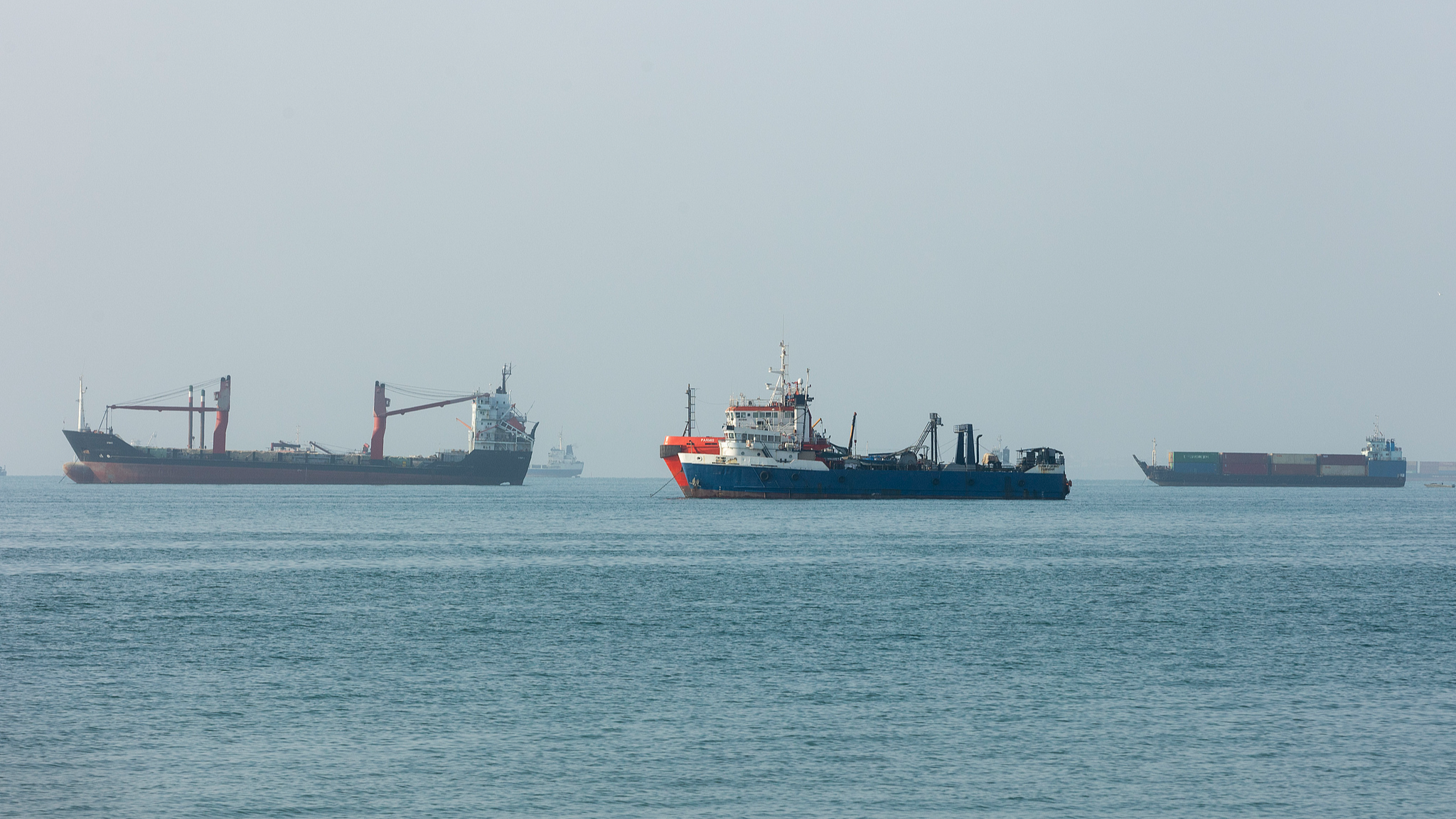
File photo of vessels off the coast in the Persian Gulf in Bandar Abbas, Iran. /VCG
The International Maritime Organization (IMO) on Wednesday released operational details of a large-scale evacuation plan for seafarers stranded around the Strait of Hormuz, while Washington and Tehran signaled that technical-level negotiations would continue later this month.
According to the IMO, more than 11,000 seafarers aboard roughly 500 to 600 vessels remain stranded in the Gulf region. Under the plan, vessels are required to remain in their current positions and await instructions rather than moving independently toward the strait or designated waiting areas. The organization said the measure is intended to prevent congestion and reduce risks associated with mines and degraded navigation conditions.
The evacuation scheme establishes two temporary transit routes through the Strait of Hormuz. One runs through Iranian waters, while the other passes through waters coordinated by Oman and the United States. The IMO said traffic management and navigational coordination would be handled by coastal states, while the UN agency oversees the overall framework and phased implementation.
Some vessels have already begun transiting under the arrangement. The IMO said the operation follows the US-Iran memorandum of understanding reached earlier this month and is aimed at restoring maritime security and gradually returning traffic to pre-conflict levels.
Meanwhile, US Energy Secretary Chris Wright said on Wednesday that crude oil flows through the Strait of Hormuz had largely returned to normal levels. About 72 vessels carrying roughly 20 million barrels of crude oil passed through the waterway over the previous 24 hours, he said. Wright added that some ships were still avoiding traditional shipping lanes because of concerns over mines and were instead using alternative routes with military escorts.
Oil markets appeared to respond to easing supply concerns. US crude futures fell below $70 per barrel on Wednesday for the first time since the outbreak of the conflict, as more stranded tankers began leaving the region and shipping activity gradually resumed.
On the diplomatic front, US Secretary of State Marco Rubio said technical talks between the United States and Iran are expected to resume in Switzerland around June 29 or 30. Rubio said expert-level working groups would discuss issues including nuclear energy and sanctions relief. He also reiterated that inspectors from the International Atomic Energy Agency (IAEA) should be allowed to resume work in Iran as soon as possible.
International Atomic Energy Agency (IAEA) Director General Rafael Grossi told reporters on Wednesday that IAEA will carry out inspections in Iran under the country's preliminary peace agreement with the US.
"The inspections will indeed take place... We will be working on the modalities - dates, procedures, places - very soon."
The agreement signed last week said "explicitly" that the dilution of Iran's highly enriched uranium would be carried out under IAEA supervision, he added.
However, Iranian Deputy Foreign Minister for Legal and International Affairs Kazem Gharibabadi said access to its damaged nuclear facilities and nuclear material would only be addressed within the framework of a final deal with the US.
Iran has no plan to provide IAEA with access to its nuclear facilities bombed by the United States and Israel, and no meeting was held between Iran's negotiating team and IAEA Director General Rafael Grossi in Switzerland in recent days, despite Grossi's request.
(With input from agencies)