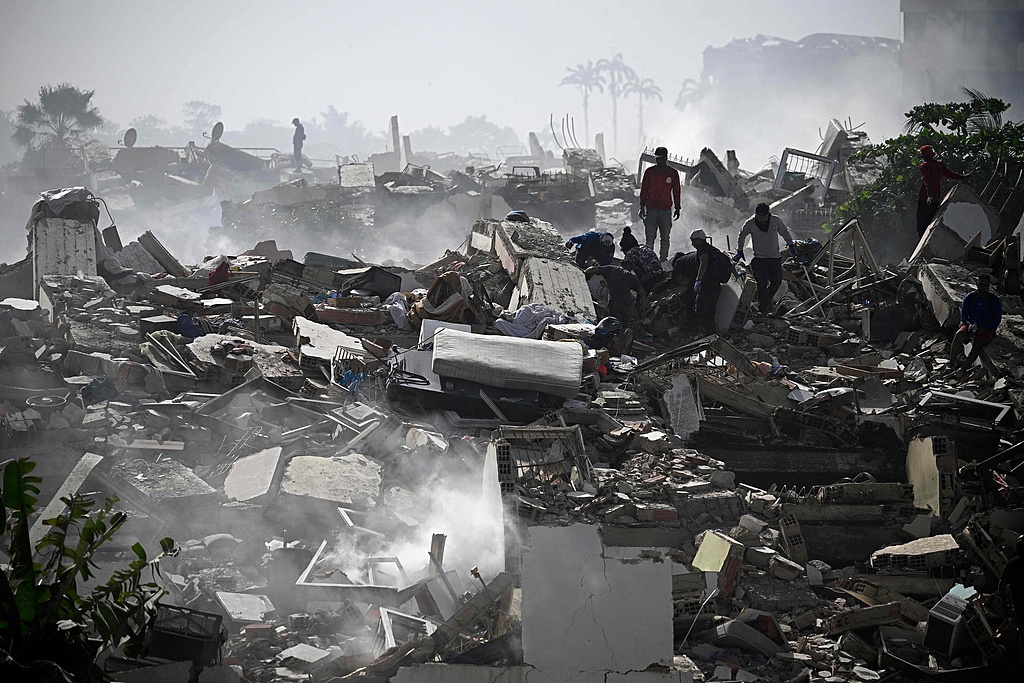
Volunteers search for survivors in a collapsed building following twin earthquakes in Caraballeda, La Guaira state, Venezuela, June 25, 2026. /CFP
Editor's note: Imran Khalid, a special commentator for CGTN, is a freelance columnist on international affairs. The article reflects the author's opinions and not necessarily the views of CGTN.
On the evening of June 24, 2026, twin earthquakes measuring 7.2 and 7.5 struck northern Venezuela just 39 seconds apart, the most powerful seismic sequence in over 125 years of the country's history.
The US Geological Survey (USGS) classified the sequence as a rare "doublet," two near-identical quakes capable of causing far greater damage than a single event. By Thursday evening, Health Minister Carlos Alvarado confirmed approximately 235 dead and at least 4,300 injured, and at least 200 people were reported trapped, with about 250 buildings collapsed. A preliminary USGS disaster model gave a 40% probability that the death toll could fall between 10,000 and 100,000. The disaster points to a wider lesson: Vulnerability to disaster is shaped as much by institutions as by geology.
The humanitarian situation is acute and still unfolding. Search-and-rescue teams are working through rubble across Caracas and La Guaira, where acting President Delcy Rodriguez declared La Guaira a "disaster zone" after more than 100 buildings collapsed there. At least 138 aftershocks have followed, compounding danger for rescuers. Hospitals are absorbing injuries and trauma cases. Médecins Sans Frontières reported large numbers sheltering outdoors, unable to return home. Direct Relief is mobilizing wound care, surgical supplies, and antibiotics. Families have been evacuated to reception centers, and shelter, water and sanitation are expected to become urgent priorities ahead.
Infrastructure damage is compounding every dimension of the response. Power, telecommunications, and transport have been disrupted across central and western Venezuela. The Simon Bolivar International Airport sustained structural damage (its runway cracked), severing a critical artery for incoming aid. Roads remain blocked, slowing rescue crews and medical teams.
Restoring these corridors is not peripheral to the humanitarian response. It is a precondition for it. With no centralized official registry, civil society groups have built independent online platforms and WhatsApp networks to trace missing loved ones, an improvised response that underlines community ingenuity and the fragility of formal systems under pressure.
The structural dimension of this catastrophe cannot be separated from Venezuela's broader context. It's reported that Caracas sits in a sedimentary basin that amplifies seismic waves, and around 80% of Venezuela's population lives in earthquake-prone areas, much in informal housing not designed for strong tremors. Also, much of the urban building materials consist of unreinforced masonry prone to collapse. The European Commission had identified 7.9 million Venezuelans in need of assistance before this disaster, with 56% in extreme poverty.
Venezuela is not an isolated case. The United Nations Office for Disaster Risk Reduction documents that disaster mortality in least developed countries runs 2.5 times higher than the global average. The earthquake did not create this fragility. It exposed structural underinvestment that is neither unique nor inevitable.
The international response is broad and widening. The UN activated Urban Search and Rescue Teams, with chief Tom Fletcher confirming teams were being dispatched globally. China, with longstanding ties to Venezuela and a track record of relief including after the 2016 Ecuador earthquake, confirmed readiness to help. Brazil and Caribbean nations have offered aid. Teams are arriving from France, Spain, Italy, Switzerland, Mexico, El Salvador, Qatar and the Dominican Republic. No country weathers a catastrophe of this magnitude alone.
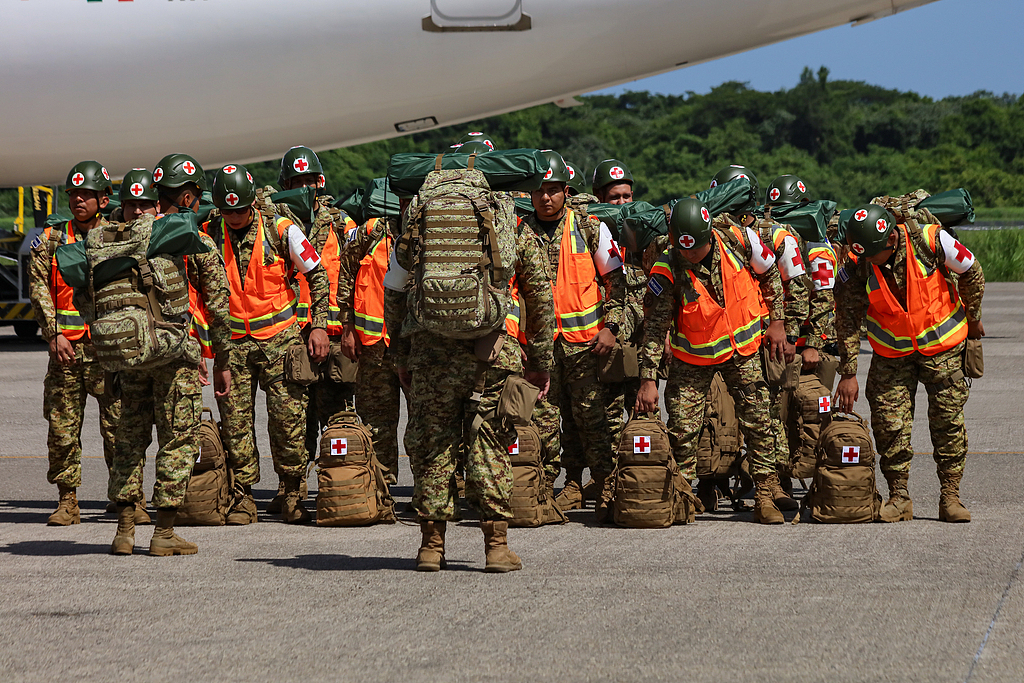
Soldiers ready to board the plane during the departure of the Salvadoran contingent of humanitarian aid to Venezuela to provide support after the earthquakes, at the Comalapa Air Base, in La Paz, El Salvador, June 25, 2026. /CFP
Solidarity and coordination, however, are not the same thing. The 2023 Türkiye-Syria earthquakes, also a doublet, killed more than 56,000 people and exposed recurring failures: poor coordination among arriving teams, bottlenecks in transport corridors, gaps between foreign rescue capabilities and local needs and slow provision of shelter. A Red Cross report found local organizations consistently sidelined in response architecture. In Venezuela, where civil society has long filled gaps left by the state (now demonstrably so, through informal missing-persons networks), their inclusion in relief coordination is not optional. It is the difference between response that reaches people and response that stalls at the perimeter.
What Venezuela's tragedy makes clear is that disaster response cannot be improvised. It must be built into the permanent architecture of international cooperation. The Sendai Framework for Disaster Risk Reduction, endorsed by the UN General Assembly and running to 2030, sets binding targets for this: reducing mortality, cutting economic losses and enhancing cooperation with developing nations through the exchange of experience, expertise and best practices. Countries that have invested in disaster preparedness demonstrate what sustained knowledge transfer looks like. For example, China, through South-South cooperation, has helped build seismic monitoring networks in countries such as Nepal, Laos, and Kenya. This is the infrastructure of resilience the multilateral community has committed to deliver more equitably.
Reconstruction must meet modern seismic standards. Medical and supply corridors must be restored and made permanently resilient. The emergency coordination improvised today must be institutionalized before the next disaster. International engagement with Venezuelan recovery must outlast the news cycle.
The earth does not send warnings. Preparedness is a choice. The difference between the two is counted in lives.
(If you want to contribute and have specific expertise, please contact us at opinions@cgtn.com. Follow @thouse_opinions on X to discover the latest commentaries in the CGTN Opinion Section.)