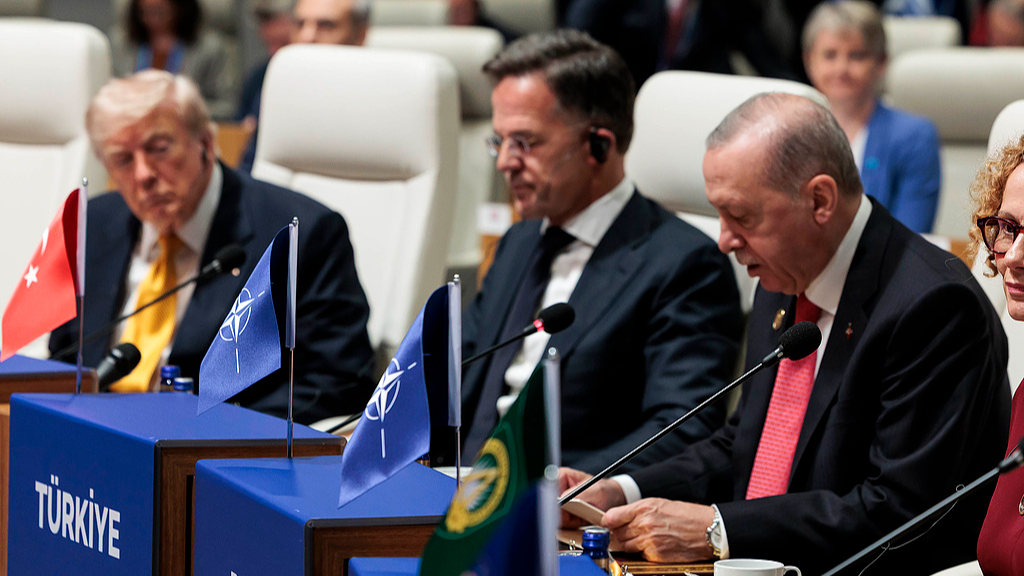
US President Donald Trump (L), NATO Secretary General Mark Rutte (M) and Turkish President Recep Tayyip Erdogan (R) during a round table meeting of the North Atlantic Council during the NATO summit in Ankara, Türkiye, July 8, 2026.. /VCG
The two-day NATO summit concluded on Wednesday with alliance leaders seeking to present a united front, but analysts said the meeting failed to resolve deep-rooted disagreements among members over defense spending, burden-sharing, the Ukraine conflict and approaches to regional security issues.
The summit focused on three major themes: strengthening military support for Ukraine, enhancing defense cooperation and reaffirming collective defense commitments. Yet these longstanding issues remained difficult to reconcile, highlighting widening differences within the alliance.
From the opening day of the summit on July 7, US President Donald Trump repeatedly made remarks that put NATO allies in an uncomfortable position.
On the sidelines of the summit, Trump reiterated that he was "very disappointed" with NATO, accusing some members of failing to support key US military objectives. During his meeting with Turkish President Recep Tayyip Erdogan, Trump said that the US may take all troops out of Europe.
Trump also renewed his call for US control over Greenland, saying the Arctic island should belong to the United States rather than Denmark. The remarks prompted a firm response from Danish Prime Minister Mette Frederiksen, who said Denmark's position remained unchanged: "Greenland is not for sale." She added that Denmark was prepared to defend every inch of NATO territory, including Danish territory.
The US president also escalated pressure on Spain over defense spending on Wednesday, calling it a "terrible partner" within NATO and saying he had instructed Treasury Secretary Scott Bessent to halt commerce with Spain over its refusal to commit to NATO's new defence spending target of 5% of GDP.
Washington has long criticized NATO members for failing to meet its defense spending expectations. At last year's NATO summit in The Hague, Spain rejected the alliance's target of increasing defense spending to 5% of GDP, saying instead that it would raise spending to 2.1%.
In March, Spain also refused to authorize US military operations from two bases on Spanish territory in connection with strikes against Iran, further underscoring differences between Madrid and Washington over security policy.
The Ukraine crisis also revealed growing divergences between the United States and its European allies.
Before the summit, Trump held separate calls with Russian President Vladimir Putin and Ukrainian President Volodymyr Zelenskyy to discuss possible ways to end the conflict. Analysts said Washington appeared increasingly eager to reduce its involvement in the crisis and encourage European countries to shoulder greater responsibility for regional security.
European nations, however, have continued to advocate a tougher stance toward Russia, supporting Ukraine through weapons deliveries, financial assistance and military training as part of a long-term strategy to maintain pressure on Moscow.
At the summit, NATO members finalized a 70-billion-euro framework for long-term military assistance to Ukraine. Under the arrangement, European countries and Canada will provide the funding, while the United States will focus on arms supplies, intelligence support and maintaining deterrence capabilities.
Despite efforts to emphasize alliance unity, analysts said the summit largely contained existing disputes rather than resolved them
"The summit did not remove the factions within NATO. Instead, it compartmentalized them," said Ali Oguz Dirioz, an associate professor of international relations at Ankara's TOBB University.
"Divisions remain, but member states are learning to live with those differences," he said.
Dirioz said one of the key trends emerging from the summit was Europe's gradual push toward greater strategic autonomy within NATO, driven partly by Washington's longstanding demands for more equal burden-sharing.
"European countries within NATO are likely to evolve toward a more autonomous defense posture because of Washington's persistent criticism over burden-sharing," he said.
However, Oytun Orhan, a senior researcher at the Ankara-based Center for Middle Eastern Studies, said that while there was a clear political desire in Europe to become less dependent on the United States, it remained uncertain whether Europe could achieve greater autonomy without affecting its military effectiveness.
"The political will exists, but the outcome is still unclear," he said.
Cui Hongjian, director of the Center for European Union and Regional Development Studies at Beijing Foreign Studies University, said NATO's handling of issues including Ukraine, Greenland and Middle East conflicts had exposed growing differences between the United States and Europe.
"Within the NATO framework, what is increasingly emerging is not a shared approach based on collective defense and acting in unity, but rather significant divergences in security considerations and strategic objectives between the two sides," Cui said.
He said the relationship between Washington and European allies was shifting from a period of relatively high mutual trust toward one characterized by growing suspicion, caution and strategic competition.
"This trend suggests that NATO's future evolution may continue to be shaped by declining mutual trust between Europe and the United States, with the alliance increasingly serving the respective strategic goals of both sides," Cui added.
(With input from agencies)