
By continuing to browse our site you agree to our use of cookies, revised Privacy Policy and Terms of Use. You can change your cookie settings through your browser.
How China is cooling cities for a hotter future

Share







Copied
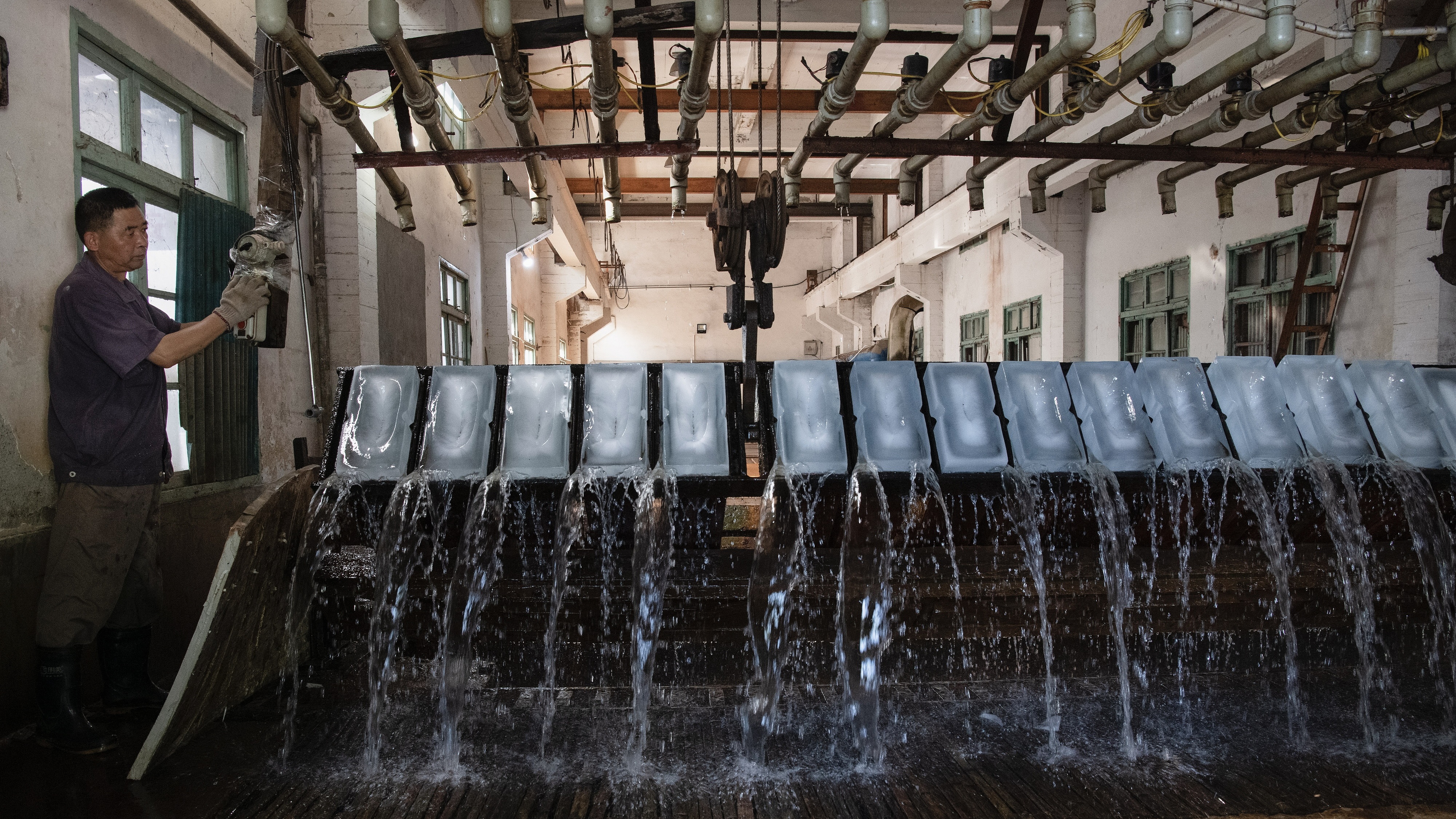
Workers produce large blocks of ice in the ice production workshop of Xincheng Cold Storage Co. in Jinhua, Zhejiang Province, China, July 5, 2024. /VCG
As another summer of extreme heat pushes air-conditioning demand higher across China, cities are facing a growing challenge: how to stay cool without placing ever greater pressure on the power grid.
Instead of simply installing more air conditioners, many Chinese cities are beginning to rethink how cooling is produced and delivered. Through centralized cooling networks, cleaner energy sources, and intelligent energy management systems, they are transforming cooling from something provided by individual buildings into shared urban infrastructure.
The shift reflects a broader effort to build greener, more resilient cities as China adapts to hotter summers while advancing its low-carbon development goals.
One of the clearest examples is district cooling.
Rather than equipping every office tower, shopping mall, or residential complex with its own chiller plant, a centralized energy station produces chilled water and distributes it through underground pipelines to multiple buildings. After absorbing heat indoors, the water returns to the station to be cooled again, creating a continuous closed-loop system.
By sharing equipment across an entire district, the system reduces duplicated infrastructure, improves energy efficiency, and frees up valuable building space.
Shenzhen's Qianhai cooperation zone has become one of China's flagship projects. According to Shenzhen Qianhai Energy, its No. 5 cooling station – the largest centralized cooling station in Asia when it entered operation – can provide cooling for about 2.75 million square meters of buildings. Once all 10 planned cooling stations are completed, the network is expected to save 130 million kilowatt-hours of electricity and cut carbon dioxide emissions by 130,000 tonnes each year.
The model is now spreading to other cities. In Guangzhou, an integrated energy project is being built for the Financial City development area. According to local authorities, the project will eventually cover about 8 square kilometers and provide more than 200,000 refrigeration tons of cooling capacity through eight centralized energy stations connected by a smart distribution network.
Building city-scale cooling systems, however, is about more than producing chilled water. It also requires cities to generate cooling more efficiently and use energy when demand on the grid is lowest.
One increasingly adopted solution is ice thermal storage. Instead of producing all the cooling needed during the hottest hours of the day, energy stations make ice overnight, when electricity demand is lower. The stored cooling is then released during the daytime peak, easing pressure on the grid while improving overall energy efficiency.
Cities are also drawing on local natural resources. In Beijing's municipal administrative center, several landmark public buildings use ground-source heat pumps, which tap the Earth's relatively stable underground temperature to provide cooling in summer and heating in winter. Other projects make use of reclaimed water or combine cooling, heating and power generation, allowing different energy sources to complement one another according to local conditions.
As these systems become larger and more interconnected, the challenge is no longer simply producing enough cooling, but deciding when and where it is needed.
Smart energy management platforms are increasingly using real-time data on weather, electricity demand, and building occupancy to coordinate cooling production, storage, and distribution. By shifting energy-intensive operations to off-peak hours and balancing different cooling sources, they help cities improve efficiency while maintaining reliable electricity supplies during periods of extreme heat.
Together, these technologies point to a broader shift in China's approach to urban development.
For decades, staying cool largely meant installing more air conditioners. Today, cooling is increasingly being designed into the city itself through centralized infrastructure, diversified energy sources and intelligent management systems.
As extreme heat becomes more frequent, China is treating cooling not simply as a building service, but as an essential part of urban infrastructure – alongside electricity, water, and transport. The result is a new generation of cities designed to stay cooler while consuming less energy.
Search Trends
