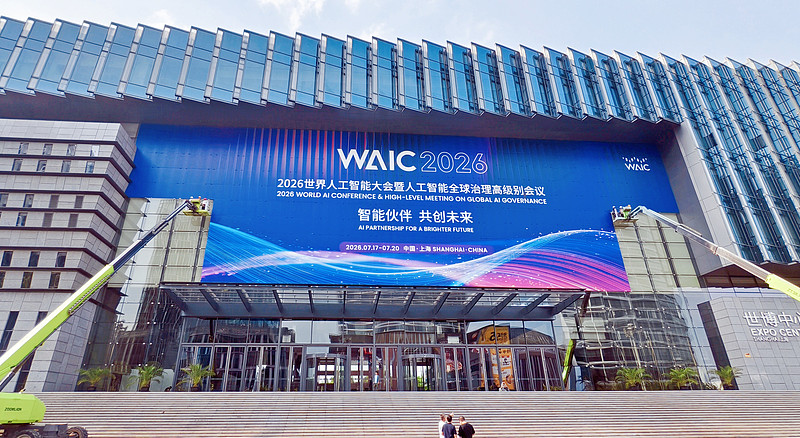
The 2026 World Artificial Intelligence (AI) Conference and High-Level Meeting on Global AI Governance are about to kick off, Shanghai, July 14, 2026. /CFP
Editor's note: Huang Yongfu is a Special Commentator on economic affairs for CGTN. After earning a PhD in economics, he started his career at the University of Cambridge and then moved on to the UN system. His current interests lie in Sino-US links and global development. The article reflects the author's opinions and not necessarily the views of CGTN.
Themed on "AI Partnership for a Brighter Future," the 2026 World Artificial Intelligence (AI) Conference and High-Level Meeting on Global AI Governance will be held in Shanghai from July 17 to 20. Chinese President Xi Jinping will attend the opening ceremony and deliver a keynote speech, setting out China's policy positions, vision and proposals on AI development and governance.
As AI technologies remain extraordinarily powerful while unpredictable, immature and easily go rogue, international cooperation should be strengthened to avoid the out-of-control AI that could wreak havoc.
The economic, social and moral impacts
The AI models could be transformative and dangerous at the same time. The AI models such as Anthropic's can complete tasks in around 30 minutes that would take human engineers hours. However, as Al grows rapidly, this danger is becoming more likely.
Current versions of models like Anthropic's Mythos and OpenAI's GPT-5.6 Sol are already good hackers and capable advisers to bio-terrorists. Some AI doomers fear that AI models could gradually squeeze people out to make room for more data centers and power generation, simply cease to care about humanity at all, usher in global totalitarianism and even cause human extinction.
The AI developments have raised considerable moral and cultural concerns such as inequality. AI could cause the replacement of actual therapists, actual friends and the like and people to shun marriage and parenthood. Leading AI labs instill appropriate values in their frontier models. For example, the worldview of GPT models, created by OpenAI, tends to be more secular while Gemini models, made by Google, place more weight on individual freedom.
The latest AI investment frenzy brings financial risks. In the corporate-bond market, the total debts of America's five "hyperscale" cloud giants – Alphabet, Amazon, Meta, Microsoft and Oracle – climbed by $228 billion in the six months to March. According to Deutsche Bank, the market capitalization of top decile of listed firms accounted for over three-quarters of the total in America, the highest share in a century.
An increasingly top-heavy structure has important ramifications for the wider economy, in terms of significant disruption to financial markets caused by the failure of just one debt-laden corporate giant.

People take selfie in front of WAIC logo, Shanghai, July 14, 2026. /CFP
Technological barriers and digital divide
In June, the Trump administration ordered Anthropic to block non-Americans from accessing Fable and Mythos, its latest and most capable frontier models. An executive order was issued to create a "classified bench-marking process that adjudicates the cyber prowess of new models by August.
The decisions have an unpleasant nationalistic tinge, making clear that Americans' AI access takes precedence over foreigners. That came not long after an extraordinary fight between Trump administration and the company over the Pentagon's access to its models broke out in March, pointing to issues such as AI safety, regulation and America's national security.
An increasingly bifurcated internet infrastructure of under sea fibre-optic cables across the Indian and Pacific oceans witnesses a combination of geopolitical risk and AI boom, avoiding choke points like the Strait of Malacca and contested waters such as the South China Sea. The so-called hyperscalers are seeking to win the AI race, in particular, Google's new Indian Ocean network and Meta's Project Waterworth. Unfortunately, no cables between America and China have been established.
Timely regulation before catastrophe strikes
The open weight should be a global practice. Most of China's leading models are "open weight," meaning that they can be downloaded and run on one's own computer. The open-weight nature stands in contrast to American labs, which keep the inner workings of their latest models secret for commercial and security reasons.
In the event of further disruption, many American AI firms have already prepared to switch to Chinese models that run on non-American data centers. The software giant Microsoft has been reported to be considering the use of a model from DeepSeek for its Copilot tool. Chinese models are especially appealing to cost-conscious users in poorer countries.
Multilateral collaboration should be the crucial way to set up global governance framework. Global regulatory framework and global technical standards should be established to ensure AI technologies to be safe, interoperable and ethically aligned. To address common challenges such as algorithm bias, data security and intelligent ethics, both developed and developing countries should stick to the spirit of the Global AI Governance Initiative, abandon technological protectionism and unilateral control and promote capacity building, and share computing power, datasets, talents and industrial experience.
China has remained committed to building a platform for all parties to consolidate global AI governance consensus, help ensure that AI advancements benefit humanity at large. Its burgeoning advances in AI highlights its pivotal role in shaping the course for global AI's future.
(If you want to contribute and have specific expertise, please contact us at opinions@cgtn.com. Follow @thouse_opinions on Twitter to discover the latest commentaries in the CGTN Opinion Section.)