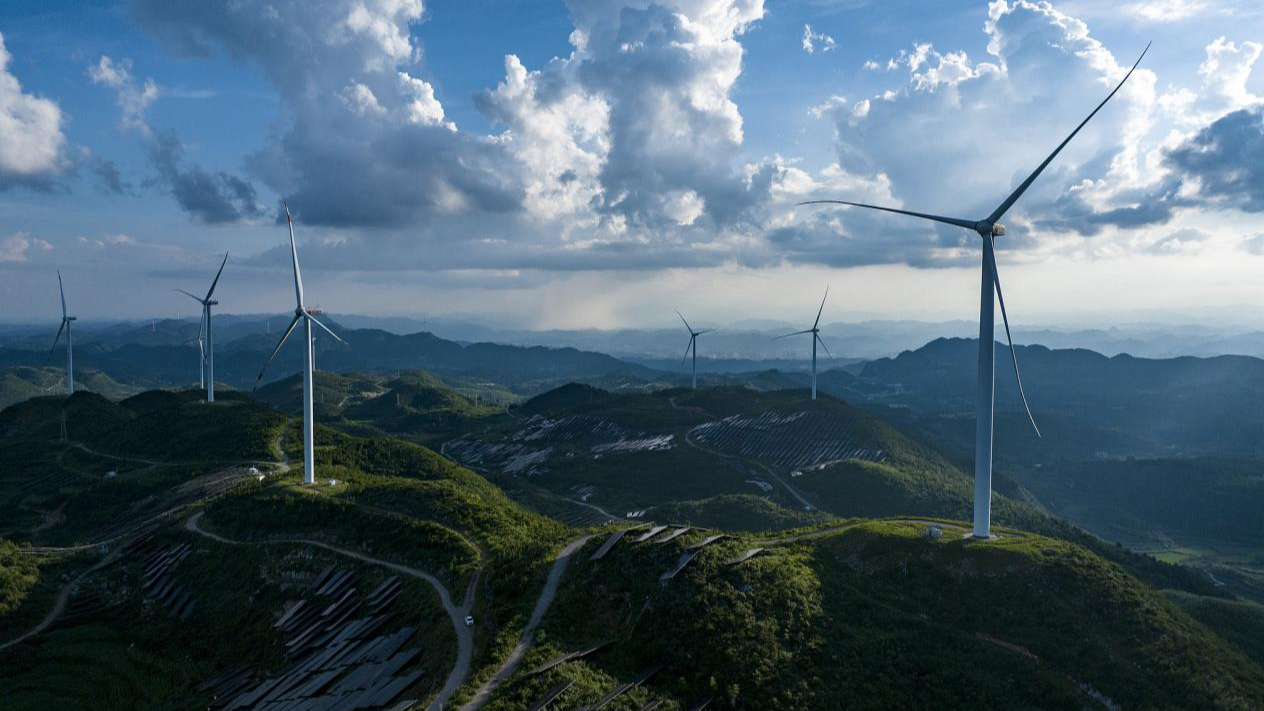
Wind turbines in Songtao Miao Autonomous County, Guizhou Province, July 11, 2026. /CFP
Editor's note: Zheng Haizhen, a special commentator for CGTN, is an assistant researcher at the Department for Global Governance and International Organization Studies, China Institute of International Studies. The article reflects the author's opinions and not necessarily the views of CGTN.
In July 2023, the National Conference on Ecological and Environmental Protection was held. Chinese President Xi Jinping emphasized the need to uphold the principle that lucid waters and lush mountains are invaluable assets, support high-quality development with a high-quality ecological environment, and accelerate modernization characterized by harmony between humanity and nature.
Over the past three years, guided by Xi Jinping Thought on Ecological Civilization, authorities across China have made coordinated efforts to cut carbon emissions, reduce pollution, expand green development and pursue economic growth.
Accelerating the green and low-carbon transition
New growth drivers in green and low-carbon industries have developed at a faster pace over the past three years. Green industries such as new energy vehicles (NEVs), lithium-ion batteries and photovoltaic products have flourished, injecting fresh momentum into economic growth and providing strong support for the comprehensive green transformation of economic and social development.
Official data show that China produced over 16.5 million NEVs in 2025, up 25.1% from the previous year. The total number of NEVs in use reached nearly 44 million by the end of the year, an increase of 12.57 million from the end of 2024. The continued expansion of production and vehicle ownership reflects the sustained release of demand for green consumption and demonstrates the strong resilience of China's green industries.
The share of renewable energy has also continued to rise. By the end of May 2026, China's total installed power generation capacity had reached 4.01 billion kilowatts, up 11% year on year. Of this total, installed solar power capacity stood at 1.26 billion kilowatts, up by 16.3%, while installed wind power capacity reached 660 million kilowatts, up 17%.
These figures show that China's green and low-carbon transition is not a matter of isolated adjustments or breakthroughs in individual sectors. It is a systemic transformation involving the country's energy and industrial structures. Green development is becoming a defining feature of high-quality development.
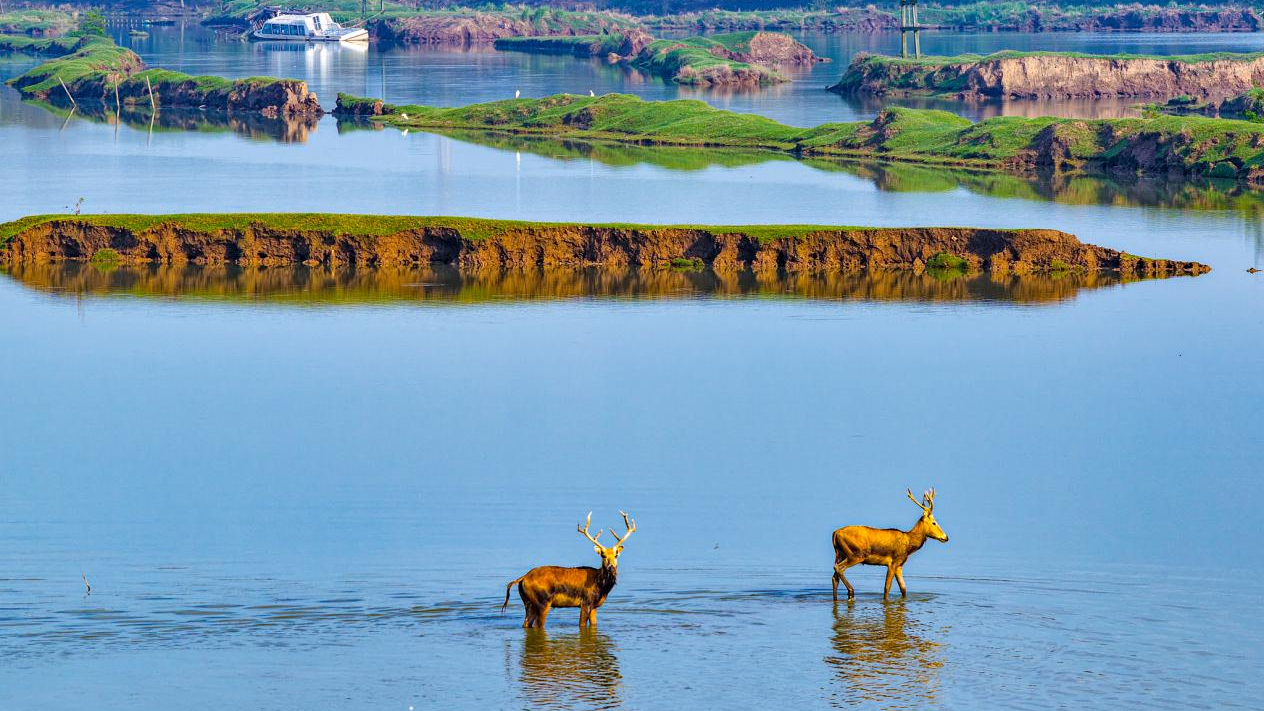
Milu deers, also known as Pere David's deers wade through lush wetlands in Yancheng, Jiangsu Province, July 16, 2026. /CFP
Advancing development and protection in a coordinated manner
Over the past three years, China has actively and prudently advanced its goals of peaking carbon emissions and achieving carbon neutrality. Official data show that China's carbon dioxide emissions per 10,000 yuan ($1477.37) of GDP fell by 3.4% year on year in 2024 and by a further 5% in 2025. The continued progress in energy conservation and carbon reduction demonstrates the rising green content of China's economic development.
China has also accelerated the development of a waste recycling system and promoted the economical, intensive, circular and efficient use of resources. The circular economy is playing an increasingly important role in safeguarding resource security and reducing carbon emissions across society.
Practice has fully demonstrated that protecting the environment is tantamount to protecting productive forces and improving the environment to developing productive forces. Coordinating high-level environmental protection with high-quality development does not mean sacrificing development. Rather, it means moving away from a development model characterized by high resource consumption and high emissions, fostering green and low-carbon industries, business models and growth drivers, and pursuing development through environmental protection and environmental protection through development.
China's practice offers insights for global environmental governance
Today, climate change, environmental pollution and other global challenges are increasingly intertwined. Extreme weather and climate events are occurring more frequently, posing severe challenges to global environmental governance. According to the United Nations Environment Programme, under current trends, global resource extraction could increase by 60% from 2020 levels by 2060, further intensifying pressures on the climate, ecosystems and the environment.
China's experience offers important insights for the world. First, humanity must pursue harmony between people and nature. Ecological and environmental problems are, at their root, those concerning models of development and ways of life. Only by accelerating the formation of green production methods and lifestyles and promoting the comprehensive green transformation of economic and social development can the pressure on resources and the environment be reduced at its source.
Second, high-quality development and high-level environmental protection must be advanced in a coordinated manner. For developing countries in particular, ecological and environmental governance cannot be divorced from their economic and social realities. Nor should the green transition come at the expense of their right to development or their development space.
China continues to deepen international cooperation on green development and has carried out green energy projects with more than 100 countries and regions. It has provided support within its capacity in areas including clean energy, green infrastructure, energy conservation and environmental protection, as well as capacity building for addressing climate change. China's green development not only benefits its own people but also contributes to the global green transition by providing advanced technologies, products and solutions.
(If you want to contribute and have specific expertise, please contact us at opinions@cgtn.com. Follow @thouse_opinions on Twitter to discover the latest commentaries in the CGTN Opinion Section.)