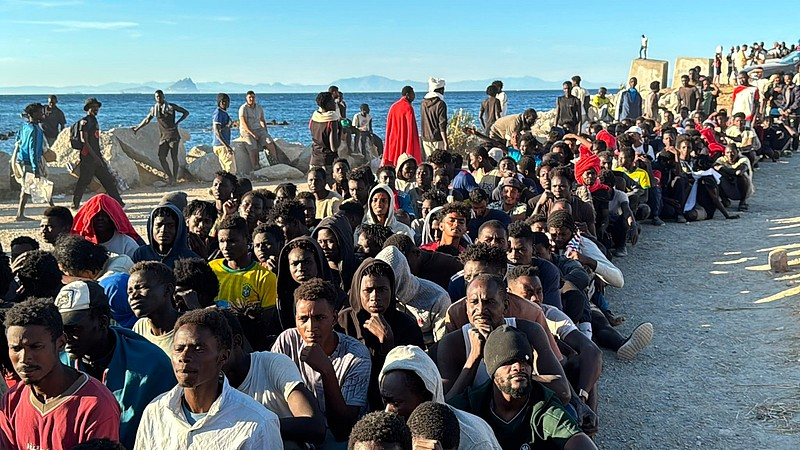
Migrants gather on a beach in Spain's North African enclave of Ceuta amid a surge of irregular arrivals, August 3, 2026. /VCG
EU interior ministers on Tuesday called for tougher action against migrant smuggling networks and stronger returns policies after about 72,000 migrants entered Spain's North African enclave of Ceuta last week, triggering alarm across the bloc.
At an emergency meeting, the ministers also urged closer cooperation with countries outside the European Union to curb irregular migration and prevent a repeat of the surge, which began on Thursday at one of the bloc's two land borders with Africa, both shared with Morocco.
The Spanish government's delegation in Ceuta confirmed on Tuesday that three more bodies linked to the mass crossing had been recovered since Monday, raising the confirmed death toll from the incident to 75.
European Commissioner for Internal Affairs and Migration Magnus Brunner told a news conference after the emergency meeting of EU justice and home affairs ministers that the influx had been fueled by criminal smuggling networks and disinformation on social media.
He declined to say whether Morocco bore any responsibility, but praised Rabat's cooperation with Spanish authorities on returns.
Spanish Interior Minister Fernando Grande-Marlaska said following the meeting that around 70,000 migrants have returned to Morocco.
Range of measures discussed
The ministers discussed a range of measures, including better intelligence-sharing, closer monitoring of social media to detect migration surges earlier, and stronger protection of the EU's external borders.
Some analysts have questioned whether Moroccan authorities turned a blind eye to the crossings, noting previous occasions when Rabat was accused of using migration as political leverage.
The last major surge occurred in May 2021, when Moroccan authorities appeared to relax border controls, a move widely interpreted as retaliation for Spain's hosting of a Western Sahara independence leader. The territory is disputed, with Morocco claiming sovereignty over it.
Brunner also said the EU was negotiating a strategic comprehensive partnership agreement with Morocco.
On Monday, Morocco rejected claims it was responsible for the surge, saying Spain should have foreseen the consequences of a court ruling that concluded that migrants who arrived by swimming could not be immediately deported if no barrier was in place.
Spain worked as fast as possible to install a maritime barrier off Ceuta's coast after the ruling, Grande-Marlaska said on Monday, adding that Spanish intelligence had given no indication of a mass crossing being planned.
"There are things that happen where there does not necessarily need to be someone responsible," Grande-Marlaska said.
The EU has increasingly relied on migration agreements with North African countries to curb irregular arrivals, but critics say the approach leaves the bloc vulnerable to pressure from transit countries that can ease, or threaten to ease, border controls in pursuit of political or economic concessions.
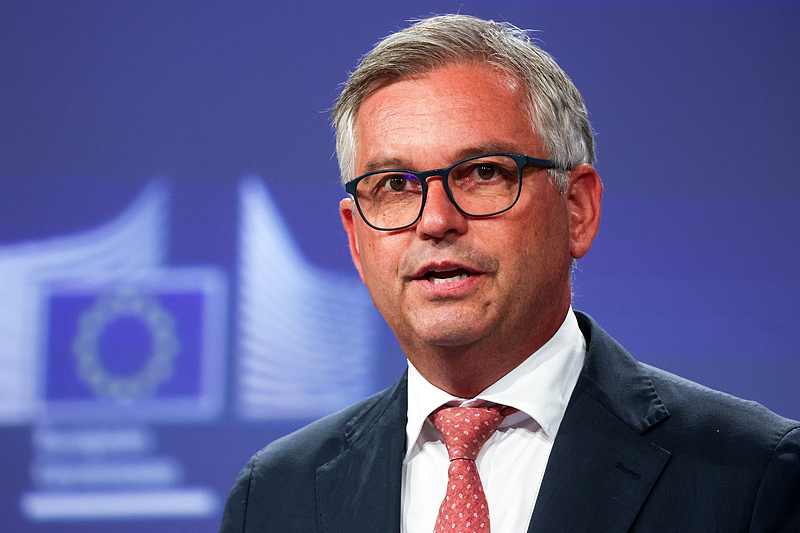
European Commissioner for Internal Affairs and Migration Magnus Brunner speaks during a press conference following an online meeting of European Union interior ministers at the European Commission in Brussels, Belgium, August 4, 2026. /VCG
Some EU members urge tougher measures
Denmark and Italy used the emergency talks to press for tougher migration measures, according to government statements.
Danish Immigration Minister Morten Bodskov called for increased EU funding for border security.
Italy's Interior Minister Matteo Piantedosi urged the bloc to adopt "new hub models for the external processing of asylum procedures and for returns in safe third countries."
Marlaska said Ceuta has special arrangements under the Schengen framework and that no one can leave the enclave for mainland Spain without undergoing effective document checks. The Schengen area was therefore never at risk, he said.
European Commission President Ursula von der Leyen said earlier that not a single person involved in the mass crossing had reached mainland Spain or any other part of the EU from Ceuta.
Nevertheless, Italy suspended passport-free Schengen travel arrangements with Spain for a month, even though they do not apply to Ceuta, while 22 of the EU's 27 member states urged coordinated action to strengthen the bloc's external borders.
Greek Prime Minister Kyriakos Mitsotakis wrote in a Politico opinion piece published on Tuesday that the EU should allow for the temporary suspension of asylum registrations during sudden mass arrivals.
Thousands estimated still in Ceuta
Spain's central government estimates that about 2,500 migrants remain in Ceuta, while the local government puts the figure at between 3,000 and 5,000. According to the local authorities, at least 1,000 of those remaining are minors.
Spanish Minister for Inclusion, Social Security and Migration Elma Saiz announced on Tuesday that the central government would provide Ceuta with an additional 25 million euros (about $29 million) to accommodate and care for unaccompanied minors in the enclave.
The migrants still left in Ceuta were seen sleeping on the beach and using its showers.
Spanish Commission for Refugee Aid Director-General Mauricio Valiente said Spain should be providing them with facilities where they can be accommodated with dignity and properly processed, including the opportunity to apply for asylum where relevant.
"If they think that by keeping people in poor conditions they will decide to return (home), we believe that is a bad decision and poor management," he said.
Many migrants have been fleeing poverty, conflict or instability and risking dangerous journeys in search of safety or better opportunities.
(With input from agencies)