
By continuing to browse our site you agree to our use of cookies, revised Privacy Policy and Terms of Use. You can change your cookie settings through your browser.
Demystifying the China-Nepal mudslide tragedy

Share







Copied
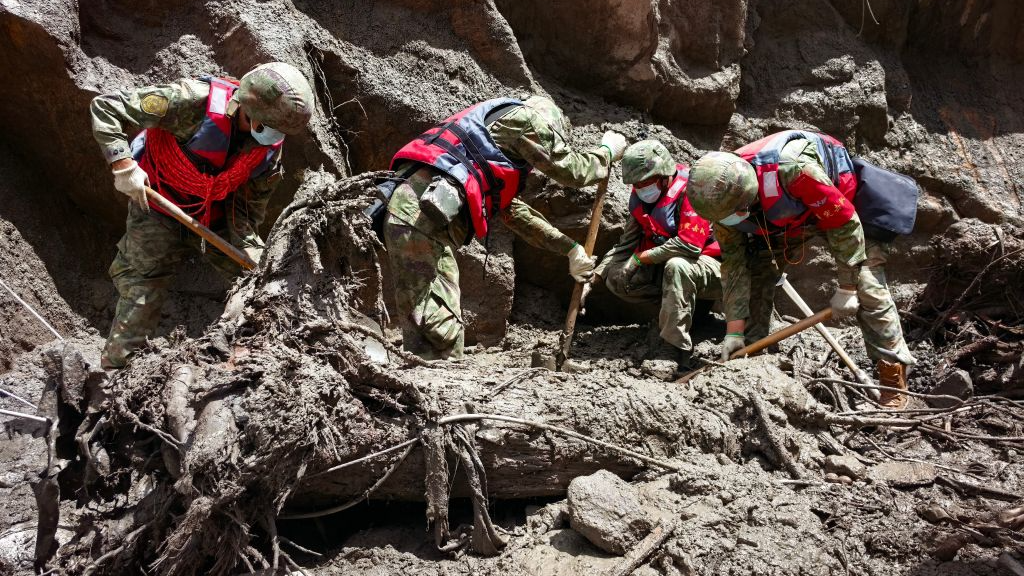
Rescuers from the Chinese People's Liberation Army work in a mudslide-hit area near Gyirong Port in Gyirong County, in Xigaze, southwest China's Xizang Autonomous Region, August 28, 2026. /Xinhua
Editor's note: Xu Ying is a Beijing-based international affairs commentator for CGTN. The article reflects the author's opinions and not necessarily the views of CGTN.
On Wednesday, a massive high-altitude glacier collapse in Nepal triggered a catastrophic cross-border mudslide that slammed into Gyirong Port in China's Xizang Autonomous Region. As of Saturday, Chinese authorities reported seven deaths and 554 people missing on the Chinese side. In northern Nepal, flash floods have reportedly claimed more than 500 lives.
Regarding the causes for the severe mudslide, a key fact is that the disaster originated with a glacier collapse at an elevation of more than 5,200 meters inside Nepal. The destructive chain of ice, rock, mud, and water therefore surged downhill from the Nepalese side toward China.
This event was identified as a collapse-type earthquake generated by the impact and movement of the massive mudslide, rather than evidence of an artificial breach. This also explains why a 5.1-magnitude seismic event was detected near Gyirong Port. The region's geological vulnerability is well established. Dozens of glacial lakes in the upper basin have become increasingly unstable amid rising temperatures and changing weather patterns.
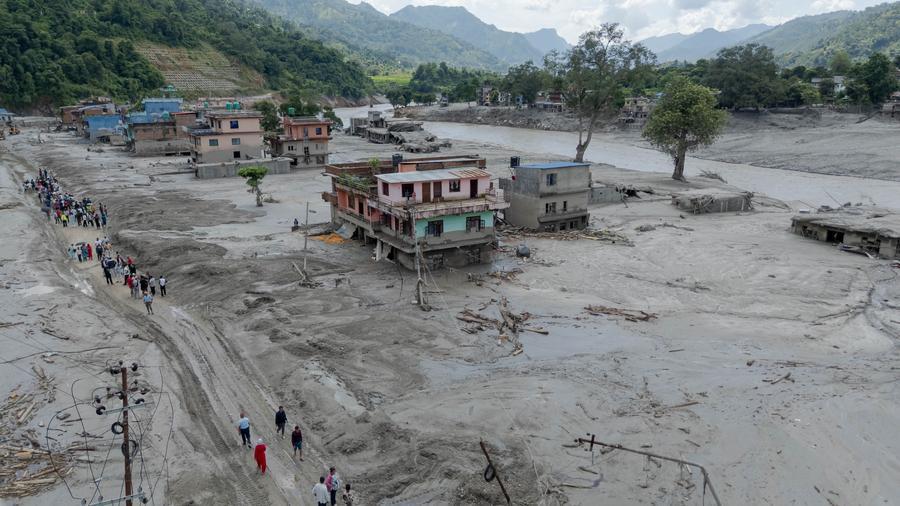
A view of a flood-hit area in Nuwakot, Nepal, August 27, 2026. /Xinhua
Indeed, China is developing infrastructure in the Himalayan region. But that does not establish any causal connection to a specific natural disaster. Available expert assessments point to glacial instability, extreme weather, and difficult Himalayan terrain as the relevant factors. Gyirong Valley itself lies in a geologically active region with a dramatic elevation drop of roughly 2,400 meters. The devastating 2015 Nepal earthquake also severely destabilized rock masses in the wider region, leaving geological risks that can persist for years.
Against this background, infrastructure should not be the reason for every flood, landslide or glacial event. Attributing natural disasters to infrastructure also risks undermining precisely the cross-border infrastructure cooperation that can improve disaster preparedness, evacuation and humanitarian response.
Moreover, China has been conducting all-out efforts to ensure the safety of both domestic and foreign people’s lives. Chinese Foreign Ministry spokesperson Lin Jian stated that rescue operations treat all personnel equally. More than 1,386 rescuers, including People's Liberation Army personnel, were deployed with about 570 pieces of equipment. Y-20 transport aircraft and helicopters were also mobilized to support emergency operations. Information concerning missing foreign nationals was promptly shared with relevant embassies and diplomatic missions.
The fact that foreign nationals account for nearly half of those missing on the Chinese side should make one thing obvious: This is a humanitarian emergency, not a nationality-based rescue operation.
Access to the hardest-hit areas was inevitably constrained by destroyed roads, bridges and communications infrastructure, as well as the risk of secondary landslides and further flooding. Rescue teams themselves faced grave dangers.
Disaster zones are not television studios. When terrain becomes unstable, roads are destroyed and secondary disasters remain possible, authorities have a responsibility to control access for public safety and rescue efficiency. Preventing unnecessary crowds from entering hazardous areas is standard disaster-management practice around the world. China has also continued to provide updates through official channels and communicate with foreign diplomatic missions.
The Himalayas do not recognize national borders. Neither do glaciers, floods, or extreme weather. Climate change is destabilizing high-altitude environments across the region, creating risks that no single country can manage alone. Nepal and China are both vulnerable to these forces. Treating shared environmental risks as ammunition in geopolitical rivalry will only make both countries less safe.
The tragedy should therefore be a call for greater cooperation, not greater suspicion: stronger cross-border monitoring of glaciers and glacial lakes, better early-warning systems, faster information sharing, coordinated emergency-response mechanisms and deeper scientific cooperation.
(If you want to contribute and have specific expertise, please contact us at opinions@cgtn.com. Follow @thouse_opinions on X to discover the latest commentaries in the CGTN Opinion Section.)
Search Trends
