
By continuing to browse our site you agree to our use of cookies, revised Privacy Policy and Terms of Use. You can change your cookie settings through your browser.
Analysis: Three questions to know ahead of Beijing Xiangshan security forum

Share







Copied
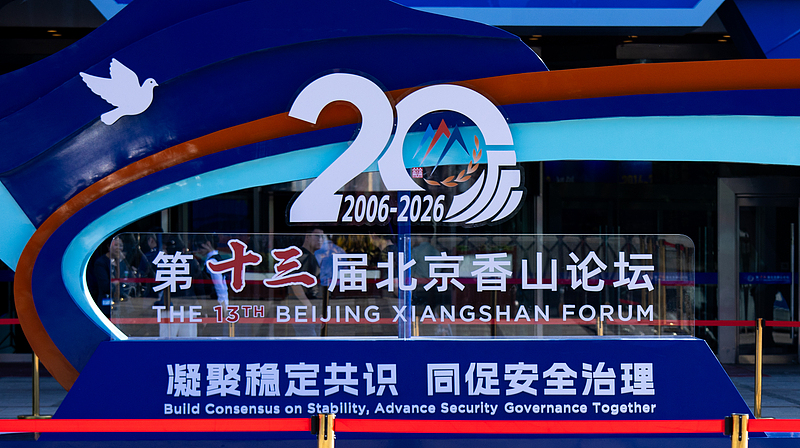
The logo of the 13th Beijing Xiangshan Forum at Beijing International Convention Center in Beijing, China, September 14, 2026. /VCG
Two decades ago, the Beijing Xiangshan Forum was just an informal gathering of a few dozen scholars dedicated to debating the peace and security of the Asia-Pacific region.
As it marks its 20th anniversary in 2026, the forum now draws roughly 1,800 officials and experts, elevating from a little-known Track 2 dialogue to an indispensable Track 1.5 arena for global security discussion.
From Tuesday to Thursday, the 13th Beijing Xiangshan Forum will be held under the theme of "Build Consensus on Stability, Advance Security Governance Together."
Who is attending?
This year's event boasts one of the most diverse and high-profile delegations in its history. Jiang Bin, a spokesperson for the Chinese Ministry of National Defense, said on Monday that more than 60 ministers, military chiefs and senior leaders of comparable rank, and nearly 100 official delegations will join the forum.
Organizers have also prioritized balanced and inclusive participation. Li Fei, director of the office of the China Association for Military Science, a co-organizer, described this year's scholar lineup with three core traits: high-level influence, youth engagement and global coverage.
In a media briefing last week, Li said the forum has invited prominent former political figures, including former Japanese Prime Minister Yukio Hatoyama, former European Parliament Vice President Ryszard Czarnecki, and former Shanghai Cooperation Organization Secretary General Vladimir Noro.
The expert pool covers every major region across the globe, including representatives from top think tanks in the United States, Russia and Europe. It also features voices often underrepresented in mainstream security talks, including scholars from Latin America, the Middle East, Southeast Asia and Africa.
"The wide coverage and representation speaks to the spirit of openness and inclusiveness championed by the forum," said Jiang on Monday.
A defining feature of the Beijing Xiangshan Forum is its willingness to host open dialogue among conflicting parties, a rarity in international security gatherings.
Speaking at last year's edition, Jean Christophe Baron von Pfetten, chairman of the Royal Institute for East West Strategic Studies in the United Kingdom, praised the platform's unique inclusiveness.
"No other forum in the world could bring together military leaders of Ukraine, the North Atlantic Treaty Organization and Russia for a meeting," he said.
In a recent essay, Liu Silong, a researcher with the forum's secretariat, said the event always welcomes all voices without bias, allowing representatives of parties embroiled in conflicts to take the same stage for candid exchanges.
"The forum uniquely serves to bridge differences, mediate for peace, and help delegates from various countries build trust and clear misunderstandings through dialogue," Liu wrote.
What will be discussed?
This year's agenda further expands the forum's scope, covering both traditional security issues and cutting-edge security challenges such as those posed by artificial intelligence (AI).
Its four plenary sessions will examine the international order and strategic stability, dilemmas in regional conflicts and pathways to their resolution, risks and challenges to security and stability in the Asia-Pacific, and the roles and visions of developing countries.
The eight parallel breakout sessions are set to address multipolarity and the international order, major-country relations and strategic stability, an Asian approach to security challenges, new hurdles facing international arms control, local conflict resolution and regional security architecture.
Maritime chokepoint safety and security governance, risks and controls around the military applications of emerging technologies, and the future of space security governance will also be covered at the parallel sessions.
In designing its agenda, this edition of the forum centers on prominent and pressing major challenges in global security, and directly answers urgent concerns of different parties, said Li.
He added that the forum, capitalizing on its unique Track 1.5 setup, also includes closed-door academic sessions where delegates with contrasting stances can hold frank conversations on sensitive geopolitical topics.
According to the PLA Daily, such discussions at high-level dialogues and closed-door sessions will address a constructive China-US relationship of strategic stability, Middle East peace prospects and the impact of AI on future warfare.
How is it different?
Beyond dialogue, the 2026 edition continues to elevate the voice of Global South nations, one focus of the forum since 2024.
It will co-host the 4th China-Africa Peace and Security Forum during the event, continuing its effort to address the underrepresentation of developing countries in global security decision-making.
The forum is also a major platform to deepen exchange and cooperation on security with others in implementing the Global Security Initiative (GSI), a Chinese proposal that promotes the vision of common, comprehensive, cooperative and sustainable security.
The forum does not judge the weight of voices by a country's size or influence, and stresses that every security concern should be treated equally, according to an essay published on Sunday by the China Association for Military Science on its official WeChat social media account.
The spirit of Xiangshan echoes the GSI's commitment to peacefully resolving differences and disputes between countries through dialogue and consultation, it said.
As global tensions rise and overlapping traditional and non-traditional security threats plague today's world, the 20-year-old Beijing Xiangshan Forum has gained greater significance in promoting dialogue, according to the essay.
"Xiangshan speaks for dialogue and peace. In a world hungry for stability and certainty, this voice deserves to be heard – and more people are listening."
Search Trends
