
Business
21:14, 12-Apr-2018
World Bank raises China 2018 growth to 6.5%
 ["china"]
Share







Copied
The World Bank raised its growth forecast for China to 6.5 percent, up from its October forecast of 6.4 percent.
The Washington-based lender said in a report on Thursday that China's economy will continue to rebalance away from investment towards domestic consumption, with policies that focus more on slowing credit expansion and improving the quality of growth.
Meanwhile, the World Bank revised upward its growth outlook for developing East Asia and Pacific up 0.1 percent to 6.3 percent. The bank said that the strong growth is supported by a continued broad-based global recovery and robust domestic demand.
Sudhir Shetty, the World Bank’s chief economist for the region, said the forecast did not take into account a potential trade war between the world’s two largest economies, although he did not feel that one was imminent.
Shetty noted that two thirds of Chinese goods on a US list targeted for increased tariffs are made in a supply chain that stretches across the region, particularly in the Philippines, Malaysia and Vietnam.
Should the tariffs be imposed on goods assembled in China, there would be “a knock-on effect” to economies in the supply chain, Shetty told a news conference.
“That is a significant thing to be concerned about because the success of this region is based on open trade,” he added.
The World Bank suggested bolstering regional trade through mechanisms such as the ASEAN Economic Community, the Comprehensive and Progressive Agreement for Trans-Pacific Partnership and the China-led Regional Comprehensive Economic Partnership so that the region can try to insulate itself against the threat of a trade war.
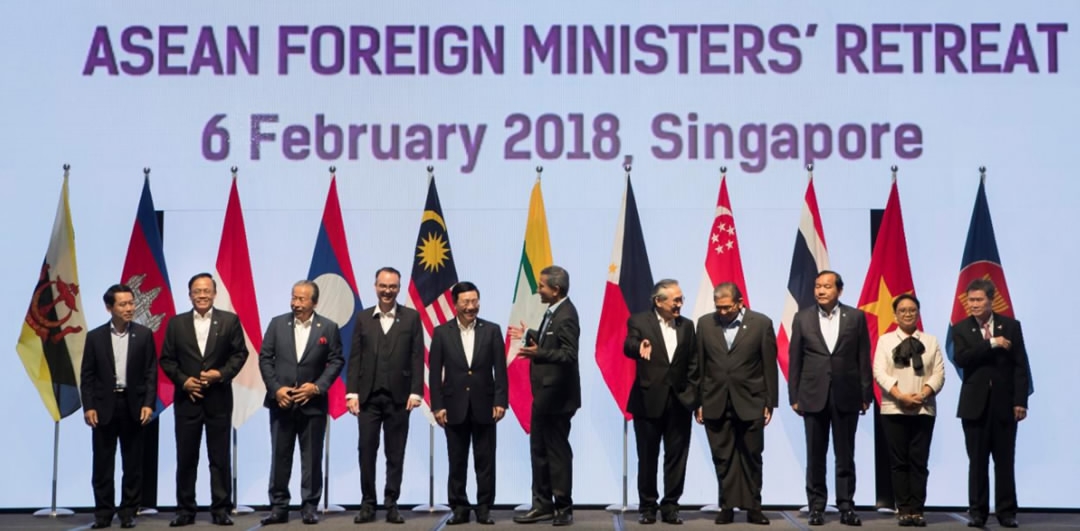
Group photo at the Association of Southeast Asian Nations (ASEAN) Foreign Ministers' Meeting retreat in Singapore, February 6, 2018. /Reuters Photo
Group photo at the Association of Southeast Asian Nations (ASEAN) Foreign Ministers' Meeting retreat in Singapore, February 6, 2018. /Reuters Photo
“Will that completely offset the impact of a possible trade war? Probably not, but it could certainly mitigate against the worst effects of those developments,” Shetty said.
The pace of interest rate increases in advanced economies is another short-term risk for the region, Shetty said.
Interest rates in most economies in the EAP region are currently at historically low levels and monetary tightening may be needed to help offset capital outflows should rates in advanced economies rise faster than expected, he said.
This was particularly the case for countries with high debt levels or rapid credit growth, such as Malaysia, he said.
Meanwhile, countries such as Papua New Guinea, Laos and Myanmar may have to increase their fiscal buffers through a conservative fiscal stance and better public debt management, he said.
(With input from Reuters)