
16:51, 26-Mar-2019
Syrian Conflict: UAE hosts Damscus delegation as it seeks to mend ties
Updated
16:50, 29-Mar-2019
 []
[]
Share







Copied
03:21
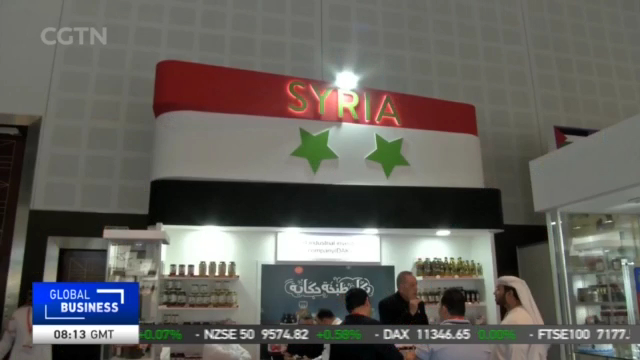
The UAE is taking steps towards rebuilding ties with Syrian President Bashar al-Assad. The Gulf nation decided to reopen its Damascus embassy in late December and it has become the leading Gulf state trying to mend relations. As Jacob Greaves reports from Dubai, this could pave the way for improved business ties in the future.
In a symbolic victory for Syrian President Bashar al-Assad, the UAE flag now flies in Damascus. Since reopening their embassy, the UAE has also hosted a Syrian delegation to discuss cooperation in trade, infrastructure and agriculture among others. And at a recent food exhibition in Dubai, Syrian businesses showed their appetite for boosting bilateral ties.
"We already sell to the Arab world but after the embassy is opened, we hope we can start dealing with the UAE, hopefully, their relations can get better and better."
"We used to suffer because there was no embassy in Syria due to the circumstances, but thank god the UAE is the first country to reopen its embassy in Syria, to be honest, when I applied for the visa for the Gulf food exhibition and I applied for it urgently. It took only three hours, and we were very surprised at the duration, and it's proved the UAE is very attentive to its relationship with all countries."
But that doesn't guarantee the type of investment Syria needs to rebuild the country.
JACOB GREAVES DUBAI "Whilst there might be some business representation such as at this international food exhibition in Dubai, more potentially beneficial cooperation such as in construction and energy comes with added diplomatic complications."
The UAE's Foreign Minister has called for more Arab states to engage with Syria to-quote-"crowd the space" taken by Russia and Iran. But that's not a view held by all Gulf states. Regional powerhouses Saudi Arabia and Qatar have been less openly supportive of rapprochement. And the biggest stumbling block of all could be the international pressure on Assad.
TAUFIQ RAHIM EXECUTIVE DIRECTOR, GLOBESIGHT "While the Gulf will be reengaging a lot will be a wait and see approach because there are still US and European sanctions and that affects the ability for the international community writ large to participate in any type of reconstruction of Syria and of course companies that are working on an international level to be able to engage and be involved, they will want to avoid both stigma and legal consequences that may arise by getting involved in projects inside Syria itself."
Indeed according to Reuters, sources say the US is lobbying Gulf nations to hold off on restoring ties with Syria. The next major rehabilitation of Assad's government could be reinstatement to the Arab League. But the group of nations recently said there was not yet the necessary consensus for that to happen. Success on the battlefield has seen Assad and his allies reclaim much of Syria. But the struggle to end Syria's political and economic isolation amongst regional powers might just be getting started. JG, CGTN, Dubai.