
13:30, 31-Mar-2019
Shooting Terror Attacks: Activists say media should downplay coverage of attackers
Updated
13:20, 03-Apr-2019
 []
[]
Share







Copied
03:04
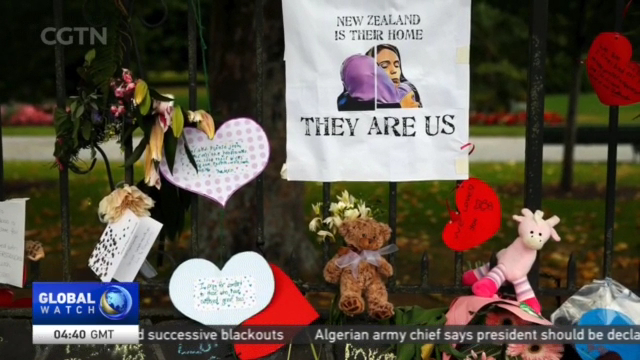
The Columbine High School shooting 20 years ago in Colorado is often pointed to as when the current trend of such attacks in the US began. The recent massacre of 50 Muslim worshippers in New Zealand has brought back bad memories for families of victims. The fact that it was streamed online has only made matters worse. CGTN's Hendrik Sybrandy spoke about this with the daughter of a Columbine victim.
On March 15th, a gunman killed 50 Muslims at two mosques in Christchurch, New Zealand. A camera mounted on the shooter's military-style helmet transmitted the rampage in real time on Facebook Live. We're not showing that footage here.
CONI SANDERS DAUGHTER OF COLUMBINE VICTIM "I was sick. I was sick at the fact that this video was out there."
Coni Sanders lost her father Dave nearly 20 years ago in the Columbine High School shootings in Colorado. She believes live streaming a crime is merely the latest example of a killer's use of social media in an attempt to gain fame.
CONI SANDERS DAUGHTER OF COLUMBINE VICTIM "People are having to become more creative because they know that people are getting less and less tolerant of the shooters gaining notoriety."
Sanders says she learned, painfully, that all the attention paid to her father's killers pushed the 13 Columbine victims into the background.
CONI SANDERS DAUGHTER OF COLUMBINE VICTIM "They wrote in their journals that they wanted fame. They wanted to go down in history, and we granted their wish and put a bow on it."
Encouraging more school shootings, she argues. The No Notoriety movement, of which she's a part, encourages the downplaying of details in the media about killers and killings. In fact, the gunman's face was blurred when he was filmed in a New Zealand court.
HENDRIK SYBRANDY DENVER "And Facebook worked furiously to remove 1.5 million copies of the shooter's video from its site soon after the live broadcast which it says was viewed fewer than 200 times."
Still, the disturbing images spread quickly across the Internet just as the suspect apparently intended.
PROFESSOR LYNN SCHOFIELD CLARK UNIVERSITY OF DENVER "I think that he was very savvy about seeing the possibilities for this becoming viral, and that's the thing that's dangerous about it."
Clark believes some kind of U.S. or global agency is needed to regulate web content, something she says Internet giants are sure to resist.
PROFESSOR LYNN SCHOFIELD CLARK UNIVERSITY OF DENVER "And so that means it's up to us as a public to figure out what do we want and not want and how do we want to make sure we're holding these organizations accountable when these bad things do happen."
CONI SANDERS DAUGHTER OF COLUMBINE VICTIM "Maybe a 10-minute delay. Maybe it's not Facebook Live, it's Facebook 10 minutes ago."
Sanders says while the public has a right to know, it also deserves to be protected from the most graphic parts of events like the live 2015 shooting death of a reporter whose father is now trying to get Google to remove the video from its site.
CONI SANDERS DAUGHTER OF COLUMBINE VICTIM "Oh this is a terrible way to put it. It would take away one of the benefits of killing people. If I want to be famous and I know that killing people was not going to get that for me, maybe I'll try something else, like music."
We all have a responsibility when it comes to this issue, she says. We're all in it together.
CONI SANDERS DAUGHTER OF COLUMBINE VICTIM "It's not a pipe dream. We can do this."
Hendrik Sybrandy, CGTN, Denver.