
08:24, 20-Jul-2019
Mobile Payment: Who will dominate the future of mobile payment?
Updated
10:19, 20-Jul-2019

Share






Copied
In China, many cities have become cashless societies thanks to China's world-leading mobile payment industry. But does the QR-code-based scan-and-pay model represent the future of online payment around the world? Will cryptocurrencies like bitcoin or Facebook's Libra gain the upper hand? CGTN reporter Ge Yunfei takes a look.
Consumers in China transacted nearly 280 trillion yuan in mobile payments alone last year. That's nearly 42 trillion US dollars, and more than three times the nation's total GDP. They're also bringing this habit to foreign countries, like Japan.
CHINESE TOURIST "We can also use Wechat to pay here, just like in China. It's very convenient for us because the language won't bother us anymore."
WeChat Pay, one of the most popular mobile payment apps in China, now has 800 million monthly active users across the nation. And in Japan, WeChat can already be used to do other things, like find smart travel guides and order food online.
LI PEIKU VICE PRESIDENT, WECHAT PAY, TENCENT "We believe this is a great opportunity. We hope to bring China's cutting-edge mobile payment experience to countries all over the world, because China's cashless societies based on mobile payment has ushered in a very advanced technology. Under these circumstances, we think it's very necessary for us to explore the global mobile payment market."
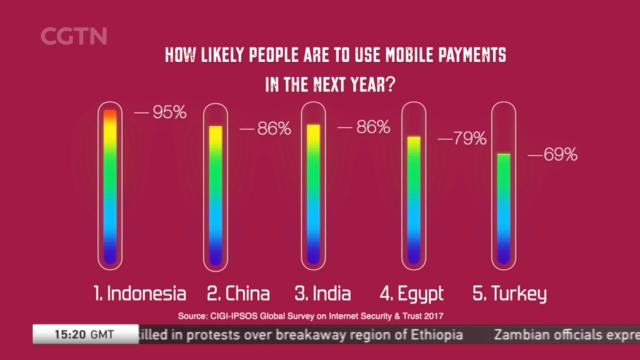
In a 2017 global survey, the top three countries willing to try mobile payment were Indonesia, China, and India--all developing economies in Asia. G7 countries like the US and Japan are all at the bottom of the list. Chinese mobile payment giants however are cutting through the conservative foreign markets with Chinese tourists.
LI PEIKU VICE PRESIDENT, WECHAT PAY, TENCENT "In the past three years, we've basically covered 46 countries that Chinese tourists like to visit, spanning 16 different currencies. And apart from payment, we're also trying to establish a mobile payment ecosystem in those countries."
WeChat's mobile payment success is also drawing the attention of Facebook. Recently, the world's biggest social network launched its plan for Libra, a global cryptocurrency.
GE YUNFEI GUANGZHOU "For many industry insiders, Facebook's ambitious move into the world of digital payments can be seen as an effort to emulate the success of WeChat. Some are even saying that the Libra will completely replace current mobile payment tools in the future. Facing this potential competition, will WeChat follow suit?"
MICHAEL CAMERON CEO, UNITY LABS TECHNOLOGY, GUANGZHOU "I think the tech is there and the problem is regulations of the government. There's a lot of red tape you have to go through to kind of make these things officially happen."
Major countries like China and the US, and several international organizations have all voiced their opposition to the Libra cryptocurrency, mainly due to concerns of privacy, money-laundering, and supervision issues.
MICHAEL CAMERON CEO, UNITY LABS TECHNOLOGY, GUANGZHOU "It is something that cannot be stopped. And it's sort of this force that's just moving forward. And nothing is really going to stop it. Yeah, perhaps governments can step in and try to limit it and control it. But long term say twenty years, I think it's it's much more than that."
Experts say, at least in the near future, the current mobile payment tools will still be the dominant force in the global market. Ge Yunfei, CGTN, Guangzhou.