
13:48, 07-Apr-2019
Iran-Iraq Relations: Iraqi PM visits Tehran despite US sanctions
Updated
13:40, 10-Apr-2019
 []
[]
Share







Copied
03:12
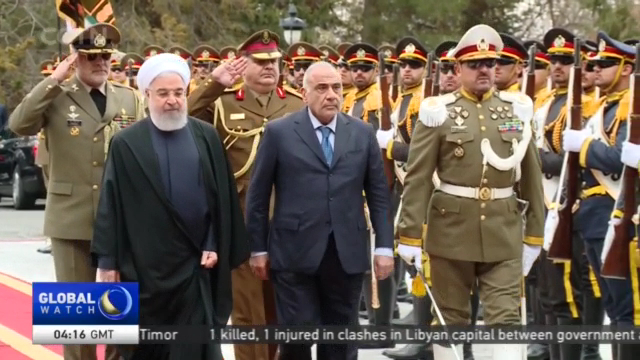
Iraqi Prime Minister Adel Abdul Mahdi is on a two-day visit to Iran, following Iranian President Hassan Rouhani's official visit to Iraq several weeks ago. But in light of US sanctions, how will relations between the two develop? CGTN's Zhu Xuesong reports from Tehran.
Iraqi Prime Minister Adel Abdul Mahdi was received by Iranian President Hassan Rouhani during his trip to the neighbouring country. The two will oversee an Iran-Iraq joint economic meeting with members of both countries' chambers of commerce.
ADEL ABDUL MAHDI IRAQI PRIME MINISTER "The Islamic Republic of Iran has helped us fight terrorism. We succeeded in winning many victories, and we've had a lot of success in this regard in terms of seeing more peace and stability in Iraq."
Iran and Iraq are bound together by centuries of economic, religious and political ties. Expectations were high after Iranian President Hassan Rouhani visited neighboring Iraq last month. During the trip, Rouhani signed multiple trade deals with Iraq. The deals covered a variety of sectors including railway construction, electricity infrastructure, and engineering services. The Iraqi prime minister's visit today could be seen as a follow-up to these deals.
HASSAN ROUHANI IRANIAN PRESIDENT "Trade relations between the two countries are very good. Our target is to reach a 20-billion-US-dollar turnover between the two countries. We hope we can reach this point as soon as possible in the coming months and years."
The two countries' close relationship reflects Iran's new diplomatic and economic strategy towards its onetime foe. By placing a greater priority on ties with Iraq, Tehran is seeking to both mitigate the impact of US sanctions while also countering US influence. For Iraq, it relies on its neighbor to help meet its demand in oil and electricity. Emerging from nearly two decades of conflict, Iraq is now entering a post-war era in which reconstruction will be the foremost political priority.
PROFESSOR MOHAMMAD MARANDI INTERNATIONAL RELATIONS DEPT., TEHRAN UNIVERSITY "The Iraqi government knows that it is not in their interests to abide by American demands. It's impossible, basically, to disengage Iraqis and Iranians from each other. I don't think Iranians feel that the Americans have the same sort of power and influence they had a decade ago."
But any planned growth in bilateral trade will depend on the two countries addressing a range of financial disagreements, exacerbated in part by US sanctions. The Trump administration has given Iraq a waiver that allows it to continue buying electricity and gas from Iran. But it expires on May 5th.
ZHU XUESONG TEHRAN "It remains to be seen to what extent American opposition prevents stronger ties developing between Iraq and Iran, but it is clear that both countries are seeking to reassure each other of their commitment to expanded economic ties. And both will be hoping the United States gets the message. Zhu Xuesong, CGTN, Tehran, Iran."