
13:24, 24-May-2018
China Pharmaceutical Market: Citizens welcome more opening-up, but plenty more to do
 []
[]
Share







Copied
03:24
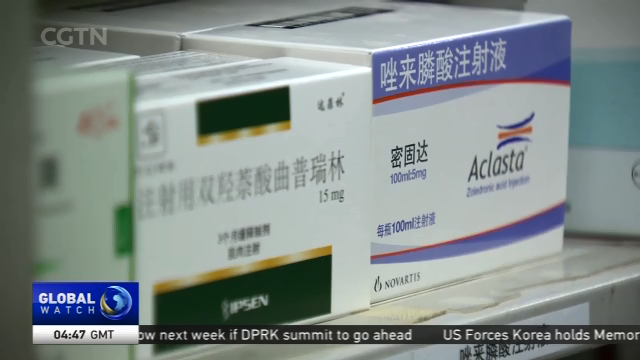
As of May 1st, China has waived import tariffs on 28 common drugs, including all cancer drugs. This forms part of the country's move to further open up its ever-growing pharmaceutical market. CGTN's Wei Lynn Tang checks in with a doctor and a patient at Peking University Shougang Hospital, to see how they responded to this zero-tariff policy.
In a country where new cancer patients account for almost a quarter of the world's, access to suitable and quality drugs at an affordable price is key.
As such, many welcome the Chinese government's move in removing tariffs on all common drugs, including cancer drugs, implemented just over three weeks ago. In fact, some commended China's gradual stance in bringing down healthcare costs.
MS. WANG, CANCER PATIENT PEKING UNIVERSITY SHOUGANG HOSPITAL "The reduction of tariffs on drugs has benefited us ordinary people. I was happy to hear the drug I am taking, Rituximab Mabthera, was included as part of medical insurance coverage in September last year. My sickness had yet to relapse at that point, but I managed to catch it this time around with the zero tariffs. It's good to know the government cares about us."
WEI LYNN TANG BEIJING China's pharmaceutical market is the world's second largest, worth over 120 billion US dollars in 2017. And despite having seen a compound annual growth rate of more than 9 percent from 2013 to 2017, experts say this market still has legs to go.
This comes as China's healthcare expenditure--as a share of the country's GDP--remains well below the average for countries in the Organisation for Economic Co-operation and Development, at 5.5 percent.
According to the OECD, China is ranked the fourth lowest among its 35 member countries.
Doctor Wang Delin says as China has a huge population and number of patients, relying on imports for new drugs will burden the country's medical insurance and fiscal position.
DOCTOR WANG DELIN CHIEF PHYSICIAN, ONCOLOGY DEPARTMENT PEKING UNIVERSITY SHOUGANG HOSPITAL "We have to continue to independently develop our own brand of new drugs. We can also seek to negotiate with others to shorten the protection time of patents, or to buy the protection rights, to reduce the time spent on basic research to allow more drugs to enter clinical use as soon as possible."
The May 1st announcement also saw value-added tax on cancer drugs reduced from 17 percent to 3 percent. This comes as import tariffs make up only 3 to 6 percent of a drug's cost.
DOCTOR WANG DELIN, CHIEF PHYSICIAN, ONCOLOGY DEPARTMENT PEKING UNIVERSITY SHOUGANG HOSPITAL "But this is a good start. It's the direction going forward that counts. Overall, our statistics show there has been a 10 to 30 percent reduction in a patient's financial burden, partly due to the zero tariff policy. Plus, for a policy to see an immediate impact, many supporting policies are needed--that includes medical insurance, patients and doctors' ideologies, to keep up with changes of times.
The zero tariff policy for all cancer drugs forms yet another of China's moves in further opening up its economy, and it's in line with its 'Made in China 2025' plan to boost homegrown development. After all, the consumer wins from a more competitive environment with both domestic and foreign players. WLT, CGTN, Beijing.