
World
15:13, 21-Mar-2018
OECD study underlines dilemma facing immigrant students
 ["europe","other","Germany"]
Share







Copied
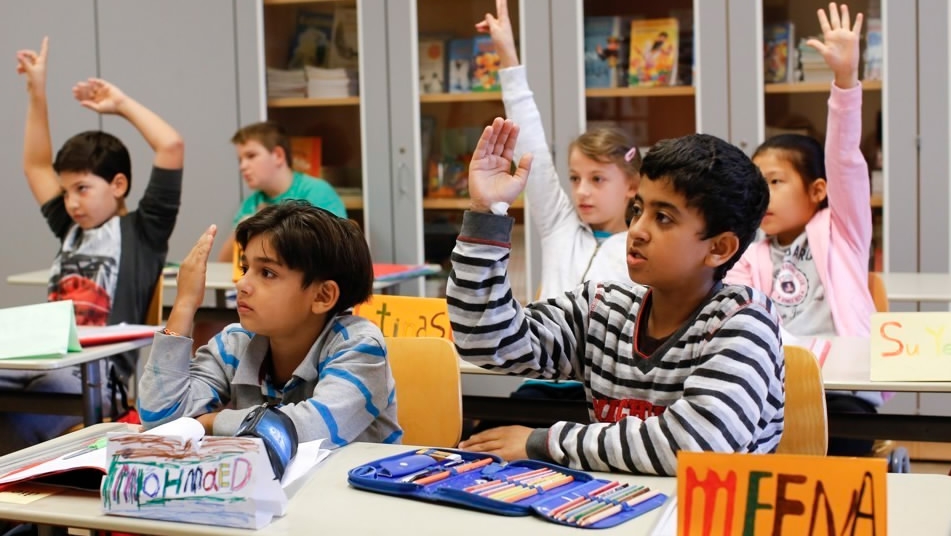
A new study blamed language barriers and socio-economic hurdles for the underperformance of immigrant students in classrooms in many EU member states.
A special report by the Organization for Economic Co-operation and Development (OECD) said students with an immigrant background increasingly feel left behind in EU schools.
The European Commission, which mandated the study, however, welcomed the report, saying it confirms the need to promote inclusive education and common values.
The bloc is on the right track in promoting active citizenship, common values and high quality, inclusive education, said EU Commissioner for Education, Culture, Youth and Sport, Tibor Navracsics.
"The European Commission strives to provide everyone in Europe with real opportunities. This is why our first package of measures to build a European Education Area presented in January included a proposal on promoting inclusive education and common values," he said.
Challenging issue
The situation is particularly pressing in Germany where more than one million migrants have arrived since 2015, as Europe's biggest economy faces the challenge of integrating a large number of migrants into society.

November 9, 2015: Cordula Heckmann, principal of Berlin's Ruetli Campus, speakes to her pupils in Berlin, Germany. /Reuters Photo
November 9, 2015: Cordula Heckmann, principal of Berlin's Ruetli Campus, speakes to her pupils in Berlin, Germany. /Reuters Photo
Immigrant children are showing poor performance in German schools than their native peers, the report said.
A total of 43 percent of students with foreign backgrounds in Germany perform poor at school, it added, saying they often lack a sense of belonging to their school community and are more likely to face schoolwork-related anxiety.
Germany is known for diversity in classrooms as more than one in four pupils have an immigrant background.
Figures from the country's Federal Statistical Office show that 1.2 million students, every tenth, have a foreign nationality.
Who are immigrant students
The OECD, which based its research on data from the 2015 Pisa survey that analyzed the performance of 15-year-old students across 35 countries, defines students with an immigrant background as those who have at least one foreign-born parent or who are either foreign-born.
Academic underperformance is common to most students with an immigrant background, but particularly first-generation immigrant students, it said.
The language barrier is one of the hurdles facing immigrant students in countries like Germany where they underperform compared to native students.
Elsewhere in the EU/OECD
In France, Iceland, and Spain, immigrant students were less likely than natives to be satisfied with their lives.
In Austria, Finland, Luxembourg, and Switzerland, they were more likely to face high levels of schoolwork-related anxiety.
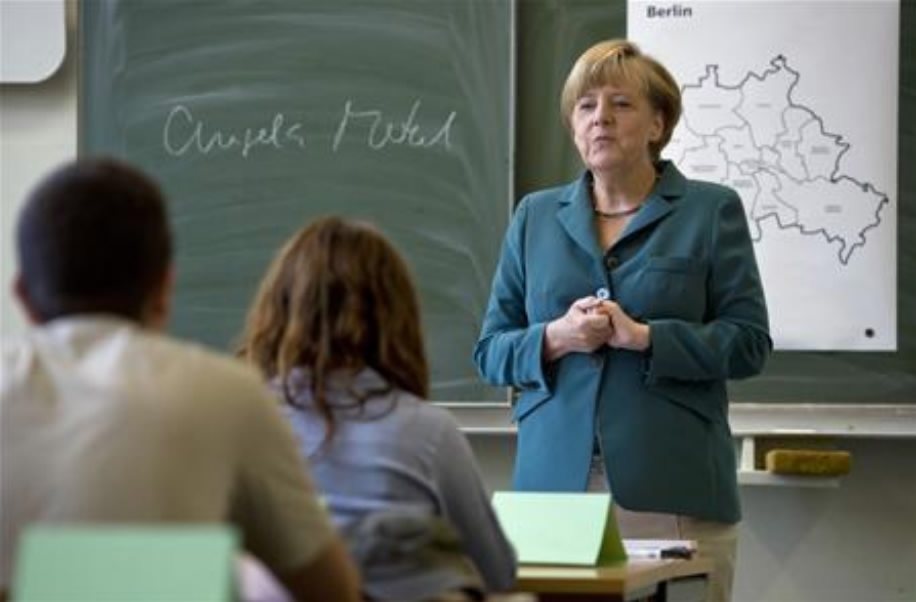
August 13, 2013: German Chancellor Angela Merkel gives a lecture after writing her name on a board, in a classroom in Heinrich Schliemann Gymnasium, a secondary school in Berlin. /Reuters Photo
August 13, 2013: German Chancellor Angela Merkel gives a lecture after writing her name on a board, in a classroom in Heinrich Schliemann Gymnasium, a secondary school in Berlin. /Reuters Photo
In the Czech Republic, Estonia, China, Ireland, and the UK, immigrant students who reach baseline levels of academic proficiency feel a lack of belonging or low life satisfaction or both.
In Austria, Croatia, Finland, Hungary, the Netherlands and Spain, however, immigrant students who perform at the same level were likely to feel high life satisfaction and a strong sense of belonging or both.
The ratio of native students achieving baseline academic proficiency in the EU is 72.3 percent as compared to 54.3 percent of immigrant students.
The study, however, finds that immigrant students, 65.8 percent, tend to show higher aspirations to succeed than native students, who account for 57.55 percent.
A positive outlook
The report highlighted the role of education systems, schools and teachers in helping immigrant students integrate into their communities.
It confirmed that education is crucial in enabling immigrants to acquire skills and contribute to the economy, as well as in fostering their social and emotional well-being.
European Commision said in a statement that EU leaders have in recent months expressed their strong support for ensuring smooth and full integration of immigrants as well as establishing common values and inclusive societies.
Beyond Europe
The global ratio of underperforming first-generation immigrant students was 51 percent in 2015, compared to 28 percent of their native peers, the study added.
It, however, said a large number of migrant students, particularly those from China, India and the Philippines, are bucking international trends in Australia, surpassing native students to achieve baseline academic results.
[Cover
Photo: Children of a welcome class for immigrants from Syria, Poland, and
Romania attend a German lesson at the Katharina-Heinroth primary school in
Berlin. /Reuters Photo]