
21:37, 30-Jun-2019
Xiqu Opera: Hong Kong opens new home for ancient drama form
Updated
17:00, 09-Jul-2019

Share






Copied
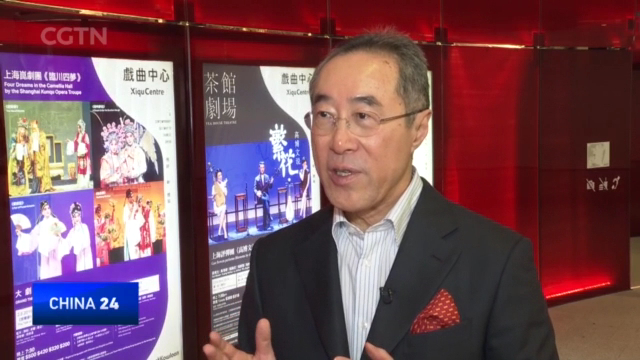
A theatre for enjoying Xiqu, the general term for traditional Chinese drama, has opened in Hong Kong. The Xiqu Center pays homage to an art form that dates back to the Ming dynasty of a few hundred years ago. CGTN Reporter Zhu Dan has more.
A dream come true. A contemporary home for an ancient heritage. A contemporary gateway to Chinese opera, the ancient art form also known as Xiqu has a new home in Hong Kong.
ZHU DAN HONG KONG "A world-class venue, a special place between the old and new, the west and east, this is the Xiqu Center, Hong Kong's prestigious new home for traditional Chinese opera. Let's take a look at what's inside."
Stepping through the main entrance, visitors are led directly into a lively atrium with a raised podium and space, where people can stop and relax.
Surprisingly, we found a bird's nest up in the tree (in the atrium), which shows us the perfect match between the complex and nature.
The 30,000 square meter complex houses a 1,072-seat Grand Theater, a more intimate Tea House Theater, eight professional studios and a seminar hall, all designed for different types of Xiqu-related activities.
BRYANT LU, RONALD LU & PARTNERS CO-DESIGNER OF XIQU CENTER "The site is very small, so when we did the design, we used the Chinese lantern as an inspiration. But I think more importantly, we come here, this is a performing arts theater. So we wanted to give them a sense of going into a theater and then the most dramatic part is when they raise the curtain. So the way we designed the external façade creates a very soft feeling of as if the curtain has been raised."
On the first floor, the 200-seat Tea House Theater is designed to attract new audiences. It delivers shorter performances, with tea and Chinese dim sum served during each show.
BRYANT LU, RONALD LU & PARTNERS CO-DESIGNER OF XIQU CENTER "We all love food, just make it more casual, and allow people to come in and watch. I think having this small intimate setting, it gives an opportunity to be even more interactive performance. The way we designed it is to make it a very modern language, so that the young people would say, hey, this is a cool place."
The Xiqu Center raised its curtain in January, putting these ancient art forms in the spotlight again.
As Henry Tang, the chairman of the West Kowloon Cultural District Authority Board says, Hong Kong is a perfect platform for these ancient arts.
HENRY TANG, CHAIRMAN WEST KOWLOON CULTURAL DISTRICT AUTHORITY BOARD "When we developed this West Kowloon Cultural District, our aim was to create a platform which passes on our Chinese culture, going international through HK. Meanwhile, the culture of the rest of Asia and the world can also come to HK through this platform."
LAW KAR-YING HONG KONG CANTONESE OPERA SINGER AND ACTOR "It's getting better and better now, not just Cantonese opera, but all kinds of Chinese ancient opera that come here to perform are all welcomed by HK people. HK people love western TV and movies, and also look back for those traditional operas and culture."
The efforts they have put in to preserve the vanishing tradition have definitely proven significant. Over 150 performances have been staged in the tea house since its opening in January. You can register for the ballot at the Xiqu Center ticket office. Have a cup of tea, and enjoy classical opera, an experience worth a try. Zhu Dan, CGTN, Hong Kong.