
12:42, 19-Jul-2019
Tibet Up-Close: Traditional Tibetan medicine treatment in time-honored way
Updated
13:01, 19-Jul-2019

Share






Copied
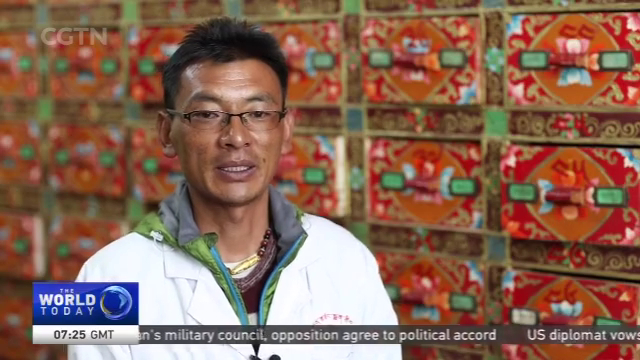
Therapies from traditional Tibetan medicines made the UNESCO heritage list this year and also earned protective status. For Tibetans in the region's high-altitude of Shenzha county, their time-honored treatments, from observation to application to cure, haven't changed in over 2,000 years. CGTN's Sun Ye shows us more.
Tibetan doctors begin their days going over medical codes dating back thousands of years. Recorded in detail and often in metaphors, it's the reference book one could never do without, says GERONGWANGDUI, the hospital's head doctor.
And when he sits in the consulting room, GERONG applies that age-old wisdom. Through a lot of touching, looking and feeling the pulses.
GERONG says he can tell anyone's heart condition with his index finger, stomach conditions with his middle finger, and kidney issues with the ring finger. He says my heart suffers from being 4500 meters above sea level. He is right.
And most of the sicknesses he treats come from living at such unforgiving heights.
GERONGWANGDUI SHENZHA TRADITIONAL TIBETAN HOSPITAL "Rheumatism, high altitude heart disease, gastric ulcers, these are our most common diseases. They're largely caused by the challenging environment. Many get rheumatism from herding in extreme cold. And until recently, vegetables were rare here. People relied on unseasoned meat."
So Tibetan medicine had developed to counter the challenging local environment, with local herbs and local stones. From mica to iron ore to corals, precious stones found their way into the prescriptions. They are called "KACA" if proven effective.
GERONGWANGDUI SHENZHA TRADITIONAL TIBETAN HOSPITAL "We've always used local minerals and plants for diseases specific to the area. Some mistake us for taking minerals directly. But they are well processed and handled when put into medicine."
ZHUOMABENGJI PATIENT "I have cholecystitis. The first drugs prescribed weren't working well. But the KAQIU KACA prescribed the second time were good."
For patients coming in from all across the region, their confidence with the Tibetan style of healing has never wavered. But Doctor GERONG suggests taking some western medicine too to get the best of both worlds.
GERONGWANGDUI SHENZHA TRADITIONAL TIBETAN HOSPITAL "For injuries, trauma and acute illnesses, we suggest they treat it with western medicine. But for chronic disease, it's Tibetan medicine that works better. As with Chinese medicine, to cure permanently you need to address the root cause."
It might be slow. But that's the way Tibetan medicine has worked, for over two millennia. SY, CGTN, TIBET AUTONOMOUS REGION.