
11:26, 28-Mar-2019
Cyclone Idai: South Africa continues aid efforts in Mozambique
Updated
11:20, 31-Mar-2019
 []
[]
Share







Copied
02:47
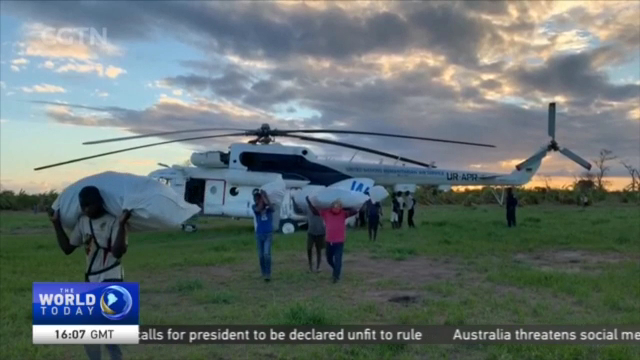
Meanwhile, a fresh batch of medical supplies from South Africa has made its way to flood-ravaged regions in Mozambique. Rescue crews have been working around the clock to save thousands of people stranded since Cyclone Idai made landfall more than 10 days ago. CGTN's Julie Scheier has this report from the Waterkloof Airforce Base outside Pretoria.
It's turning into a humanitarian crisis for Southern Africa rated by the United Nations on the same scale as Yemen and Syria. Cyclone Idai hit Mozambique more than 10 days ago, spreading to Malawi and Zimbabwe.
EMILY THOMAS PROJECT COORDINATOR, GIFT OF THE GIVERS "This is our biggest water crisis in terms of where we have to rescue people from the water in the 26 years at Gift of the Givers. This is the biggest for us. And it was also a challenge for our people on the ground because not only was Mozambique affected but also Zimbabwe."
Rescue workers have been working tirelessly plucking people from the water. Aid has been trickling in from South Africa and elsewhere. But there's hope that it will now flow easier as flood waters recede and roads are re-opened. NGO, Gift of the Givers and the military have led the relief effort from South Africa.
EMILY THOMAS PROJECT COORDINATOR, GIFT OF THE GIVERS "People have lost everything from their possessions to their medications. And right now, our teams are at work, trying to assist people, still trying to rescue people, giving medical assistance and also distributing humanitarian aid on the ground."
JULIE SCHEIER WATERKLOOF AIR FORCE BASE, SOUTH AFRICA "12 tonnes of food and lifesaving medical supplies are on this plane, destined for Mozambique and Malawi. They will be used to feed and treat thousands of people left desolate and starving in the wake of Cyclone Idai."
The threat of water-related illnesses are now also growing.
BRIGADIER GENERAL MAFI MGOBOZI SPOKESPERSON, SOUTH AFRICAN NATIONAL DEFENCE FORCE "The problem which we have that after the floods is waterborne diseases, the spread of cholera and other waterborne diseases, that is the most critical thing. In coming months, if we don't treat those people, the situation is going to get worse."
LIEUTENANT COLONEL PIETER ARLOW SOUTH AFRICAN NATIONAL DEFENCE FORCE "As long as the requirement is there, we will be assisting, we will be aiding. Our people that we've put into those areas will remain there up to a certain time and where after we will reassess. At this stage, we are aiding in IDP camps. At some stage, these people need to be moved out into other places where they can be stabilised and also normalised as well."
It may be months before the people of Mozambique, Malawi and Zimbabwe start to rebuild their lives but at least for now help is on the way. JS CGTN, WATERKLOOF AIRFORCE BASE, PTA, SA.