
17:27, 22-Mar-2019
World Water Day: China's rural water supply scaling up, challenges remain
Updated
17:20, 25-Mar-2019
 []
[]
Share







Copied
03:46
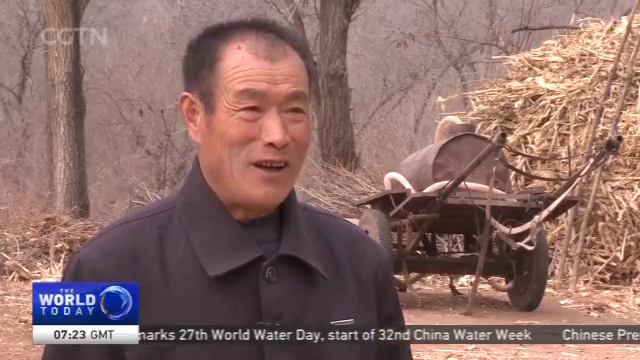
China has one-fifth of the world's population, but only 6 percent of its water resources. Experts say the water supply here could be better, especially in the nation's remote areas. CGTN reporter Feng Yilei has more.
Starting a new day with clean, crystal clear tap water. 60-year-old Hou Zhanming, like 80 more families in this village, no longer struggles with everyday water use.
He still remembers the old days when a donkey cart was the only way for him to get drinking water back home from miles away.
HOU ZHANMING VILLAGER, KAZUO COUNTY "It's more convenient for people and livestock to drink good-quality water now. I have more time to do farm work and even get a part-time job outside."
It all seems fine now, after years of infrastructure development in Kazuo county, one of the driest places in northeastern China. The last thing on Hou's wish list - he hopes soon he can use public deep-well water for irrigation instead of his small, draining up well.
On the driest days, farming still relies heavily on luck. Many sow and wait for the rain.
But at this cooperative farm, some pioneers are fighting against their fate with intensive farming and water-saving facilities.
Their attempts show a bigger goal ensuring that water supply and sustainability should not just help farmers make a living but also a stable gain.
LI BAOJIANG, DIRECTOR BAOJIANG COOPERATIVE FARM "In the beginning, only a few villagers used membrane-facilitated drip irrigation. And it turned out to be less labor-intensive, more water-conserving and more productive. Then all the rest joined in and we could better develop efficient irrigating methods."
Local government has made it a priority to promote safe drinking water and water-efficient irrigation projects. Now the majority are enjoying sanitary tap water. And more areas benefit from modern farming methods, especially impoverished ones. But still about half of the farmland and nearly one-third of villagers are doing things the old way. Most don't lack water but are vulnerable to drought risk.
FENG YILEI KAZUO COUNTY "Across the country, the pressure is also intense. China's minister of water resources has predicted that this summer's rainfall will be less than normal in northern China, and extreme weather is likely to be more frequent. That will make regions like this county more prone to drought."
And even though China has established a water supply system serving about 9 hundred million rural people, the supply now has a few new problems, namely low water levels, an increase in water use, and pollution.
YANG HAIWEN, DEPUTY DIRECTOR WATER RESOURCES DEPARTMENT OF KAZUO "We are naturally short of water and thus we will focus on not just establishment but also operation of safe drinking water facilities and water resource management. And we plan to encourage farmers to plant drought-enduring trees to counter the main difficulty that some hill plots are too dry and too scattered to develop water-efficient farming."
As we are about to leave Kazuo, raindrops fall onto the arid ground for the first time in six months. For the excited villagers ready for spring ploughing, as the old saying goes: spring rainwater is as precious as oil. But what they really hope for, is that one day they no longer need to live at the mercy of Mother Nature. Feng Yilei, CGTN, Kazuo county in Liaoning Province.