
18:18, 26-Jul-2018
China-U.S. Trade War: American multinationals relying more on global markets
Updated
17:17, 29-Jul-2018
 []
[]
Share







Copied
02:46
Meanwhile. Globalization has boosted trade as well as investment. Most multinationals increasingly rely on a global market for profits rather than their parent country. Analysts call American multinationals economic pioneers and say they're the biggest beneficiaries of globalization as they move to reduce the impact of ongoing trade wars.
Tesla CEO Elon Musk signed a deal in Shanghai on July 10th for his company to build its first overseas plant. Production at the so-called giga-factory is planned at 500 thousand electric cars a year. That's equal to Tesla's production in the U.S. Tesla recorded revenues of 11-point-7 billion US dollars last year. China is Tesla's second largest market and contributed 2 billion dollars or 17 percent, to the company's sales last year. Tesla's investment in China will help the company expand its sales and avoid hefty retaliatory tariffs.
TU XINQUAN UNIVERSITY OF INTERNATIONAL BUSINESS AND ECONOMICS "U.S. companies make billions in profits in their overseas operations. But those profits belong to those companies and aren't calculated within the concept of a country. Statistically, there is not a concept of national profit. But the profit is true. And that's not considered or deliberately ignored by the U.S. government."
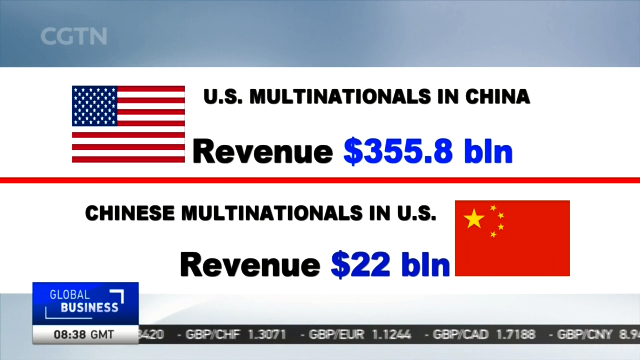
U.S Commerce Department numbers show that American multinationals' operations in China earned combined revenues of 356 billion U.S. dollars in 2015. That's while the arms of the Chinese multinationals in the U.S. reported revenues of about 22 billion dollars in the same period.
At the same time, economic ties with China also benefit the American population. Data from the U.S. China Business Council shows that bilateral trade and investment supported about 2-point-6 million jobs in the U.S. in 2015. That same trade and investment also contributed 216 billion U.S. dollars or 1-point-2 percent to the U.S. economy. Moreover, inexpensive goods from China reduced U.S. consumer prices by 1 to 1.5 percent in 2015. That WAS a savings of about 850 US dollars for a typical U.S. household with an income of 56 thousand US dollars.
JIN CANRONG RENMIN UNIVERSITY OF CHINA "Without Chinese goods, the U.S. may face high inflation if it keeps unemployment at low levels. But Chinese goods help the U.S. economy strike that balance. Some economists even say that Chinese international settlements with the U.S. dollar provide a second pillar to the dollar hegemony besides oil."
America's trade deficit with China is only one aspect of the two countries' economic relationship but not all. The ties also indirectly benefit U.S. multinationals and the American economy.