
18:11, 07-Jun-2018
SCO Summit: Interview with Kazakh Ambassador to China Shakhrat Nuryshev
 []
[]
Share







Copied
03:23
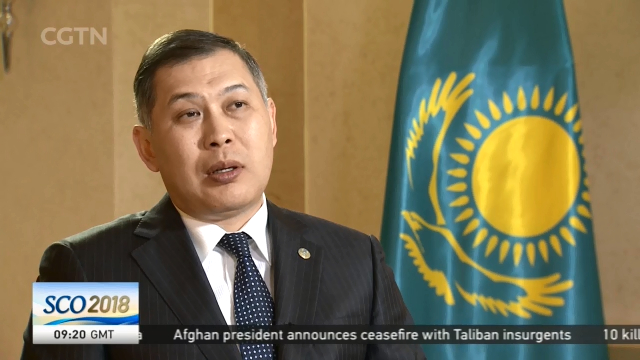
China took over the rotating presidency of the SCO from Kazakhstan following last year's summit in Astana. Our reporter Su Yuting sat down with the Kazakh Ambassador to China and got his thoughts on this year's meeting in Qingdao. He said Kazakhstan is willing to work with China to push for more cooperation within the organization.
SU YUTING BEIJING "What's your expectations for the Qingdao summit, and what's your assessment of China's role in strengthening cooperation with member states under the SCO framework?"
SHAKHRAT NURYSHEV KAZAKH AMBASSADOR TO CHINA "I am very glad to meet you and accept your invitation again. I think this interview is very meaningful, as China - as the rotating president - has prepared well for the SCO Summit in Qingdao. I think this summit is an unprecedented one, because it's the first time for all eight SCO member states to gather together to discuss important issues. As one of the founding members of the SCO, China has contributed a lot to the development of the SCO. Proceeding from the Shanghai Spirit, the SCO pursues common development and win-win cooperation, based on the principles of mutual trust, mutual benefit and equality. All the members, no matter weak or strong, small or big, respect each other and resolve their problems through mutual consultations. As a responsible country, China has been cooperating with other countries in safeguarding regional security, enhancing culture exchanges and strengthening economic and trade cooperation."
SU YUTING BEIJING "During the Astana Summit last year, the SCO accepted India and Pakistan as full members in its first expansion since its founding in 2001. What will that mean for the future development of the SCO?"
SHAKHRAT NURYSHEV KAZAKH AMBASSADOR TO CHINA "After India and Pakistan joined, the SCO covers more than 40 percent of the world's entire population, and about 20 percent of the global GDP. The SCO has become a very important organization in the region, a more influential bloc and is playing a more important role in the world."
SU YUTING BEIJING "The Belt and Road Initiative, first proposed by Xi in 2013 in Kazakhstan, comprises the Silk Road Economic Belt and the 21st Century Maritime Silk Road. Its aim is to build a trade and infrastructure network connecting Asia with Europe and Africa along the ancient trade routes. What's your assessment of the Initiative? And how will Kazakhstan cooperate with China under the Belt and Road Initiative?"
SHAKHRAT NURYSHEV KAZAKH AMBASSADOR TO CHINA "In 2013, Chinese President Xi Jinping gave a speech on the Silk Road Economic Belt at Nazarbayev University in Astana. Kazakhstan's President Nazarbayev immediately showed his support for President Xi's proposal. Our two countries have had a wide range of cooperation, on issues such as transportation. Five railways come through the land of Kazakhstan, including those starting from China and stretching towards Russia, the Gulf, Central Asia and Europe. Container handling capacity between China and Europe has doubled annually. Chinese and Kazakh railway companies also have very close cooperation in transportation. Kazakhstan has invested 9 billion US dollars in developing its railway construction to build the country as an important transportation hub along the route of the Silk Road Economic Belt. I want to emphasize that we are willing to cooperate with China to push forward the development of the Belt and Road Initiative, which has proved to be win-win and effective."