
13:48, 13-Apr-2019
Delivering Big Projects: First Sino-Russian rail bridge to boost connectivity and trade
Updated
13:40, 16-Apr-2019
 []
[]
Share







Copied
03:05
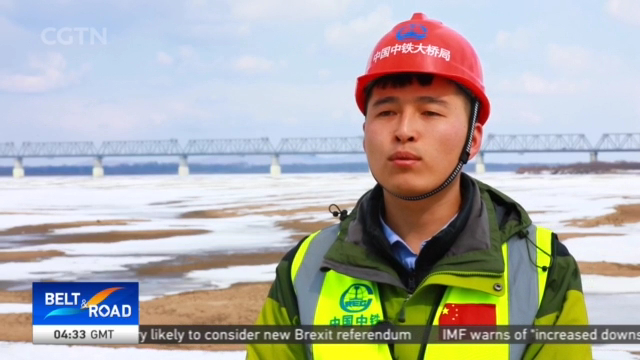
After years of hard work, a bridge that's the first of its kind is set to open. It will boost trade and economic activity between Russia and China. So much so that one border city is eager to see the benefits pay off locally. CGTN Reporter Feng Yilei has this episode of our Belt and Road special coverage.
In the frigid northeastern corner of China, only a small body of water separates the city of Tongjiang from Russia. For years, border trade was complicated by seasonal ice blockages and bumpy road trips. But now, a rail bridge linking both sides will alleviate this.
LI HUACHAO, CHIEF ENGINEER TONGJIANG SINO-RUSSIA RAIL BRIDGE DEPT. RAILWAY MAJOR BRIDGE ENGINEERING GROUP "It's a very unique bridge built by China and Russia together. It's also the first-ever cross-border railway bridge between the two countries."
The chief engineer in charge of construction on the Chinese side says progress was slow and difficult. Decades of negotiations and nearly 5 years of extreme weather and financing problems hampered builders' efforts.
LI HUACHAO, CHIEF ENGINEER TONGJIANG SINO-RUSSIA RAIL BRIDGE DEPT. RAILWAY MAJOR BRIDGE ENGINEERING GROUP "Engineers from both sides met frequently to solve many technical difficulties and plan for the main structure. We took into account different track gauges, train loads, design styles from both countries and we learned from each other."
The final countdown is now on for the opening of the steel and concrete crossing. And many are jumping at the business opportunities. Fenglinda, a trading company producing organic fertilizer moved to Tongjiang in 2012, mainly for the bridge.
SU HUI, OPERATION MANAGER FENGLINDA TRADING COMPANY "Our company purchased 400,000 square meters of peat soil in the far east to make fertilizer. We have been using road transportation, which is very expensive. When the bridge opens, our costs will drop by about 50%."
And the railway will also allow for larger exports of iron ore, coal, lumber, and other natural resources from Russia to meet the nation's eastward shift in economic output, and China's industrial demand.
FENG YILEI TONGJIANG "Merchants say the more cross-border linkage, the greater the opportunities for increasing the flow of goods. This 2,000-meter-long tie, together with other ongoing Sino-Russian cross-border infrastructure programs expected to be completed soon, will make northern China a corridor towards central Asia and Europe."
There is still room for the two countries to deepen strategic partnerships. For instance, the railway system they are working on to connect China's northeastern railway network with Russia's Siberian railway network will also reach the bigger Belt and Road region.
LI ENGUO, DEPUTY DIRECTOR TONGJIANG COMMERCE AND PORT BUREAU "We have based many economic parks, development zones, and timber parks on the bridge economy. The Russian Jewish Autonomous Region on the other side is also trying to attract more Chinese enterprises to their advanced development zones."
By the time the bridge is fully operational, it is expected to have an annual throughput capacity of 21 million metric tons, and take trade to new heights. Feng Yilei, CGTN, Tongjiang.