
14:46, 14-Mar-2018
Beyond the Stars: Astrophysicists from US & Mexico discover ancient, faraway galaxy
 []
[]
Share







Copied
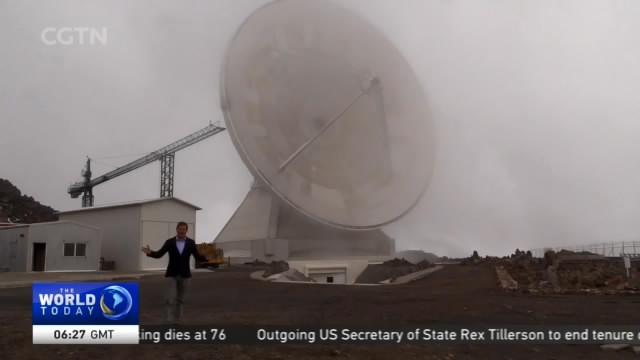
Astrophysicists from the United States and Mexico have discovered a 'new' galaxy. It is one of the oldest celestial objects in the universe and challenges our understanding of it. CGTN's Alasdair Baverstock explains.
From high on the slopes of Mexico's tallest mountain, one of the world's most powerful telescopes has discovered a new galaxy. Twenty-seven billion light-years from earth, the formation is one of the oldest things in the universe, and the second most-distant object yet known to mankind. The discovery was made as part of a joint study between the University of Massachusetts astrophysics department and the Mexican team led by Jorge Zavala.
JORGE ZAVALA ASTROPHYSICIST "It's 27 billion light-years away, an incomprehensible distance, and has existed for ninety-seven percent of the life of the universe. But it's an important discovery because our current understanding of the universe doesn't allow for the formation of such a massive galaxy so soon after the Big Bang."
Zavala used the Large Milimetric Telescope, or LMT, located in eastern Mexico, to make his groundbreaking discovery.
ALASDAIR BAVERSTOCK PUEBLA STATE, MEXICO "Here at an altitude of forty-five hundred meters, on the slopes of a dormant volcano, this telescope is the largest of its kind in the world. But rather than light, this dish, fifty meters in diameter, detects radio waves arriving on earth from the farthest distances of our universe."
Yet, because the light has taken billions of years to reach planet Earth, the astronomers cannot say whether their new discovery still even exists.
DAVID HUGHES DIRECTOR, LARGE MILLIMETER TELESCOPE "When the light from this galaxy started traveling towards us, it has been more than ninety percent of the history of the universe, and today, we're now receiving that light. It's a galaxy that exists very early in the history of the universe. It may not even exist as a galaxy today. We're traveling back in time, we're seeing that galaxy at the moment of formation, but what does that galaxy look like today We have no idea."
While the Mexican astronomer's discovery may not appear definitive, the stargazer is not disheartened.
JORGE ZAVALA ASTROPHYSICIST "It shows us that our science isn't perfect and that we still have a long way to go in understanding our universe."
From above the clouds, Hughes and his team say they will continue to search the distant skies. Alasdair Baverstock, CGTN, Puebla State in eastern Mexico.