
Politics
11:19, 22-Mar-2018
What makes the China-Russia relationship at its ‘best level in history’?
 ["china","europe"]
Share







Copied
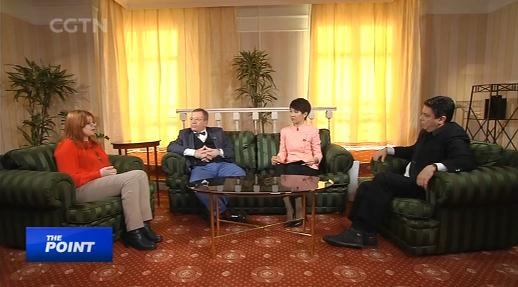
By CGTN’s The Point
“Russia and China have a comprehensive strategic partnership, and our relationship today is an example of any relations between any countries or [at] anytime,” said Sergey Sanakoev, president of the Russian-Chinese Analytical Center. In a recent interview on the Point’s special program, Sanakoev spoke on the opportunities and challenges in the China-Russia relationship.
Chinese President Xi Jinping sent a congratulatory message to Russian President-elect Vladimir Putin on March 19, two days after Putin congratulated Xi Jinping on his re-election as Chinese president. Xi Jinping said in the message that currently, the China-Russia relationship is at its best level in history.
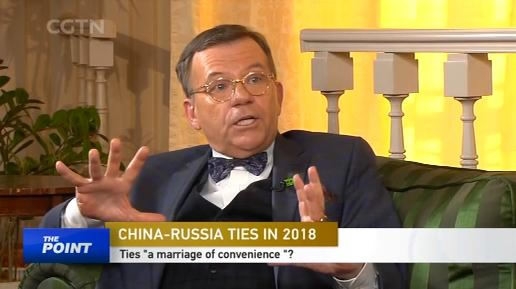
Peter Lavelle, host of the political debate program CrossTalk on RT/ CGTN
Peter Lavelle, host of the political debate program CrossTalk on RT/ CGTN
Peter Lavelle, host of the political debate program CrossTalk on RT thought the western description of the China-Russia relationship as “a marriage of convenience” is outdated. “It is not. It is a mutually accepted relationship, a relationship that is being fueled on, given a life of its own because of western hostility,” he said.
“I would not describe the Russia-China partnership as an anti-western one,” said Anna Kireeva, an associate professor from the Department of Asian and African Studies at the Moscow State Institute of International Relations. “I do believe that there are shared interests that go beyond simple opposition to the west.” She believes both Russia and China are holding their respect for sovereignty, the principle of non-interference in domestic affairs and a vision of a multipolar order.
Lavelle and Sanakoev spoke highly about Chinese President Xi Jinping’s proposal of “building a community of common destiny.” Sanakoev thought the initiative “makes this world safer.” “It’s brilliant,” said Lavelle. “When we have this common destiny, it shows you over a certain period, mid-term, or long-term, what you want to achieve. That creates stability.”

In response to some western analysts saying China has the upper hand in this bilateral relationship, Kireeva thought regarding the economic side; China has it. “The special thing is that [because of] the rift with the west of Russia and Russian foreign policy, we could see that, of course, Russia has been much more interested in and much more in need of China than vice versa,” she added.
Lavelle thought who has the upper hand or lower hand is not the issue, while the “confidence-building process” between the two countries matters. “I think that’s why it actually works; at the center of that always is sovereignty and mutual respect,” he explained.
He pointed out the difference between the organizations joined by China and Russia, and those Western organizations are that there is no hegemony. “You have big countries and small countries, but you have mutual respect,” he emphasized.
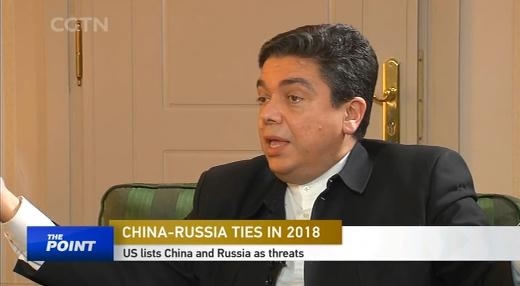
Sergey Sanakoev, President of the Russian-Chinese Analytical Center/ CGTN Photo
Sergey Sanakoev, President of the Russian-Chinese Analytical Center/ CGTN Photo
Sanakoev recalled that during the Soviet Union period, there was an argument that the Soviet Union was the “big brother” of China. “Now some people are saying that China has become the 'old brother'. This topic is especially touted in the west to make the relationship tougher, to divide us, ” he complained.
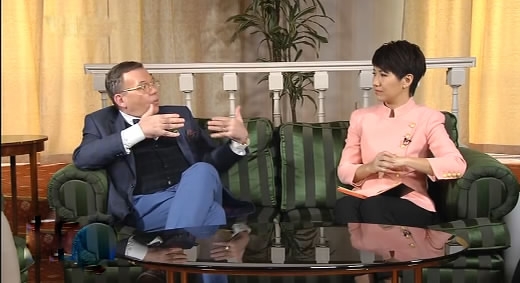
Liu Xin, the host of The Point, asked why the China and Russia we know is different from the China and Russia that is described in the international media. “The west is being confronted with something that they never could possibly imagine. That’s why we get demonized,” said Lavelle. “There is a fundamental shift going on in the global order. If you are a top dog, you do not give up easily.”
Looking ahead to the relationship between China and Russia, Lavelle thought that besides the interactions between the two top leaders, “it needs to be business and trade. It has to be people to people. The nuts and bolts of a relationship, it’s going to have to be literally a top-down operation here.”
Kireeva suggested the two countries should enhance regional cooperation, while Sanakoev concluded his expectations in a simple sentence: “We should keep moving.”
The Point with Liu Xin is a 30-minute current affairs program on CGTN. It airs weekdays at 9.30 p.m. BJT (1330GMT), with rebroadcasts at 5.30 a.m. (2130GMT) and 10.30 a.m. (0230GMT).