
12:34, 11-Apr-2019
First Image of A Black Hole: Intl. network of telescopes used to create photo
Updated
12:30, 14-Apr-2019
 []
[]
Share







Copied
02:48
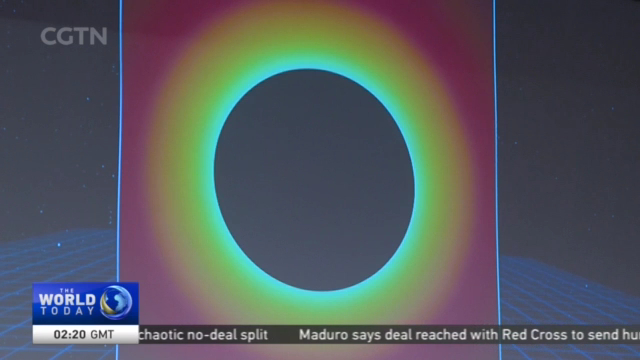
The first image of a black hole and its fiery halo has been released by a team of international scientists. The announcement was made during simultaneous news conferences in Shanghai, Washington, Brussels, Santiago, Taipei and Tokyo. The milestone in astrophysics was achieved by the Event Horizon Telescope project - a global network of synchronized radio observatories. It's expected to significantly advance research on the cosmos. The EHT collaboration, of which China is a major player, began in 2012. CGTN's Daniel Ryntjes has more.
At the center of a giant galaxy known as Messier 87, a black hole - with a mass six-and-a-half billion times that of our sun. We can never truly see a black hole, so the light in this image depicts the particles which narrowly escaped its immense gravitational force along a ring around it, known as the event horizon.
AVERY BRODERICK UNIVERSITY OF WATERLOO "The radio waves we see in these first images orbited the black hole before beginning their 55 million year journey toward us. This results in the dark shadow, or silhouette cast by the black hole's event horizon."
The Event Horizon Telescope project brought together eight telescopes from around the world, capturing and then crunching masses of data to produce this image. At one of five unveiling global events, here in the US capital, students from a local high school were also invited.
JULIAN KEARNS SCHOOLS WITHOUT BORDERS "I think it's really inspiring and inspires me to continue along a path to basically being up there myself and taking part in big projects in the future."
DANIEL RYNTJES WASHINGTON DC "Almost exactly 100 years ago photos were taken of a solar eclipse, validating aspects of Einstein's general theory of relativity, that gravity bends light. This new photo provides hard visual evidence that his calculations were correct."
Einstein's theory is intact, but another branch of theoretical physics, known as Quantum Theory has been challenging it.
FRANCE CORDOVA, DIRECTOR NATIONAL SCIENCE FOUNDATION "And we think we can learn more about quantum gravity by studying black holes of all different kinds of sizes and really reach for something that Einstein and Stephen Hawking and others have really reached for, which is a unified theory about how the universe works."
The scientists here say they expect this moment to usher in an era in which gravity becomes the most important frontier in the study of our universe. Daniel Ryntjes, CGTN, Washington.